
- JEDDAH: Higher Education Minister Khaled Al-Anqari has reiterated Saudi Arabia’s commitment to become a knowledge-based economy.
“It’s a choice that no country wanting to make progress can ignore,” he told a forum of Saudi-Japanese universities in Tokyo.
The minister said Saudi universities have established partnerships with leading institutions of higher learning in the world, including those in Japan, to develop a knowledge-based society. “We want greater cooperation with Japan in this respect,” he added.
Spelling out other measures taken by the government in this direction, Al-Anqari said: “We have increased the number of public and private universities, focused on scientific research and established new research centers and technological parks.” During the last five years, the number of government universities in the Kingdom rose from eight to 24, while nine new private universities were established.
These universities can now accommodate nearly 300,000 secondary school graduates. More than 80,000 Saudis pursue their higher studies abroad under the King Abdullah Scholarship Program.
Speaking about the significance of the Tokyo forum, Al-Anqari said it would help exchange expertise, enhance knowledge and strengthen Saudi-Japan ties.
Presidents and top officials of leading Japanese universities including University of Tokyo, University of Kyoto and University of Nagoya took part in the event.
Suleiman Abalkhail, president of Imam Muhammad bin Saud University in Riyadh, presented a paper on Custodian of the Two Holy Mosques King Abdullah’s cultural and interfaith dialogue initiative, stressing the role of educational institutions in promoting cultural dialogue for world peace.
Osama Tayeb, president of King Abdulaziz University in Jeddah, spoke about his institution’s efforts to achieve excellence in higher education by establishing partnerships with international universities, promoting scientific research and adopting international quality standards.
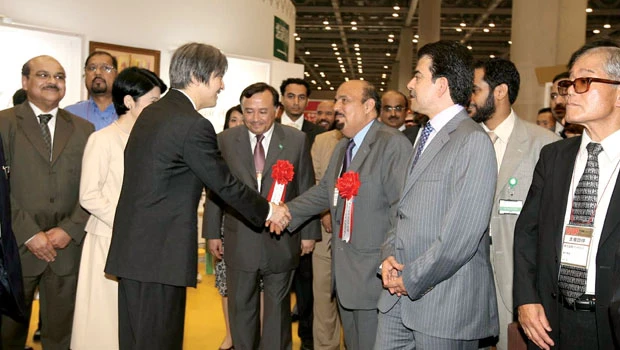
Earlier, Prince Akishino, a member of the Japanese royal family, and Al-Anqari opened an international book exhibition in Tokyo. Both of them later visited the Saudi pavilion, accompanied by Saudi Ambassador Abdul Aziz Turkistani. They also watched a documentary on Saudi Arabia.
Addressing the exhibition’s opening ceremony, Al-Anqari highlighted the strong relations between Saudi Arabia and Japan. “Japan is the Kingdom’s second biggest trading partner,” he said. More than 1,000 publishing houses from 30 countries are taking part in the exhibition.
Saudi Arabia, which is participating as guest of honor, has the largest pavilion with sections for books, paintings, Arabic calligraphy, cultural show, children’s library and cultural contests for visitors. It will also hold a number of seminars related to economic and educational ties between Saudi Arabia and Japan.
Ambassador Turkistani thanked Japan for inviting Saudi Arabia to the show as guest of honor, saying it reflected the Kingdom’s international stature. “This invitation also came in appreciation of King Abdullah’s call for interfaith dialogue,” he pointed out. The exhibits at the Kingdom’s pavilion include models of the Two Holy Mosques in Makkah and Madinah.