- WASHINGTON: A global poll says most western Europeans favor banning face-covering Islamic veils, but most Americans disapprove.
France’s hotly debated bill to ban burqa-style Islamic veils in public is going before Parliament this Tuesday is widely expected to become law, despite the concerns of many French Muslims, who fear it will stigmatize them.
Similar restrictions are being considered in Belgium and Spain.
Many law scholars also argue it would violate the constitution, but President Nicolas Sarkozy’s government casting the measure as a way to promote equality between the sexes.
While ordinary Muslim headscarves are common in France, face-covering veils are a rarity — the Interior Ministry says only 1,900 women in France wear them.
Amnesty International has urged French lawmakers to reject the bill, and a French anti-racism group, MRAP, which opposes such dress, has said a law would be “useless and dangerous.”
Even France’s highest administrative body, the Council of State, warned in March that a total ban risks being found unconstitutional.
Juliana Menasce Horowitz, Senior Researcher at the Washington-based Pew Global Attitudes Project, told Arab News the team “really didn’t know what to expect… but yes, we didn’t expect such a high number in France.”
The survey by the Pew Research Center’s Global Attitudes Project, released this week, revealed some surprising differences on this issue between the US and Western Europeans.
The poll finds that the French public overwhelmingly endorses this measure; 82% approve of a ban on Muslim women wearing full veils in public, including schools, hospitals and government offices, while just 17% disapprove.
Majorities in Germany (71%), Britain (62%) and Spain (59%) also support a similar ban in their own countries.
In contrast, most Americans oppose such a measure; 65% say they are against a ban on Muslim women wearing full veils in public places, compared with 28% who say they would approve.
Dr. Horowitz said the team was not surprised, however, that Americans polled on this issue were much more tolerant than their counterparts in Europe.
Horowitz said they believe this has to do with “Americans belief in civil liberties, because we see this across the ideological spectrum and across party lines — that Americans overwhelming disapprove of a ban on veils that cover the whole face.”
“This ties into the American belief of freedom of religion and civil liberties,” said Dr. Horowitz.
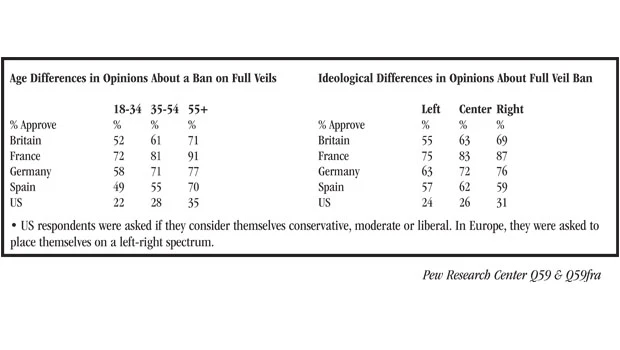
Another interesting result, she said, was the “that there are more and more demographic differences in Western Europe that supported the ban; even though older people are more likely than younger people to support the ban, the majority of all age groups are likely to support it.
“While here in the US, those who are 55 and older are more likely to support the ban, but the majorities across all age groups still reject the ban here in the US.”
Dr. Horowitz also said the pollsters did not find a lot of demographic differences and opinions.
“Men and women, for example, have pretty much the same views, even across educational groups — the more educated and the less educated — have similar views in all the 5 countries. We found this very interesting, we thought that we would see more differences in age and gender, and we didn’t.”
“On this issue, Americans more tolerant than Western Europeans, said the Pew senior researcher.
This is not always the case. On religious views, she said, Americans come across as being more conservative than Europeans.
The distinguishing fact, she believes, really “does has to do with the belief in civil liberties.”