
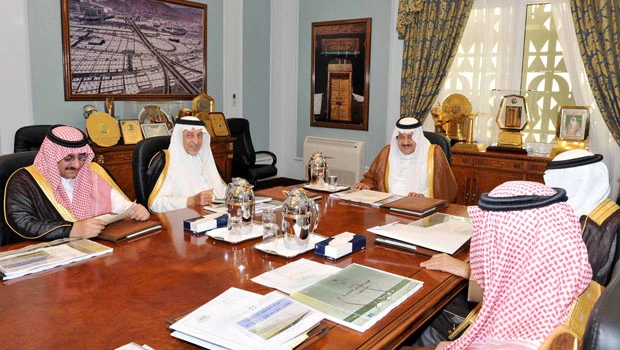
- JEDDAH: The Supreme Haj Committee met here Saturday and discussed the partial launch of the Makkah Metro, the new railway system linking the holy sites of Mina, Arafat and Muzdalifa to the holy city.
Second Deputy Premier and Minister of Interior Prince Naif, who presided over the meeting, called for greater efforts by public and private agencies to make the upcoming Haj season a success.
The first phase of the metro, which is also known as Mashair Railway and is designed to transport 70,000 pilgrims in an hour between the holy sites, would be launched during this Haj season.
“Thirty-five percent of its capacity would be used during this year’s Haj,” a senior official said. It will have 20 trains next year when it operates with full capacity. Each train will have 12 carriages.
The railway project would bring about remarkable improvements in the transportation of pilgrims between the holy sites, one of the main headaches for Saudi Haj managers. The new railway is to be tested on Aug. 1.
The Haj committee meeting also discussed the best ways to manage crowds on the mataf (the circumambulation area around the Holy Kaaba) during the peak days of Haj and Ramadan.
“The meeting also discussed prospects of using hospitals at the holy sites of Mina and Arafat throughout the year,” said Saaed Al-Harithy, secretary-general of the committee.
The meeting, which was attended by Makkah Gov. Prince Khaled Al-Faisal and 10 ministers, emphasized the need to improve arrangements at airports and seaports to receive Umrah pilgrims.
The committee decided to improve the conditions of miqats, the locations where pilgrims put on their ihram before heading to Makkah, and building mosques in those places. More lockers would also be established in Makkah and Madinah for use by pilgrims and visitors.
Other topics discussed were the linking of new Mina with the Jamrat Bridge, electrification of the Hijrah Expressway between Makkah and Madinah using solar energy, organization of pilgrim movement to the Jamrat for the stoning ritual, and application of electronic systems for Haj and Umrah affairs.