
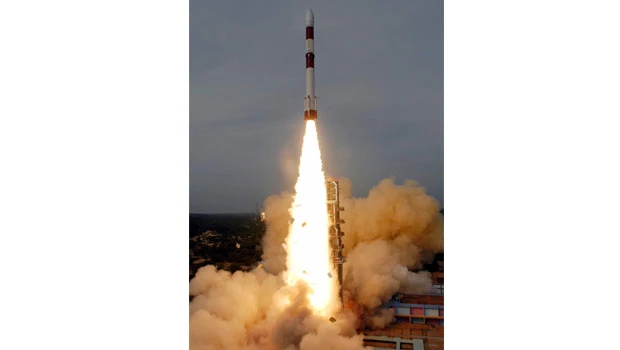
- BANGALORE: India successfully launched five satellites into orbit on Monday, three months after the country’s space ambitions suffered a setback when a rocket crashed at lift-off.
The five satellites included an advanced remote sensing satellite called Cartosat-2B, as well as a satellite from Algeria.
Three other smaller experimental devices from India, Canada and Switzerland were also released.
“The rocket deployed the five satellites in the intended polar orbits after a textbook launch from the spaceport under perfect weather conditions,” Indian Space Research Organization (ISRO) Director S. Satish told AFP.
The launch site was at Sriharikota, about 80 km northeast of Chennai.
Planning Commission Deputy Chairman Montek Singh Ahluwalia, who was present at the launch, congratulated the ISRO scientists on the “perfect launch” and said: “ISRO makes the country proud.”
ISRO officials had some anxious moments in the run up to the launch.
Originally scheduled for launch May 9, ISRO decided to postpone it as it found “a marginal drop in the pressure in the second stage of the vehicle during mandatory checks” due to a faulty valve. At that time, the rocket was almost ready except for the loading of the satellites.
The rocket had to be dismantled to replace the faulty valve. The problem persisted even after the valve replacement here and ISRO sent the second stage (engine and other systems) back to its assembly centre to be dealt with.
Built to last for five years, the Cartosat-2B is India’s 17th remote sensing satellite. It will augment ISRO’s remote sensing data services along with the Cartosat-2 and 2A launched earlier.
The satellite’s imagery can be used for preparation of detailed forest type maps, tree volume estimation, village/cadastral level crop inventory, town/village settlement mapping and planning for development, rural connectivity, canal alignment, coastal landform, mining monitoring and others.
“With the launch of Cartosat-2B, ISRO will have 10 remote sensing satellites in orbit — IRS 1D, Resourcesat 1, TES, Cartosat 1, 2 and 2A, IMS 1, RISAT-2, Oceansat 1 and 2,” S. Satish, ISRO director (publications and public relations), told IANS. India is a world leader in the remote sensing data market and earns a sizeable amount.
“The other remote sensing satellites that are slated for launch are RISAT (late 2010 or early 2011), Resourcesat and Megha-Tropiques,” Satish added.
In April an Indian rocket showcasing domestically-built booster technology crashed soon after lift-off from the same site.
The first Indian-made cryogenic powered rocket, a complex technology mastered by just five countries, fell into the Bay of Bengal due to a component failure.
India aims to launch its first manned space mission in 2016 and wants to grab a larger share of the multi-billion-dollar market for launching commercial satellites.
Last August India’s first unmanned moon mission, launched amid much fanfare in 2008, came to an abrupt end when controllers lost contact with the craft.