- Most of the more than 300 objects on display in the exhibition “Routes d’Arabie” (Arabia Routes) at the Louvre Museum in Paris have never been seen outside Saudi Arabia before.
- Indeed, many are unknown to most Saudis.
Contrary to the view that there is little of interest in the area prior to the rise of Islam and, again, little afterward because the glories of Islamic civilization were to be found elsewhere — in Damascus, Baghdad, Cairo, Iran, Spain, India — it provides a fascinating glimpse into a past that, over the millennia, was rich in different cultures and civilizations. Local societies were linked to and affected by the neighboring civilizations of Mesopotamia, Iran, Egypt, Yemen and those of classical antiquity — Greek, Roman and then Byzantine.
The exhibition is a sort of return match for the 2006 exhibition in Riyadh of works from the Louvre’s Islamic department, itself one of the results of the 2004 cultural cooperation agreement between the Louvre and the Saudi Commission for Tourism and Antiquities (SCTA), whose president is Prince Sultan bin Salman. Apart from a few objects from the Louvre, all the others belong either to the national Museum in Riyadh or King Saud University or other museums in the Kingdom, such as that at Al-Ula and Dammam. It was the SCTA and its vice president for Antiquities and Museums, Professor Ali I. Al-Ghabban, that proposed the list, their idea being to present the Kingdom’s own collection.
“Routes d’Arabie” falls into two halves: The pre-Islamic period and Islamic one. The title was deliberately chosen to illustrate the importance of communications to the life of a land that in antiquity as now was far from wholly inhabited.
In the pre-Islamic period, the trade routes were a priority; since the rise of Islam, priority fell to pilgrimage routes.
“We wanted to put the spotlight on certain regions that were enriched,” explains Françoise Demange, head curator of oriental antiquities at the Louvre, “from the fifth millennium BC with the first exchanges between the Gulf and Mesopotamia, then the routes involved in the trade in incense and luxury goods stretching from the south of Arabia to Gaza and Petra and then, in the Islamic part that goes up to the accession of King Abdul Aziz, the theme is the pilgrimage routes.
“The objects are presented in a series of rooms that do not necessarily follow a chronological order but rather move from place to place, showing what has been found in different sites. Between them are passages on the walls of which are massive photos of Saudi Arabian historical and archaeological locations by Brazilian photographer Humberto da Silveira. Strolling between them, the visitor finds himself following on a journey along Arabian routes.
The first room shows a general presentation of prehistoric Arabia, which includes two remarkable anthropomorphic steles: one from near Al-Ula and the other from near Hail.
In the second are artifacts from sites in Eastern Province — the island of Tarut and around Dhahran. They include the astounding Tarut statue of a naked, beardless man praying, sculpted wholly in Sumerian style and made of limestone either in Mesopotamia or locally by a Mesopotamian, probably around 2,500 BC. Tarut and that Arabian coast are thought at the time to have been part of the kingdom of Dilmun, based in Bahrain. Also displayed are chlorite vases, found in large numbers in Tarut, which was possibly an entrepôt from which goods were redistributed in Mesopotamia and Syria.
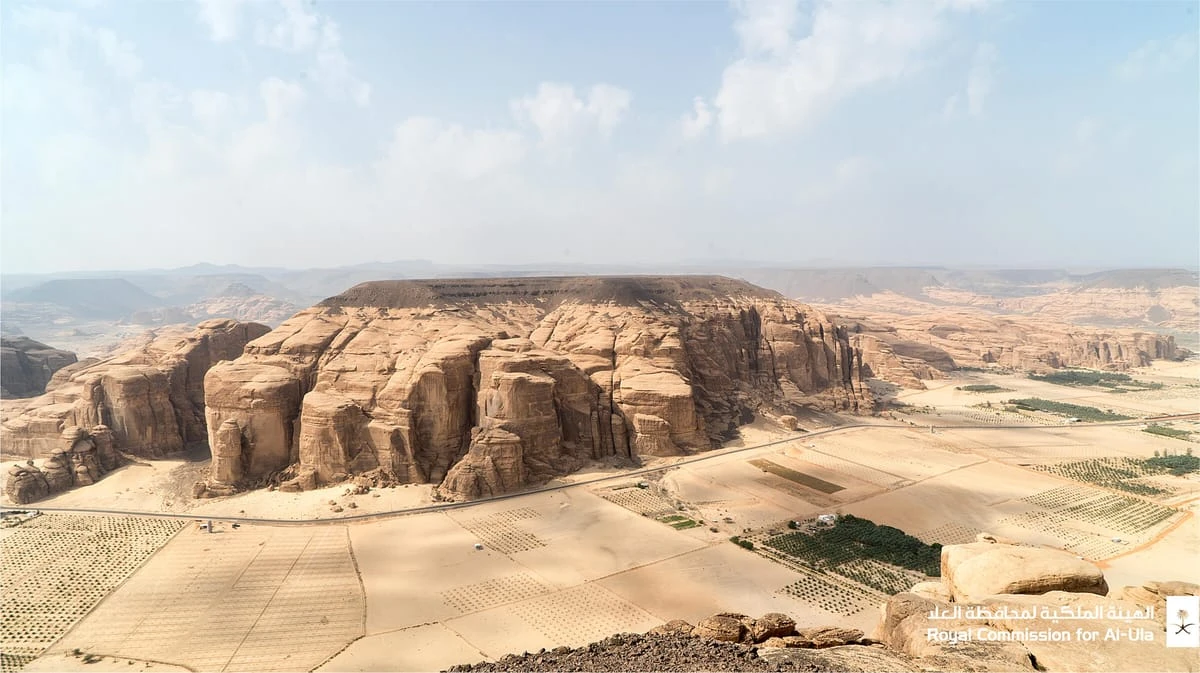
From the Eastern Province sites the visitor passes to the great oases of the north Hijaz — Tayma, Al-Ula and the best-known historical site in Saudi Arabia, Madain Saleh, which in 2008 was classified by UNESCO as a World Heritage Site.
The people who lived in these places were Arabs — the Lihyanites (also known in antiquity as the Dedanites) based at Tayma and their capital at Al-Ula (Dedan in antiquity), flourished from around 1,000 to 300 BC. These were major trading centers. Later, from the 4th century BC, there were the Nabateans whose kingdom was based at Petra in present-day Jordan. Their decision to make Madain Saleh their second capital in the 1st century resulted in Al-Ula’s decline.
The objects from these sites show clear links with neighboring empires and civilizations. There are three colossal statues and head found at Al-Ula, which are remarkably similar to those of Egyptian pharaohs. The painted head and torso of one of them were separate when found recently but have been put back together by the Louvre although the face is still missing. Similarly apparent is the Hellenistic style of the tombs at Madain Saleh.
There were considerable difficulties in presenting Madain Saleh, known as Hegra in ancient times, because it is essentially unmovable architecture. The designers therefore conceived a massive space of photos to show the facades of the tomb and explain the residential areas, as well as the discoveries in Jebel Ithlib, south of Madain Saleh, and elsewhere. Among the few objects presented are a fragment of material found in one of the tombs, two large ceramic jars and a small Nabatean capital from the doorway to a tomb.
There is also a Latin inscription found quite recently — the only one found to date — that shows that in the 2nd century AD, Madain Saleh was under Roman rule. It recounts that two Roman centurions during the reign of the emperor Marcus Aurelius (AD 161-180) directed the restoration of the walls of the city.
It probably dates around 175 AD. Some 70 years earlier, in 106 AD, the Nabatean kingdom had been captured by the Roman emperor Trajan and became the Province of Arabia Petrea. It brought the Roman Empire into what is now Saudi Arabia. Much of Marcus Aurelius’ reign was a time of war against the Parthian empire of the Persians and this part of Arabia was front-line territory.
One of the recently discovered objects from Tayma, a stele, is particularly interesting. It provides proof of the presence in the city of Nabonidus, the last king of the second Babylonian empire who lost it to the Persian leader Cyrus in 539 BC. He left Babylon in the hands of his son Belshazzar probably for religious as well as trade reasons, Tayma being a major commercial center at the time. He was a follower of the Mesopotamian moon god, Sin, worshipped at Al-Ula, whereas the official god of Babylon was Marduk. He remained in Al-Ula for ten years before returning to Babylon. It is thought that it was his alienation from the religious establishment of Babylon that resulted in his overthrow and the capture of the city by the Cyrus.
Qaryat Al-Faw and the center of Arabia
From the story of Tayma, Madain Saleh and Al-Ula a passageway takes the visitor to the center of Arabia, to Qaryat Al-Faw and Najran.
Qaryat Al-Faw was a staging post on the caravan route to the Gulf and the fabled lost city of Gerrha. We know of Gerrha from Classical writers, including Pliny the Elder who says that it had “walls five miles in circumference with towers built of salt blocks.” It was supposed to be fabulously wealthy, having grown rich on the incense and spices trade between India and the Mediterranean world. Its walls were supposedly covered in gold.
Qaryat Al-Faw was very rich too. It flourished between 200 BC and 300 AD. Unlike Madain Saleh it was strongly influenced by south Arabia in its culture, although a large number of Hellenistic items have been found there.
In the 1st and 2nd centuries AD there were important commercial interchanges with the Hellenistic world, not just at Qaryat Al-Far: Hellenistic fashions spread all around Arabia. From this period, there are frescos from Qaryat, markedly Hellenistic. One, with the head of a man and a bunch of grapes is suggestively Dionysic. Also on display is a funerary bed, typically Greek, which the Louvre has partly reconstructed to provide an evocation of that it looked like. The bronze legs were all that remained; the wood had rotted.
Also found at Qaryat Al-Faw are imported glass ware including a small glass bottle in form of a date (Syrian, 1st century AD), as well as large and small bronzes, totally Greek in style and probably imported, and silver objects including a strainer and a serving spoon which were part of a drinking service. Similar services have been found in numbers in the Gulf region and on the Syrian coast. These all show that Qaryat Al-Faw may have been a town on the edge of the Empty Quarter but the elite of its society had very refined tastes and were open to the latest Hellenistic fashions. The city was abandoned in the 3rd century AD, perhaps because the wells became blocked.
From Najran, there is a bronze lion’s head that was found in the 1930s by explorer and writer Abdullah (Harry St. John) Philby, the father of the spy Kim. He presented it to King Abdul Aziz.
From there the visitor on his own journey along the routes of Arabia, returns to what is now Eastern Province to see what was happening there in the Classical period.
There too Hellenistic fashion was in vogue rather than Iranian, despite the proximity to Iran. Tombs with typically Hellenistic jewelry have been found in tombs at Ain Jawan and at Thaj, some 150 kms from the coast, and some of their contents are on display. It was one, discovered in 1999 at Thaj by Nabiel Al-Shaikh and a team from Dammam museum that clinched the view for many that it is the lost city of Gerrha. The location of Gerrha has been a matter of debate for many years. It has been identified variously with Qatif, Al-Hasa and Uqair as well as Thaj.
Unlike many other tombs, this one had not been robbed in antiquity and contained many gold objects, including a gold burial mask in Greek style, on display at the exhibition, which is remarkably similar to the “Mask of Agamemnon” found at Mycenae in 1876.
The tomb was that of a girl. There were strips of gold around her head, a golden glove (also exhibited) on one of her hands and she had been taken to the grave wearing gold necklaces, rings and bracelets. She had been wrapped in a cloth sewn with gold foil on which were stamped images of Greek gods and goddesses. The funerary bed she was laid on was Greek in style, with bronze dolphins as the feet. She was clearly from a very rich family — very much the sort of family that would have lived in fabulously rich Gerrha. The historian Strabo said that in its houses were to be found “ivory and gold and silver set with precious stones.”
A Danish dig in the 1960s had already shown that Thaj was a major trading center, dating from the immediate post-Alexander the Great Hellenistic period. There were finds of Attic pottery from Greece and incense burners, showing that it was in the incense route. Now came this remarkable tomb providing the evidence lost for centuries as to the location of Gerrha. Also on display from Thaj is a funerary stele with Greek inscriptions.
The pre-Islamic part ends there. The visitor moves forward through a room focusing on the development of Arabic script.
From the story of Tayma, Madain Saleh and Al-Ula a passageway takes the visitor to the center of Arabia, to Qaryat Al-Faw and Najran.
Qaryat Al-Faw was a staging post on the caravan route to the Gulf and the fabled lost city of Gerrha. We know of Gerrha from Classical writers, including Pliny the Elder who says that it had “walls five miles in circumference with towers built of salt blocks.” It was supposed to be fabulously wealthy, having grown rich on the incense and spices trade between India and the Mediterranean world. Its walls were supposedly covered in gold.
Qaryat Al-Faw was very rich too. It flourished between 200 BC and 300 AD. Unlike Madain Saleh it was strongly influenced by south Arabia in its culture, although a large number of Hellenistic items have been found there.
In the 1st and 2nd centuries AD there were important commercial interchanges with the Hellenistic world, not just at Qaryat Al-Far: Hellenistic fashions spread all around Arabia. From this period, there are frescos from Qaryat, markedly Hellenistic. One, with the head of a man and a bunch of grapes is suggestively Dionysic. Also on display is a funerary bed, typically Greek, which the Louvre has partly reconstructed to provide an evocation of that it looked like. The bronze legs were all that remained; the wood had rotted.
Also found at Qaryat Al-Faw are imported glass ware including a small glass bottle in form of a date (Syrian, 1st century AD), as well as large and small bronzes, totally Greek in style and probably imported, and silver objects including a strainer and a serving spoon which were part of a drinking service. Similar services have been found in numbers in the Gulf region and on the Syrian coast. These all show that Qaryat Al-Faw may have been a town on the edge of the Empty Quarter but the elite of its society had very refined tastes and were open to the latest Hellenistic fashions. The city was abandoned in the 3rd century AD, perhaps because the wells became blocked.
From Najran, there is a bronze lion’s head that was found in the 1930s by explorer and writer Abdullah (Harry St. John) Philby, the father of the spy Kim. He presented it to King Abdul Aziz.
From there the visitor on his own journey along the routes of Arabia, returns to what is now Eastern Province to see what was happening there in the Classical period.
There too Hellenistic fashion was in vogue rather than Iranian, despite the proximity to Iran. Tombs with typically Hellenistic jewelry have been found in tombs at Ain Jawan and at Thaj, some 150 kms from the coast, and some of their contents are on display. It was one, discovered in 1999 at Thaj by Nabiel Al-Shaikh and a team from Dammam museum that clinched the view for many that it is the lost city of Gerrha. The location of Gerrha has been a matter of debate for many years. It has been identified variously with Qatif, Al-Hasa and Uqair as well as Thaj.
Unlike many other tombs, this one had not been robbed in antiquity and contained many gold objects, including a gold burial mask in Greek style, on display at the exhibition, which is remarkably similar to the “Mask of Agamemnon” found at Mycenae in 1876.
The tomb was that of a girl. There were strips of gold around her head, a golden glove (also exhibited) on one of her hands and she had been taken to the grave wearing gold necklaces, rings and bracelets. She had been wrapped in a cloth sewn with gold foil on which were stamped images of Greek gods and goddesses. The funerary bed she was laid on was Greek in style, with bronze dolphins as the feet. She was clearly from a very rich family — very much the sort of family that would have lived in fabulously rich Gerrha. The historian Strabo said that in its houses were to be found “ivory and gold and silver set with precious stones.”
A Danish dig in the 1960s had already shown that Thaj was a major trading center, dating from the immediate post-Alexander the Great Hellenistic period. There were finds of Attic pottery from Greece and incense burners, showing that it was in the incense route. Now came this remarkable tomb providing the evidence lost for centuries as to the location of Gerrha. Also on display from Thaj is a funerary stele with Greek inscriptions.
The pre-Islamic part ends there. The visitor moves forward through a room focusing on the development of Arabic script.
hree Pilgrimage routes
There is a distinct change of style. Now the routes that mark development and activity in Arabia are those taken by pilgrims to the holy cities of Makkah and Madinah. The exhibition concentrates on discoveries at three site on three different routes: Al-Rabadhah, 200 kms for Madinah on the route bringing pilgrims from what is now Iraq; Al-Mabiyat (ancient name: “Qurh”) on the route from Syria; and Al-Hawra on the Red Sea coast, north of Yanbu, on the route from Egypt.
On show from Al-Rabadhah are ceramics and glass, mainly brought in from Iraq probably by pilgrims. The town developed very early in the Islamic period and may even have had pre-Islamic origins, but its apogee was during the period of the Abbasid caliphate that was based mainly in Baghdad. The material therefore dates from the 8th to 10th centuries. The city was abandoned in the 10th century following the changes that saw the decline of the Abbasid caliphate, notably the revolt of the Qarmatians. Al-Rabadhah was excavated between 1979 and 2000.
From Al-Mabiyat there are various architectural fragments and metal-glazed ceramic items. From the third route there is just a door lintel with a Quranic inscription on it in a very ornate script from the Ayat Al-Kursi [Throne Verse] (2: 255).
Having followed the pilgrimage routes, the visitor then “arrives” at holy places, passing first though another passage that displays old photos, in particular those taken by an Egyptian civil servant a century ago.
Mohammed Ali Effendi Sa’oudi twice accompanied the Amir Al-Hajj who was attached to the official Egyptian pilgrim caravan and his diaries and photos were this year published by the American University in Cairo under the title “A Photographer on the Hajj: The Travels of Mohammed Ali Effendi Sa’oudi 1904–1908.” Other photos include one taken at the end of 19th century and now in the possession of the Royal Geographic Society, London, but never published and two from the King Abdul Aziz Library in Riyadh.
On display in the next room are 18 gravestones from the cemetery in Makkah dating from the 9th century to the 16th centuries. They show the evolution both of Arabic calligraphy and different decorative styles. Some, for example, from the end of the 12th century and the beginning of 13th show epitaphs framed in a niche evoking the shape of mihrabs. There is a 16th-century stone with particularly beautiful calligraphy. Many of these Makkah gravestones were damaged or destroyed over the years. Several hundreds survived, although very few remain from the Ottoman period.
Part of the difficulties in mounting an exhibition on Islamic artifacts from Arabia is that while it is the heart of the Islamic world it has not been the center of Islamic history or Islamic art. That is why these gravestones are so important. They were produced on site. They are about the only indigenous artistic products in the holy cities.
The epitaphs and the choice of Quranic texts are interesting and there is a great deal of historical information to be gleaned from them about Makkah over the centuries — who these people were, their origins, where they were from, sometimes what they did, their relationships to important families. They show the flow of pilgrims, of people who came on pilgrimage and died while in Makkah, or who came and stayed, such as that of an imam from Meknes in Morocco who became the Malikite imam in the holy sanctuary.
Some stones are signed. There were families of stonemasons who designed and carved gravestones. There are two such stones in the exhibition by the Abi Harami Al-Makki family, principally Abdul Rahman b. Abi Harami Al-Makki and his nephew Muhammad who is presumed to have been his apprentice. Their reputation was such that gravestones designed by them even turn up on the Dahlak archipelago off the coast of Eritrea.
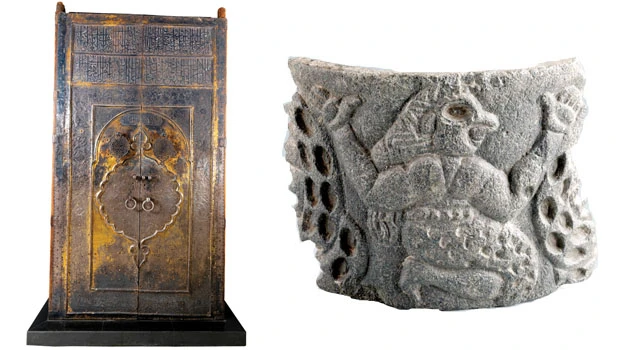
The next object the visitor sees is a pair of gates originally from the Kaaba, silver gilt on wood, and made probably in Turkey or possibly Syria or Egypt around 1635. They were the gift of the Murad IV (1623-40) the last warrior Ottoman sultan, who briefly restored the fortunes of the empire. Throughout the Islamic period, rulers — Mamelukes, Ottomans and others — hoped to reinforce their authority and legitimacy by giving gifts to the Holy Places such as doors, keys, and ornate coverings for the Kaaba.
There is a photo by Philby in 1937 showing the doors still in place but they were replaced in the expansion and restoration works to the Holy Mosque carried out by King Abdul Aziz.
Other objects in this section include a Key of the Kaaba and, from the Tomb of the Prophet at Madinah, locks, a candlestick and a fragment of the inner veil of the Kaaba dating from the 18th century. Also from Madinah is a incense burner given by Murad IV’s mother, Kosem Sultan, the most powerful woman in Ottoman history who during Murad’s reign, that of his brother Ibrahim I and finally of her grandson Mehmed IV exercised vast power before finally being murdered by Mehmed’s mother in 1651.
Also on display are drawings and maps of the Holy Places, mainly 19th century, some of which have never been on public display before — such as a map of the sanctuary of Makkah, dated 1815 by the Spanish adventurer, writer and possibly Napoleon’s spy, Domingo Badia y Leblich (also known as Ali Bey Al-Abbasi), who was in Makkah in 1803 when it was captured by Saud Al-Saud (Saud the Great) ruler of the first Saudi state.
The last room covers the Saudi dynasty and bring the exhibition right up to the time of King Abdul Aziz.
Altogether, the exhibition provides a fascinating glimpse into the history of Arabia, a history largely unknown but that is now beginning to come to light thanks to work of Saudi archaeologists and those from France and other countries — and the enthusiasm of the Saudi Commission of Tourism and Antiquities.
Any exhibition with over 300 objects would not be easy to organize but in fact this was not too difficult and the Louvre pays credit to the help from Riyadh. The exhibition is expected to go to Barcelona and then probably to the United States, although a location has, as yet, to be chosen.