
- Humberto da Silveira is a very private man.
- He eschews publicity as vigorously as far-less-talented photographers seek it.
Da Silveira originally started to train as a doctor but was overtaken with a love of history and archaeology. He is a lean, fit-looking perfectionist whose intense dark-eyed gaze framed by wire-rimmed spectacles speaks of a passion for his craft bordering on obsession. His highly focused conversation almost devoid of adjectives is punctuated with academic references that demonstrate a lifelong devotion to and knowledge of the history of the Middle East and Persia that informs both his eye and choice of subjects.
In conversation he never strays off the subject and, if diverted, waits patiently until the moment allows him to continue unbroken from where he left of. He exudes commitment and intensity and gives the impression that nothing at all is left to chance. This is a stripped-down custom-made photographer of tremendous ability and energy who is on a mission.
It is therefore no surprise at all that he was the choice of the Louvre Museum to research, provide and source photographs that accompany the “Routes d’Arabie” exhibition that formally opens on July 12.
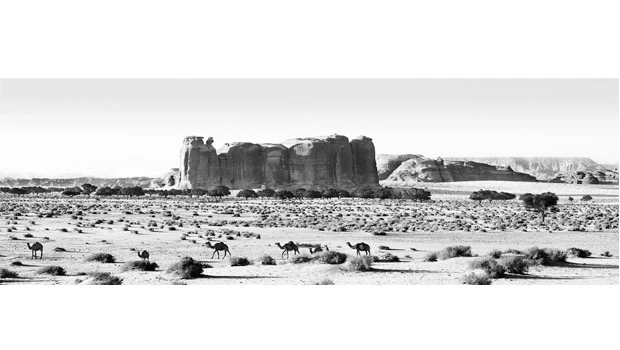
It also explains why the museum chose his magnificent panoramic photograph of the desert near Madain Saleh, placed in the rotunda entrance of the Louvre’s Napoleon Gallery, as the background for the formal opening.
The photograph itself is something of a feat. Nineteen meters long and 3.57 meters wide, it dominates the entrance to the five-month exhibition. The image was taken on a Linhof camera with a Schneider ultra-wide angle lens. The negative was scanned to produce a huge single image using technology not available even three years ago when the exhibition was still in the planning stage.
The choice of camera is significant. Da Silveira’s perfectionist approach commits him to exotic equipment that is unheard of anywhere but professional circles.
“I am allergic to Japanese digital cameras,” he said in his decisive manner. “There is nothing to match the power of German lenses or the cameras made by them and the Swedes.”
Hasselblad, Linhof and Alpa all are standard to his 70kg assembly of kit that he takes on his assignments.
He has however, recently included digital equipment into his mix. Indeed, some of his photos in the exhibition are digitally produced.
Best viewed from at least five meters distance, the panoramic entrance photo captures the magnificent desolation of the sandstone and desert region surrounding Madain Saleh, showing the challenges facing both the ancient city’s Nabatean builders and travelers using the roads to Arabia over the centuries.
The sheer scale of the image, resonating with the vastness of the desert, is an essential part of the impact it makes on the beholder. The forbidding rock formations that frame it open into a central plain that offers a way forward, leading the viewer into the desert environment central to the image and onward to something hinted at as just over the horizon. No suggestion of hope or promise is given; it is the quintessential desert in its full existential bleakness. It is what it is, its own justification and foundation.
Yet, the viewer knows what was born there. Rich cultures, trade, learning and, of course, Islam. The central contradiction of the image whence its power comes is that the desert apparently offers nothing yet we understand from the history of its native people that it has offered intellectual, philosophical and artistic riches to the world.
The exhibition confirms that contention with the 300 or so samples of pre-Islamic and Islamic culture furnished by Saudi Arabia. It is this richness of culture that da Silveira seeks to capture and present in his work and it is his compendious knowledge of the region and its cultures that informs it.
Da Silveira sees himself as part of the sequence of photographers who have recorded Arabia in general and the Kingdom in particular over the years starting with Capt. William Shakespear. Shakespear was a keen photographer and the first Westerner both to meet and to photograph King Abdul Aziz bin Abdulrahman bin Faisal Al-Saud. While posted in Arabia, Shakespear would record his desert explorations and produced some of the best-known early images of Kuwait and Saudi Arabia as a valuable record of a bygone era.
“I am totally involved with photography; it is my life. It is part of me and is my main tool,” he said in a rare conversation.
Not only does he refuse to be photographed, regarding it as a distraction from his work to the viewer, he does not give interviews.
“My vision is very academic — I am not even a photographer — I like to think I am a historian. I like research and I have a scientific mind. I think that this separates my work from all other work [about the region] that has been done.”
His vision is to complete a multivolume masterwork of the history of the region as expressed through images of its people, architecture and monuments. Photography is the tool, he said, with which he communicates the history in a readily accessible form, the image.
All shot in black and white and some processed with a sepia tint redolent of the early images of the region, da Silveira’s work is immediately accessible simply as beautifully composed and striking images.
However, they have a quality that grasps the attention at the surface level and as the viewer gazes, subtle features emerge that involve the eye and the image seems to alter in depth and content. Much of this gentle morphing from two-dimensional image to visual conversation with the photographer through the image is the masterful use of lighting — often low angle and dramatic. Careful study reveals da Silveira’s use of shadow — not the dark blocky areas characteristics of images from early in the 20th Century but, through the use of his beloved wide aperture Schneider and Zeiss lenses, the inclusion of incredible amounts of shadow detail, which through their emerging complexity, add life to an apparently static scene.
The shadow detail is now something of a signature technique for da Silveira. Perfectly able to achieve it on film with complex exposure, developing and printing techniques, life became somewhat richer recently. Still allergic to Japanese digital cameras, he went digital. European digital, that is.
“Why? With 60 megapixels you see 300 percent more clearly than your eye,” he said. “It completely revolutionizes shadow detail and has given me a whole new niche to exploit. The old fox has to be much more clever!”
He will not be moved off his adherence to equipment he has tried and tested over his professional life.
“German lenses, Swedish and Swiss cameras and engineering — totally unbeatable.” So much so that he uses film camera chassis converted to take digital shots. Though some are not yet perfected for color shooting this does not affect him at all as he only ever uses black and white. “Going to digital has, as an aside, lightened the load I have to carry in the field,” he smiled.
Many of his images are without people present. His definitive 1994 study “Bedou” that recorded a breed of desert people that is now almost extinct as the modernization of their territory inexorably progresses was an exception. So was “Abdulaziz,” a 1999 photo-biography of King Abdul Aziz.
Other of his published works include the 1992 “Najd,” presenting his vision of Saudi Arabia’s Neolithic, Classical and 19th Century traditional architecture, in the last years of its functional existence prior to modernization.
Ready to publish as part of his masterwork among others are “Hegra” that illustrates the historical and archaeological heritage the Nabatean, Tamoud, Dedanite, Lihyanite and Minaean cultures, “Nabataea” — a classic photographic study of the Nabatean civilization and “Yemen” — a vision of its Neolithic, Bronze and Classical periods with a study of the stone and mud traditional architecture and its people.
Perhaps the most important of his unpublished work is the latest production, “The Third Mosque.” For this sensitive, highly detailed and researched study of Al-Aqsa Mosque, da Silveira spent considerable time getting a royal sponsor and special clearances from the Mosque authorities to photograph what may yet prove to be his definitive work.
His has a single objective, he said, to compile photographic evidence of the highest quality, “to contribute to the preservation of archaeological sites and traditions that still speak to us of the ancient world, and thus bear witness to the practical realities of mankind’s cultural development.
The photography is an adjunct to this main interest and vision that is to learn, to understand and communicate. “You have to work on the image, to analyze it and to think — almost as if the image has a thousand words. The photographer is there to make that accessible to the viewer.”
This da Silveira does and in the company of hundreds of archaeological and cultural rarities on display at the exhibition. The photographs set the scene for the physical reality of the artifacts on display. The overall effect is magnificent.
For those who have the eyes to see it and some knowledge of the history of the Middle East to understand it, da Silveira’s work does not simply speak for him; it commands.