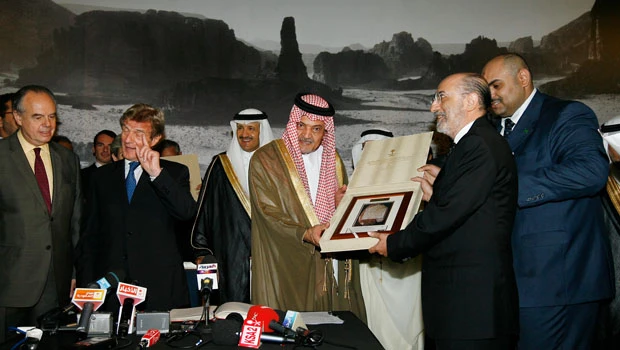
- PARIS: The landmark exhibition at the Louvre Museum in Paris of pre-Islamic and Islamic treasures from the Kingdom was opened Tuesday by the Saudi and French foreign ministers, Prince Saud Al-Faisal and Bernard Kouchner.
Also present were Prince Sultan bin Salman, head of the Saudi Commission for Tourism and Antiquities (SCTA) which jointly organized the exhibition with the Louvre; Prince Turki Al-Faisal, chairman of the King Faisal Center for Research and Islamic Studies in Riyadh; Bahraini Minister of Culture Sheikha Mai bint Mohammed Al-Khalifa; French Culture Minister Frederic Mitterrand; and UNESCO Director-General Irina Bolkova.
Most of the more than 350 artifacts at the exhibition have never been seen outside the Kingdom before. They show the different cultures and civilizations that have inhabited the Arabian Peninsula and the wealth of history to which Saudi Arabia is heir. The statues, vases, inscriptions, architectural pieces and so many other objects cover a span of some 7,000 years. Many are in a remarkable state of preservation, such as a 3,000-year-old highly decorated and colored conical vase. It would be easy, for example, to mistake a wonderful chlorite vase from the island of Tarut in the Gulf for a 1920s object rather than from the 3rd Millennium BC; the palm leaf design made it look almost art deco.
In his speech at the opening, Prince Saud Al-Faisal thanked France and the Louvre Museum for staging the exhibition, paying homage to the collaboration between the SCTA and French experts. They had, he said, helped make a long-cherished dream come true.
Kouchner spoke of the exhibition as "historic" and " a wonder", saying that it showed that the relationship between Saudi Arabia and France went beyond the political and commercial. He particularly appreciated the different inscriptions showing the development of writing. He also paid homage to work by French archaeologists in the Kingdom over the years.
There was a palpable sense of pride and wonder among the many guests at the objects on display. There was also a strong feeling that the exhibition, which had been two and a half years in the planning, would change ideas about Saudi Arabia.
"It brings Saudi Arabia to the rest of the world," Prince Turki told Arab News. "This way people will get to know the Kingdom better than they do now."
For Prince Sultan bin Salman the event was not about marketing Saudi Arabia. It established what he called a new "dimension" in people's minds about the Kingdom. The Kingdom, he said, was well known for its Islamic dimension as well as its economic and political ones — its economic resources, its role as a member of G20, its involvement in regional and world affairs. But its heritage "dimension" — the past civilizations and history of the land — was largely unknown. But today they are becoming "a very important part" of Saudi Arabia. The country "has not come out of a void," he told Arab News. "It has a historic continuity." The role today of Saudi Arabia was not just political or economic. It had a role to play, long fixed in history.
This was reiterated by professor Ali I. Al-Ghabban, vice president of Antiquities and Museums at the SCTA, who was in part responsible for selecting the items on show.
The exhibition was "a beginning" he said — a beginning at showing the world "the deep history of our country." It would open people's eyes to "the role of Arabia in the history of humanity." It showed that "it has always been a land of exchange, not only political and commercial exchange through the ages but cultural exchange — with places such as Mesopotamia and Egypt," he said. The Kingdom of Saudi Arabia was a continuation of that role, he explained. "When there is unity, there is civilization. We have unity thanks to the Al-Saud dynasty."
Others, not just Saudis, spoke of the importance of the exhibition. Sheikha Mai Al-Khalifa said it gave one "a reason to come to Paris". It showed the Arabs of the peninsula were "rich in culture," she said. "We have to show that to the world."
"So much more important for Saudi image in the world than economic forums,” was the assessment of one enthusiastic French official.
"It should have been done years ago" was the comment of a prominent Jeddah businessman. "It shows what we have hidden treasures in our land", he said, adding that those who were unhappy about displaying pre-Islamic objects such as statues had nothing to fear.
The exhibition, supported by the Total Foundation and Saudi fashion chain Al Rubayat, remains open until Sept. 27. After that it is scheduled to go to Barcelona, Berlin, Washington and probably at least one other city in the United States.