- Elham Al-Rayes can be considered the first Saudi artist who chose to study the art of optical reflections and hold a first exhibition based on that particular theme.
Although there is an absence of art exhibitions and galleries based on optical reflections in the Kingdom, she still chose to study and work in the field.
Al-Rayes studied a bachelor’s degree at the art college at Umm Al-Qura University in Makkah. She then completed her higher studies at King Abdulaziz University in Jeddah in the field of optical reflection art.
“During the last few years I used to draw using several techniques associated with other artists. Later on I chose to use elements of science, vision, and imagination in one picture,” she said.
“This encouraged me to choose optical reflection art as my higher degree theme. Actually, this then required me to find the relationship between physical and art laws without ignoring the imagination. My work is based on using the various forms of mirrors, whether they are flat, spherical or concave, cylindrical or wavy. These works are based on the study of optical engineering, which relates to machines such as cameras, projectors and microscopes.”
Al-Rayes claimed that people are almost floating between digital art and optical reflection art, especially since digital cameras are used in both forms.
She confirmed that she only uses cameras in optical reflection art to capture the vision that mirrors reflect.
“The focus is on diversity within the corners of vision and digital capture angles. Finally, I used the computer to download images produced by these optical projections,” she said.
Optical reflection art can be used in several other art forms such as graphic work, textiles, geometric ornaments, organic forms and media windows, said Al-Rayes.
Al-Rayes held her first expo in optical reflection art, a work based on a scientific visual technology study linked to the operation of cognition and theories of Gestalt.
“The optical reflection art focuses on the development of the technical dimensions of vision that could reach the pinnacle of innovation. This resulted from the mix of art, science and vision in one work,” she added.
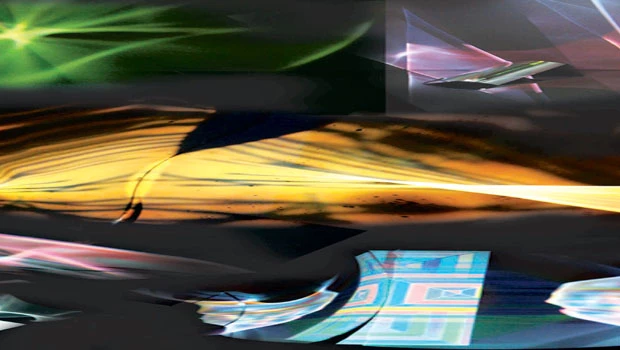
Al-Rayes presented her first exhibition, which carried the theme “Optical Reflections”. It contains about 30 pictures, reflecting images of nature from a physical and magic view.
“The presented pictures use a technique called ‘Luminocinetique’, which combines the light and movement in one area. I use dimensions or sizes in real three-dimensional mirrors. This art is called ‘Lumia art’. It emerged in the 1960s. It relies on light that is used directly to give the effect of actual movement.”
Optical reflection artists needs to be aware of the small details and requires skill, culture and perception, added Al-Rayes. She speaks about Saudi art optimistically.
“There is clear support from the Ministry of Culture and Information, through the arts associations that offer all kinds of support for the establishment of art galleries. We need to work in order to instill a culture of art in Saudi Arabia. In the past there was no one interested in visiting these exhibitions, but now things are different.”