
- ISLAMABAD: Pakistan and India said after key talks on Thursday that the process of rapprochement between the two countries is invaluable and will continue in the future, but failed to announce any tangible measures to build the trust fractured by the 2008 Mumbai attacks.
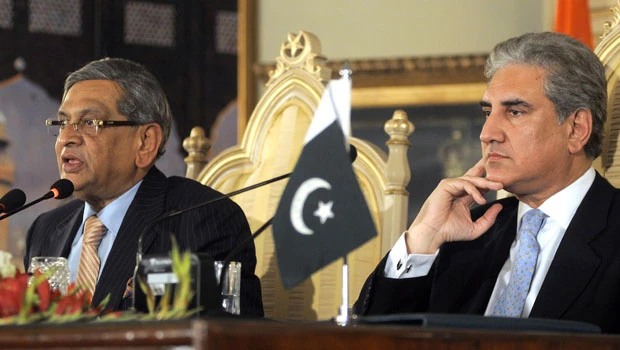
"We have agreed that this process is valuable and we will continue to meet in the future," Pakistan's Foreign Minister Shah Mehmood Qureshi told a news conference with Indian counterpart S.M. Krishna after talks ran into overtime in Islamabad.
"This was a useful meeting and we have agreed to continue this engagement in days to come," Qureshi added.
However, the talks were overshadowed by a statement by India's Home Secretary G.K. Pillai accusing Pakistan's powerful Inter-Services Intelligence (ISI) agency of masterminding the Mumbai attacks that killed 166 people.
Observers in Islamabad thought the statement was an attempt by New Delhi to "talk from a position of strength."
Pillai told the Indian Express newspaper that the ISI had controlled and coordinated the Mumbai attacks, adding that that information had emerged from the interrogation of David Coleman Headley, an American under arrest in the US. The Pakistani agency has previously denied any involvement in the Mumbai attacks.
Headley, the US-born son of a former Pakistani diplomat and an American woman, was arrested in Chicago last year and has pleaded guilty to scouting the hotels and other sites in Mumbai that were targeted by the militants.
Pakistan has admitted that the attacks were planned partly on its soil and an anti-terrorism court has charged seven suspects in connection with the violence.
Krishna met Qureshi, then Prime Minister Yousaf Raza Gilani and President Asif Ali Zardari in the heavily guarded "Red Zone" that is home to government and diplomatic missions in the center of Islamabad.
The Indian minister and Pakistani leaders spent the day locked in the third high-level contact in a six-month thaw since New Delhi broke off peace talks after the Mumbai attacks.
Talks ran into extra time, delaying a news conference by more than six hours as discussions focused on Indian concerns about terrorism and allegations of a Pakistani role in the Mumbai carnage.
Krishna said he would return to New Delhi "with an assurance from the highest level" of Pakistan's political leadership over leads thrown up by Headley.
"I'm going back with the hope there will be further interrogation based on leads given by Headley," he told the news conference.
"If it could help unravel the conspiracy and go after the perpetrators of the Mumbai attacks, there could be the biggest confidence-building measure."
He invited Qureshi to visit India in the "near future."
"Pakistan would take the leads provided by the (Indian) home minister very seriously because we want to move on," Qureshi said.
"There are important issues including terrorism and they should be addressed and we have to discuss them. We have agreed on the need to discuss important issues to make the process meaningful."
Although the ultimate goal is to resume peace talks, Thursday's talks yielded little concrete agreement beyond assurances and Krishna's invitation to Qureshi to visit India.
Both sides described the talks as constructive and said that all issues had been up for discussion during marathon meetings that started mid-morning and continued after nightfall.
Despite the diplomatic language, there were gaps between the two foreign ministers at the news conference.
Qureshi said he hoped for a timeframe to proceed with confidence-building steps but admitted: "I, through my interaction with the Indian delegation, realized that presently they were not in a position to be bound by time."
President Zardari called on both governments to "work more closely" and share intelligence "to prevent any incident of terrorism and violence," his office said.
"Pakistan is against militancy and terrorism in any form and in any location and both the governments needed to work more closely for eliminating this menace," Zardari said in a statement.
India and Pakistan's prime ministers met in April on the sidelines of a regional summit in Bhutan, which set in motion the process of reviving suspended contacts at different levels of government.
— With input from agencies