
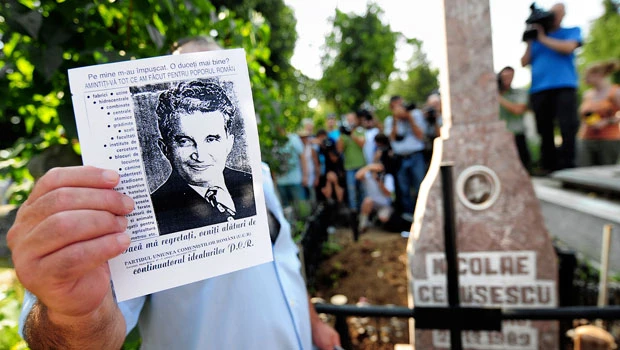
- BUCHAREST: The graves of Romania's former communist dictator Nicolae Ceausescu and his wife Elena were dug up on Wednesday, some 20 years after their deaths, to check if they were truly buried there, their son-in-law said.
Forensic experts estimate it could take weeks or months for the DNA test results to be completed, depending on the quality of samples taken from the graves.
Ceausescu ruled Romania from 1965 until he and Elena were captured and shot by firing squad on Christmas Day in 1989 after fleeing mass protests in Bucharest, marking the fall of communism in the southeast European country.
The execution took place at an army base near the town of Targoviste and the bodies were buried without fanfare, causing some to doubt whether the graves in Bucharest really contain their remains.
"The exhumation takes place today and we're taking samples of the remains," Mircea Opran, the husband of the Ceausescus' late daughter Zoia, told television station Realitatea TV. Early morning footage showed the excavation as it was going on.
"The samples will be taken for tests and the rest will be buried," Opran said. "I don't know what will happen if it is discovered that the Ceausescus are not in these graves. Probably we will sue the Romanian state."
Zoia Ceausescu, who died of lung cancer in 2006, first asked for the identities of the bodies to be checked soon after the executions but the process was delayed for years as it proceeded through Romania's bureaucratic legal system.
If the bodies are found not to be those of Ceausescu it could cause an uproar in Romania, where the former dictator has been ranked as both the most loved and most hated figure of the last century.
Anti-communists accuse an elite tied to the toppled regime of preserving their power by snapping up the nation's wealth in the chaotic aftermath of the 1989 revolt, while sympathizers of the dictator see Romania looted by a new super-rich elite.
Those nostalgic for the old times say the shift to democracy and European Union membership has robbed them of stability and sent the country off in the wrong direction.
Opran said after the exhumation he tended to believe the remains were indeed those of the former communist dictator and his wife, who ruled the country using the feared former secret police Securitate.
He said he saw bullet holes in the clothes they found in Ceausescu's grave.
"The mystery is not elucidated. After what I saw, I tend to believe they are them. But until the DNA test is finished, I do not have a 100 percent confirmation, I am not 100 percent convinced."