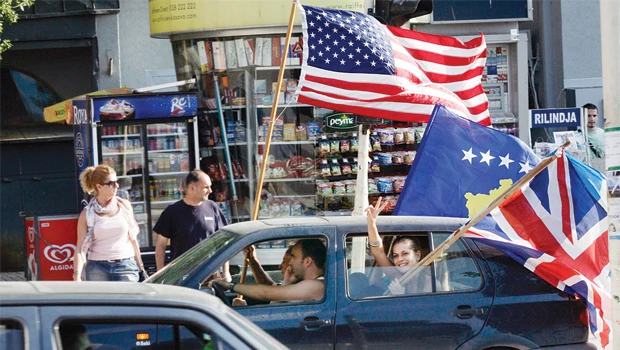
- THE HAGUE, Netherlands: Kosovo won a major victory on the world stage Thursday as the United Nations' highest court said its 2008 declaration of independence from Serbia was legal.
- The nonbinding opinion by the International Court of Justice sets the stage for Kosovo to renew its appeals for further international recognition.
“Kosovo's historic victory should not be felt as loss in Belgrade,” Kosovo Prime Minister Hashim Thaci said, calling the ruling “the best possible answer for the entire world.”
Serbia quickly denounced the ruling and vowed it would never recognize Kosovo as separate.
The verdict — passed in a 10-4 vote by court judges and read by court President Hisashi Owada — says international law contains “no ... prohibition of declarations of independence” and therefore Kosovo's declaration “did not violate general international law.”
UN Secretary-General Ban Ki-moon will forward the advisory opinion to the General Assembly “which had requested the court's advice and which will determine how to proceed on this matter,” UN spokesman Martin Nesirky said.
“The secretary-general strongly encourages the parties to engage in a constructive dialogue,” Nesirky told reporters at UN headquarters in New York. “The secretary-general urges all sides to avoid any steps that could be seen as provocative and derail the dialogue.”
Serbian President Boris Tadic said that Serbia will propose to the assembly in September a resolution on Kosovo that will represent a “compromise” between Serbs and Kosovo Albanians. “The only sustainable solution is the one accepted by all sides,” Tadic said.
Russia, a close ally of Serbia, said its position against Kosovo's declaration of independence remains unchanged. “We believe the resolution of the problem of Kosovo is possible only through negotiations between the interested parties, on the basis of the provisions of Resolution 1244 of the UN Security Council," the Foreign Ministry said in a statement.
This resolution "remains the basis of judicial and international regulation recognized by all," it said.
US Secretary of State Hillary Clinton called on all nations including Serbia to recognize Kosovo "We call on all states to move beyond the issue of Kosovo's status and engage constructively in support of peace and stability in the Balkans, and we call on those states that have not yet done so to recognize Kosovo," she said.
Earlier, State Department spokesman P.J. Crowley said: “Now it is time for Europe to unite behind a common future.”
EU foreign policy chief Catherine Ashton said other European Union is ready to help Serbia and Kosovo hold a dialogue to strengthen their chances of joining the bloc.
She said the European Union welcomed the World Court's ruling. "The EU is ... ready to facilitate a process of dialogue between Pristina and Belgrade. This dialogue would be to promote cooperation, achieve progress on the path to Europe and improve the lives of the people," Ashton said in a statement.
Kosovo sparked sharp debate worldwide when it seceded from Serbia in 2008, following a bloody 1998-99 war with Serbia and nearly a decade of international administration.
Serbia and Russia have led opposing countries in condemning Kosovo's statehood, with Serbs arguing it has been the cradle of their civilization and national identity since 1389, when a Christian army led by Serbian Prince Lazar lost an epic battle to invading Ottoman forces.
Serbia's ultranationalist Radical Party said the court “gravely violated” international law, and called on the government to demand an urgent session of the UN Security Council to end the EU peacekeeping mission in Kosovo.