
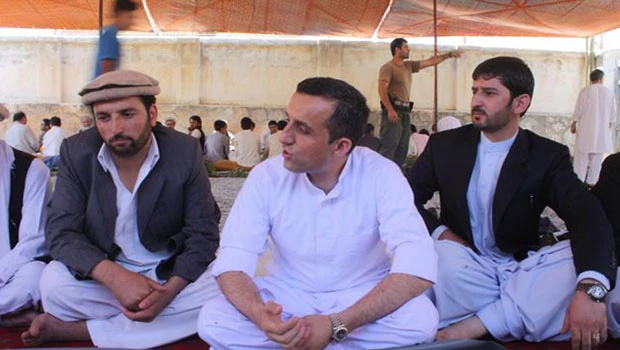
- PANJSHIR VALLEY: The man who served as President Hamid Karzai’s top intelligence official for six years has launched an urgent campaign to warn Afghans that their leader has lost conviction in the fight against the Taleban and is recklessly pursuing a political deal with insurgents.
In speeches to small groups in Kabul and across northern Afghanistan over the past month, Amarullah Saleh has repeated his belief that Karzai’s push for negotiation with insurgents is a fatal mistake and a recipe for civil war. He says Karzai’s chosen policy endangers the fitful progress of the past nine years in areas such as democracy and women’s rights.
“If I don’t raise my voice we are headed toward a crisis,” he told a gathering of college students in Kabul.
That view is shared by a growing number of Afghan minority leaders who once participated fully in Karzai’s government, but now feel alienated from it. Tajik, Hazara and Uzbek politicians have expressed increasing concern that they are being marginalized by Karzai and his efforts to strike a peace deal with his fellow Pashtuns in the insurgency.
Saleh’s warnings come as the United States struggles to formulate its own position on reconciliation with the Taleban. While US officials have supported Afghan government-led talks in theory, they have watched with apprehension as Karzai has pursued his own peace initiatives, seemingly without Western involvement.
NATO’s senior civilian representative in Afghanistan, Ambassador Mark Sedwill, cautioned recently that “any political reconciliation process has to be genuinely national and genuinely inclusive. Otherwise we’re simply storing up the next set of problems that will break out. And in this country when problems break out, they tend to lead to violence.”
Still, with war costs and casualties rising, US policymakers are increasingly looking for a way out, and a power-sharing deal between Karzai and the Taleban may be the best they can hope for. One senior NATO official in Kabul described Saleh as “brilliant.” But the official said Saleh’s hard-line stance against negotiations does not offer any path to ending the long-running US war.
Saleh, 38 and a Tajik, began his intelligence career in this scenic valley north of Kabul working for the legendary guerrilla commander Ahmad Shah Massoud. He said he is not motivated by ethnic rivalries with the majority Pashtuns or by a desire to undermine Karzai, whom he describes as a decent man and a patriot.
Rather, Saleh said he wants to use nonviolent, grass-roots organizing to pressure the government into a harder line against the Taleban by showing that Afghans who do not accept the return of the Taleban are a formidable force. Saleh resigned last month as director of the National Directorate of Security after he said he realized that Karzai no longer valued his advice.
“The Taleban have reached the gates of Kabul,” Saleh said. “We will not stop this movement even if it costs our blood.”
Karzai spokesman Waheed Omar declined to comment on Saleh’s analysis. Karzai’s government has made reconciliation a top priority, and officials say they are proceeding carefully. Karzai has invited Taleban leaders to talk, but he has said insurgents must accept the constitution, renounce violence and sever their links to foreign terrorists before they can rejoin society.
Those conditions do little to mollify Afghan minority leaders, many of whom had backed Karzai in the past but are now breaking with the president. Some are concerned that a deal between Karzai and the Taleban could spawn the sort of civil war that existed in Afghanistan prior to the US-led invasion in late 2001. “The new political path that Karzai has chosen will not only destroy him, it will destroy the country. It’s a kind of suicide,” said Mohammad Mohaqiq, a Hazara leader and former Karzai ally.
With the defection of Saleh and the transfer of another Tajik, Bismillah Khan, from his position as chief of army staff to interior minister, Karzai critics see an erosion of strong anti-Taleban views within the government. Khan, many argue, was more important to the war effort in his army post than at the Interior Ministry, which oversees the police. “Now Tajiks, Hazaras and Uzbeks, they are not partners in Karzai’s government, they are just employees,” said Saleh Mohammad Registani, a Tajik parliament member from the Panjshir. “Karzai wants to use them as symbols.”
To spread his message, Saleh has sought out young, educated students and university graduates. Through them he intends to form groups across the country to apply grass-roots political pressure. His aims are nonviolent, he said, and not intended to further ethnic divisions, but he has said they must prepare for the worst.
Saleh was born in the Panjshir Valley before the family moved to Kabul. He joined the armed opposition, or mujahideen, rather than be conscripted into the Afghan army and in 1997 started as an intelligence officer with Massoud’s forces.
Saleh was appointed to run Afghanistan’s fledgling intelligence service in 2004, and developed a reputation among US officials as one of the most effective and honest cabinet ministers.
In Saleh’s view, Karzai’s shift from fighting to accommodating the Taleban began last August. The messy aftermath of the presidential election, in which Karzai prevailed but was widely accused of electoral fraud, was taken as a personal insult, Saleh said.
“It was very abrupt, it was not a process,” Saleh said of Karzai’s changing views. “He thought he was hurt by democracy and by the Americans. He felt he should have won with dignity.”
After the election, Afghan relations with the United States plunged to new lows, as Karzai railed against Western interference in his government and threatened to join the Taleban. Saleh said Karzai believes that the United States and NATO cannot prevail in Afghanistan and will soon depart. For that reason he has shifted his attention to Pakistan, which is thought to hold considerable sway over elements of the insurgency, in an attempt to broker a deal with the Taleban.
“We are heading toward settlement. Democracy is dying,” Saleh said. He recalled Karzai saying, “’I’ve given everybody a chance to defeat the Taleban. It’s been nine years. Where is the victory?”’
In his speeches, Saleh recounts Taleban brutalities: Busloads of laborers lined up and executed, young men chopped in half with axes, women and children slain before their families. His rhetoric is harshly critical of Pakistan.
“All the goals you have will collapse if the Taleban comes back,” he told a gathering of college students under a tent outside his house in Kabul. “I don’t want your university to be closed just because of a political deal. It will be closed if we do not raise our voices.”
Saleh believes the Taleban will not abide by a peaceful power-sharing deal because they want to regain total authority. Despite a significant US troop buildup this year and major NATO offensives, he estimated that insurgents now control more than 30 percent of Afghanistan. He said the Taleban leadership — about 200 people, many of them in the Pakistani city of Karachi — are financed, armed and protected by Pakistan’s intelligence agency. “The inner circle is totally under their control,” Saleh said. Pakistan has long denied it supports the Taleban.
The second ring of Taleban leadership — about 1,700 field commanders — oversees a fighting force of 10,000 to 30,000 people, depending on the season, Saleh said. Under former NATO commander Gen. Stanley McChrystal, 700 of these Taleban commanders were captured or killed, Saleh said, only to be replaced by a new crop.
“The factory is not shut,” he said. “It keeps producing.”