
- T’is the summer of “Kabooms” in Saudi Arabia as electrical equipment is blowing up all over.
- Actually “blowing up” is an exaggeration.
When equipment such as a PC or printer has an electrical problem, it’s usually the power supply (PSU) that gets destroyed. Of course that malfunctioning power supply can take out the motherboard or other components, but more often than not, it’s only the PSU that dies. The problem with destroyed power supplies is so bad in the Kingdom right now that some hardware vendors will replace the PSU free just one time in equipment under warranty.
This week I went into an older office building in Al-Khobar and stuck a multimeter into a 110 V socket. The device read 160 volts. This is a fairly common problem in structures built in the 1970s and 1980s. It is the responsibility of Saudi Electricity Company (SEC) to deliver electricity to the meter socket and then it is the building owner’s responsibility to bring the electricity into the structure. Many older buildings have inadequate electrical systems to support the demands made by the enormous amount of electrical equipment now used in the workplace. Businesses leasing office space compound the problem by using unqualified technicians to install electrical wiring, overloading circuits further.
Everyone should be aware that even if damage to equipment is caused by a power surge or cut from SEC, the Kingdom’s regulations specify that no compensation for the damage will be provided. It will be extremely difficult as well to receive compensation from a building owner for damage to equipment caused by power issues within the building itself.
The first line of defense in protecting electrical equipment is not to overload sockets. It’s easy to add fixed external power points with universal sockets to any room. While using electrical cords is a common tactic, it can be dangerous. Purchasing extension cords heavy enough for some high wattage equipment is just as expensive and potentially less safe than installing an external socket on the wall.
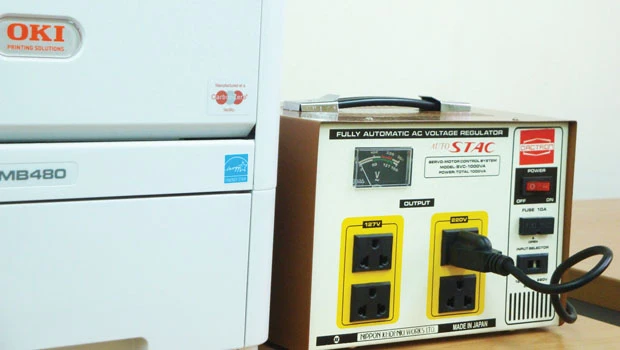
The smartest tactic to protect very expensive or sensitive equipment from electrical damage is to use automatic AC voltage stabilizers. Plug one side of the voltage stabilizer into the wall socket and the equipment plugs into sockets on the other side. Very large stabilizers may require that the equipment is directly wired to the stabilizer. It’s important to purchase a stabilizer that is large enough for the equipment it will protect. This is not simply based on the watts required for operation of the device. For instance, to connect a television or monitor to a stabilizer, the stabilizer must be more powerful that the watts indicated at the rear of the monitor or TV, because there’s a surge when the device is turned on. Don’t go cheap when buying stabilizers. I’ve used STAC branded stabilizers for decades. They cost about SR220 for 500 watts with the cost increasing with the wattage. Larger stabilizers, such as a 2000 watt model, which costs about SR620, are often a better value.
There is a move on to unify electrical power in Saudi Arabia in order to improve electricity delivery. In a report in Okaz, SEC’s CEO Ali S. Al-Barrak stated that a recommendation is before the Council of Ministers to require that all new buildings run 220 volt electricity alone. There will be no change for existing buildings because that would require too much expense.