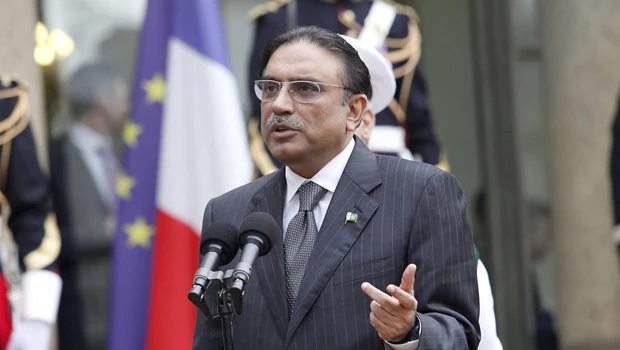
- LONDON: The US-led coalition's battle against the Taleban has already been lost because of its failure to win over the Afghan people, Pakistan's president warned Tuesday before tough talks this week with British Prime Minister David Cameron, who has accused the country of exporting terrorism.
President Asif Ali Zardari told the French daily Le Monde online that the coalition had “underestimated the situation on the ground and was not conscious of the scale of the problem” against the Taleban largely because “we have lost the battle to conquer the heart and soul” of the Afghan people. Long-term help — not just military reinforcements — was needed.
“To win the support of the Afghan population, we must bring them economic development and show that we cannot only change their lives, but above all improve them,” Zardari was quoted as saying.
Zardari is set to meet with Cameron on Friday. The talks have been overshadowed by Cameron's remarks last week that Pakistan had looked two ways in dealing with terrorists.
The visit of Zardari, the widower of Benazir Bhutto, comes amid growing concern that some elements in Pakistan's intelligence service and military have been sympathetic to militants — a claim supported in WikiLeaks, the self-described online whistle-blower that recently posted leaked US military documents alleging Pakistan's unwillingness to sever its historical ties to the Taleban.
“Pakistan and its people are the victims of the terrorists,” said Zardari, adding Britain and Pakistan needed unity — not division on the fight against terrorism.
Pakistan has lost some 2,500 of its security forces in the past few years during battles against insurgents.
Zardari denied allegations that elements in Pakistan were cooperating with the Taleban and said the WikiLeaks documents citing Pakistan predated his time as president.
Cameron's comments — made last week during his visit to Pakistan's nuclear rival, India — caused a diplomatic row.
Pakistan's intelligence chief Lt. Gen. Ahmed Shujaa Pasha called off a trip planned to London because of the dispute, while Britain's envoy to Pakistan was given a dressing-down in Islamabad. Dozens of protesters from the Shababe Milli group, meanwhile, burned an effigy of Cameron in Karachi over the weekend.
The Pakistani leader is also facing mounting criticism at home for his government's handling of deadly floods that have killed 1,500 people, some of the worst in recent history. Also marring the visit were a series of revenge attacks that killed at least 45 people in Karachi after the assassination of a prominent lawmaker.
One analyst said Zardari's decision to carry out the visit left him scratching his head.
“With all the floods, the shooting in Karachi ... David Cameron's comments, I can't imagine he's going to have very much positive to take home,” said Gareth Price, the head of the Asia program at London's Chatham House think tank.
“The politically astute move would seem to be to have canceled the whole trip to Europe and say: 'I need to be there’.”