
- WASHINGTON: US private employers added fewer workers to their payrolls in July than expected and hiring in June was much weaker than had been thought, a big blow to an already feeble economic recovery.
The dismal news on jobs poses a challenge to officials at the Federal Reserve who are debating whether more needs to be done to foster growth, as well as to Democrats hoping to retain their congressional majorities in November elections.
The Fed's policy-setting committee meets on Tuesday.
"The labor market improvement has slowed to a glacial pace, consistent with third-quarter growth even slower than the second," said Nigel Gault, chief US Economist at IHS Global Insight in Lexington Massachusetts. "It doesn't look like a double-dip, but it looks like very weak growth."
Overall non-farm payrolls fell 131,000 last month, the Labor Department said on Friday, the second straight monthly decline as temporary government jobs to conduct the decennial census dropped by 143,000.
Private employment, a better gauge of labor market health, rose a modest 71,000 after gaining just 31,000 in June. The government revised payrolls for May and June to show 97,000 fewer jobs than previously reported.
Financial markets had expected overall employment to fall 65,000 in July, with private-sector hiring increasing 90,000.
Given the poor state of the labor market, discouraged workers gave up the search for jobs in droves last month. That kept the jobless rate steady at 9.5 percent since people not looking for work are not counted as being in the labor force.
Job growth has taken a step back after fairly strong gains between February and April, putting in jeopardy the economy's recovery from its worst downturn since the 1930s.
Still, the pace of layoffs has moderated significantly from the first quarter of last year, when employers were culling an average of 752,000 jobs a month.
Growing unease over the health of the economy is weighing on President Barack Obama's popularity. Obama said on Friday pulling out of the recession would take time, but that he was encouraged the private sector continued to add jobs.
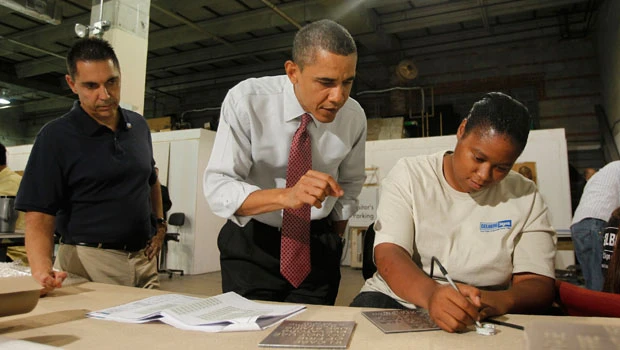
"The road to recovery doesn't follow a straight line," Obama told workers at a sign factory in Washington. "What we need to do is keep pushing forward, we can't go backward."
Republicans, who are hoping to deliver a major upset in November's elections, seized on the jobs report and said it was evidence the Obama administration's policies, including an $862 billion stimulus package, had failed to deliver results.
"Welcome to the reality of President Obama's broken promises, out-of-control spending sprees, and failing 'stimulus' policies," House of Representatives Republican leader John Boehner said.
The state of the labor market is also on the minds of policymakers at the Fed. Fed Chairman Ben Bernanke has said the US central bank could take steps to further ease monetary policy if the recovery were to falter.
There were positive elements in the report. The average workweek edged up to 34.2 hours after slipping to 34.1 hours in June, suggesting pressures to step up hiring were growing, and average hourly earnings increased by four cents to $22.59.
The dominant service sector added 38,000 jobs, but temporary help jobs, seen as a harbinger of permanent hiring, fell for the first time since September. Temporary employment gains had averaged 45,000 per month from October 2009 to May.