
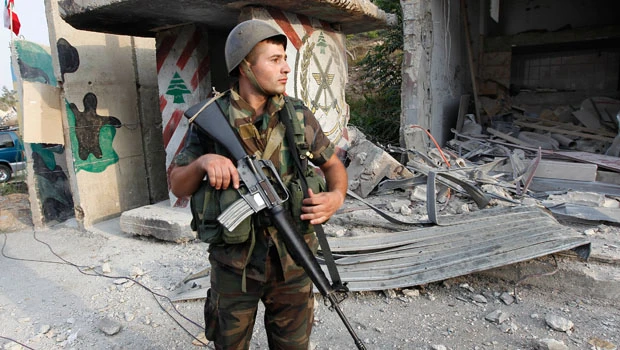
- BEIRUT: Lebanon criticized on Tuesday the US decision to suspend $100 million of military aid over concerns that Iranian-backed Hezbollah may have influence over the Arab country’s army and American-supplied weapons could be used to threaten neighboring Israel.
The cutoff renewed focus on the unusual power dynamics in Lebanon, where Hezbollah is the country’s most powerful military force, with an arsenal that far outweighs that of the Western-backed national army. The power balance has long worried the US and close ally Israel, which is Hezbollah’s sworn enemy.
The chairman of the US House Foreign Affairs Committee, Rep. Howard Berman, said on Monday he suspended the assistance to the Lebanese Armed Forces on Aug. 2. He said a deadly gunbattle between Israeli and Lebanese forces along their border last week — a day after the aid was suspended — reinforced his decision.
Though Lebanese officials and Hezbollah insisted the group was not involved, some critics in Israel and the US are charging that Hezbollah may have infiltrated the army. The Lebanese government said the cutoff was “unwarranted” and hurt American-backed efforts to build up its national army. For years, the US has pumped money into Lebanon’s military, hoping a strengthened army would extend state authority across the country and sideline Hezbollah.
“The last thing that the US or any other friend of Lebanon should do is to weaken the effort to build up our national army,” Mohamed Chatah, an adviser to Prime Minister Saad Hariri, said.
He added that government officials were contacting Washington “to make sure that there is a better and fuller understanding of the situation in Lebanon and along the border.” On the same day Congress announced its suspension in aid, US State Department spokesman P.J. Crowley defended the assistance.
“We have an extensive military cooperation program with Lebanon because it’s in our interest to have that program,” he said. “It allows the government of Lebanon to expand its sovereignty. We believe that is in the interest of both of our countries and regional stability as a whole.” Crowley said he was not aware of plans to reevaluate US military cooperation with Lebanon. However it is not unusual for members of Congress and the administration to differ on foreign policy issues.
Hezbollah has gained significant political power in Lebanon.
Lebanon’s government is now an uneasy coalition of a Western-backed bloc, headed by Hariri, and Hezbollah, which in just a few years has gained so much political power it now has a virtual veto over government decisions. Hariri’s bloc wants Hezbollah to disarm, but does not have the power to force its will.
There has long been debate over Hezbollah’s substantial arsenal.
The leader of Hezbollah has presented aerial reconnaissance footage that he said implicates Israel in the 2005 assassination of former Lebanese Prime Minister Rafik Hariri.
But Hassan Nasrallah, who has been in hiding since his group battled Israel in a monthlong 2006 war, acknowledged the material was not absolute proof.
“This is evidence, indications... that open new horizons for the investigations,” Nasrallah said at a press conference late Monday in which he spoke to reporters via satellite link.
The speech comes as pressure is mounting on Hezbollah over a Netherlands-based tribunal investigating Hariri’s assassination, which is set to issue indictments this year.
If Hezbollah is indicted, there are fears it could spark riots between the Sunni supporters of Hariri and followers of Hezbollah.
Israel swiftly dismissed Hezbollah’s allegations.
“Nasrallah’s accusations against Israel are ridiculous lies,” said Yossi Levy, a spokesman for Israel’s Foreign Ministry.
Hariri was killed in a truck bombing in 2005 that many in Lebanon blamed on Syria, which backs Hezbollah. Syria denies any involvement in the assassination.