- Born of dual heritage, a Palestinian father and an American mother, Elena Farsakh grew up in the US and in the Middle East.
- Five years ago she chose to reside in the ancestral home inherited by her father in the West Bank town of Bir Zeit, but the Israelis refused to grant her permission to remain.
Her unsure status has affected her photography and given her an even better understanding of the tragic Palestinian situation.
Farsakh was recently interviewed by Arab News. She is currently living with her parents in Virginia until her situation is resolved.
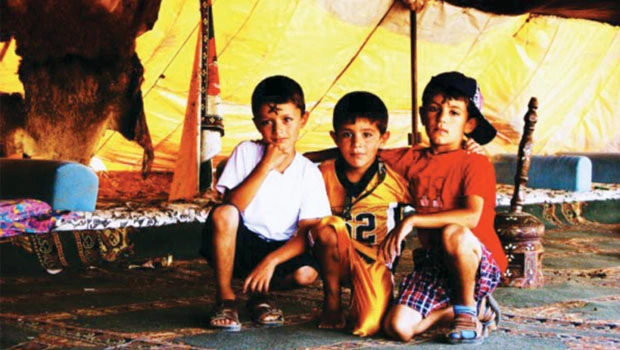
At a recent exhibition of her photos at the Washington-based Jerusalem Fund, entitled “Palestinians, Meanwhile…” the focus of Farsakh’s work is the current situation of the Palestinian people.
Like people everywhere, “They are going through the same things that everyone goes through in terms of work, falling in love, raising a family — the cycles of life.”
“But the Palestinians have the added burden — the occupation — that affects all aspects of their lives,” she said.
“The Israeli-imposed restrictions on movement prevent many people from residing with their loved ones in various areas of Palestine separated by arbitrary boundaries and checkpoints. The restrictions affect their work and the amount of time they can spend with their family and friends. You are at the mercy of the whims and moods of young soldiers who prevent you from going from one place to another.”
“It is difficult for outsiders to understand the kind of tension and insecurity that Palestinians live with on a daily basis.”
The Palestinians’ desire to lead normal lives combined with the trepidations and trials of the occupation, and the lack of attention to the Palestinian plight in the United States, is why she feels “Palestinians, Meanwhile…” was an appropriate title for her exhibition.
“Uncertainty clouds everything for everybody. One thinks there are things one can count on to have a somewhat regular routine. But to know that the likelihood is high that something is going to happen to you, and that it will probably happen because you’re living under a military occupation — is very stressful.”
Farsakh added that it is difficult for her to observe successive US administrations continuing to unconditionally support Israel’s policies toward the Palestinians.
“My father is Palestinian by birth, and a naturalized American citizen. My mother is an American who served the US government as a State Department Foreign Service officer, mainly in the Middle East. I am an American citizen by birth. I love America, but I find it painful that our foreign policy is detrimental to a large portion of my family as well as to American interests in the Middle East. “
She continues to be “frustrated, dismayed and angry” that the US government “still tries to insist that the Palestinians are always more at fault than the Israelis” when it comes to apportioning blame for an unending cycle of violence in Israel/Palestine.
An example of lack of objectivity and essential fairness is the settlement issue, said Farsakh, “as Israeli governments for decades have continued to create ‘facts on the ground’ on illegally seized Palestinian land, in clear violation of international law.
“The illegal settlement expansions and construction of new settlements, settler rampages, continuing siege of Gaza, random arrests and shootings and general lack of rule of law in the West Bank, lack of freedom of movement, and the fact that many Palestinians can’t even go to the sea or to their capital — Jerusalem…” All, she said, have a terrible effect on the Palestinian psyche.
Farsakh’s ire is also focused on the mainstream US media for creating a “news blackout here that doesn’t allow information on what is really going on over there to enable Americans to form their own judgments.
“I think Americans are very aware that they’re not being told everything, and that they don’t really understand these issues. They’re given one side, and that’s always the side that favors Israel. This ultimately does not serve American interests or Israeli interests, and certainly not Palestinian interests.
“A prime objective of my photos is to show Palestinians as they really are, as human beings, and not the often distorted images that are usually presented here in the US,” said Farsakh.
Asked about constant themes in her photography, Farsakh said: “I usually shoot what moves me. I love taking photos of people — capturing emotions that reveal our common humanity.”