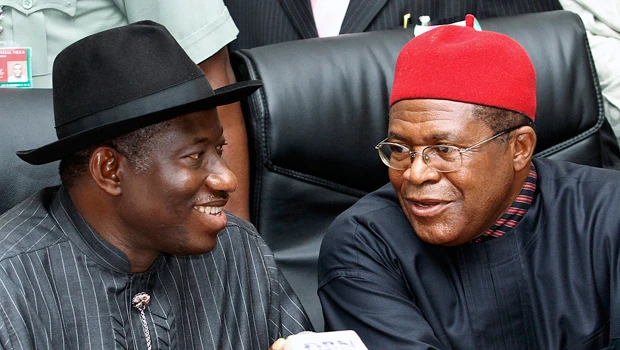
- ABUJA: The chairman of Nigeria's ruling People's Democratic Party (PDP) said on Thursday President Goodluck Jonathan had the right to contest elections due next January but stopped short of giving him outright backing.
Jonathan would need the support of his party if he is to be sure of success in the polls because of a "zoning" agreement within the PDP that says presidential terms should rotate between the Muslim north and Christian south every two terms.
Jonathan, from the southern Niger Delta, inherited the presidency when northern President Umaru Yar'Adua died this year part way through his first term.
"We did not envisage that our dear president (Yar'Adua) would die in office," PDP chairman Okwesilieze Nwodo told reporters ahead of a meeting of senior party officials with Jonathan in the capital Abuja.
"The party believes that Dr Goodluck Jonathan as part and parcel of the joint ticket has the right to contest the presidential primaries for the 2010 elections, but this would not preclude anyone in the party from contesting," Nwodo said.
A bid by Jonathan could lead to protests from some factions in the north, but his failure to stand could cause unrest in the Niger Delta, the heartland of Africa's biggest oil and gas industry, and threaten a year-old amnesty for militants.
Nobody wants to be first to declare their hand.
Should Jonathan rule himself out of the race, his power would quickly wane as state governors, ministers and parliamentarians seek to align themselves with other candidates.
Should he declare he will take part too early, rival contenders within the PDP and in other parties would have more time to mobilise and gain support.
Sources close to Jonathan say he is concerned about the implications of abandoning zoning and about his own credibility as a candidate in polls he has pledged to make free and fair.
POKER GAME
In opening remarks to the meeting, Jonathan noted some of the public figures who have weighed in on the zoning debate were from outside the PDP, suggesting they had little confidence in their own parties' abilities to field a successful candidate.
"Zoning or not zoning is a PDP primaries affair," he said.
"But the debate is even more spearheaded by non-PDP members, which means they have already conceded the presidency to us ... They are saying we know you will produce the president of this country, but do it well," he said.
The PDP nominee has won all three presidential races since the end of military rule a decade ago, making the outcome of past elections a foregone conclusion and turning Africa's most populous nation into a virtual one-party state.
Although the commercial hub Lagos and northern state of Kano, home to Nigeria's two biggest cities, are opposition strongholds, the PDP has a strong majority in both houses of parliament and holds over three quarters of Nigeria's 36 states.
Jonathan has support from state governors — who form a powerful caucus in the PDP — in the south and the central Middle Belt, where the backbone of the army are from. But northern Muslim governors have acknowledged his right to stand while stopping short of endorsing him.