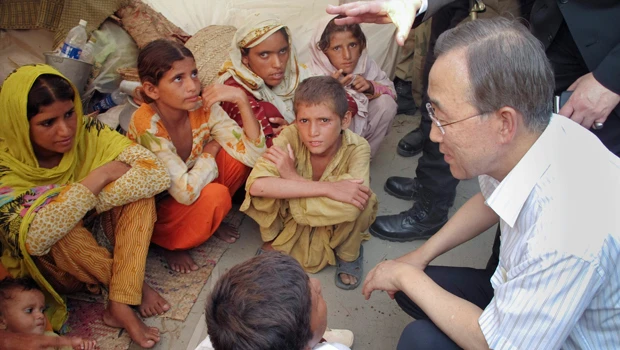
- ISLAMABAD: UN Secretary-General Ban Ki-moon said Sunday the flooding in Pakistan was the worst disaster he had ever seen, and urged foreign donors to speed up assistance to the 20 million people affected.
“This has been a heart-wrenching day for me,” Ban said after flying over the hard-hit areas with President Asif Ali Zardari. “I will never forget the destruction and suffering I have witnessed today. In the past I have witnessed many natural disasters around the world, but nothing like this.”
The floods began more than two weeks ago in the mountainous northwest and have now hit about one-quarter of the country, especially its agricultural heartland. While the death toll of 1,500 is relatively small, the scale of the flooding and number of people whose lives have been disrupted is staggering.
The world body has appealed for an initial $460 million to provide relief, but only 20 percent has been given.
Once the floods recede, billions more will be needed for reconstruction and getting people back to work in the already-poor nation of 170 million people. The International Monetary Fund has warned the floods could dent economic growth and fuel inflation.
“Waves of flood must be met with waves of support from the world,” said Ban. “I'm here to urge the world to step up assistance,” he said.
Ban said visa restrictions had been eased for humanitarian workers and they now could get visas on arrival at Pakistani airports.
On Saturday, the prime minister said 20 million people had been made homeless in the disaster. Ban said one out of 10 Pakistanis had been directly or indirectly affected.
The monsoon rains that triggered the disaster are forecast to fall for several more weeks, meaning the worst may not yet be over. Over the weekend, tens of thousand of people were forced to flee their homes when they were inundated by fresh floods from the swollen Indus River.
While local charities and international agencies have helped hundreds of thousands of people with food, water, shelter and medical treatment, the scale of the disaster has meant that many millions have received little or no assistance. The UN has voiced fears that disease in overcrowded and unsanitary relief camps may yet cause more deaths.
Earlier Sunday, survivors fought over food being handed out from a relief vehicle close to the town of Sukkur in Sindh province, ripping at each other's clothes and causing such chaos that the distribution had to be abandoned, according to an Associated Press reporter at the scene.
“The impatience of the people has deprived us of the little food that had come,” said Shaukat Ali, a flood victim waiting for food.
Waters five feet deep washed through Derra Allah Yar, a city of 300,000 people on the border of Sindh and Balochistan provinces, said government official Salim Khoso. About 200,000 had fled the city and Khoso said he did not know how they would be fed.