- A young, bohemian artist sits at a café overlooking downtown.
- His arms folded on the table, a striking tattoo on his upper arm reveals itself: A swarm of flies.
While the refugee schools were always filled with art books and supplies, there was no art teacher. “It’s important to teach the children art, especially refugees,” said Khorma. He describes his childhood in the camp, saying, “life was very hard and the children didn’t know anything about life outside the camp or the history of art, like Da Vinci, Picasso or Renoir.” When Khorma was older, he informed the head office in Amman about the situation in the camps and a certified art teacher was hired. He explains that the children should be given cultural material and be taken care of. “And maybe some day,” he continued, “one of them will become an artist.”
When Khorma was studying art at university, he visited different refugee camps in Jordan, giving free workshops to the children. “[They] have a lot of potential,” he noted, “they cannot express themselves by stories or talking. But they can express themselves by painting. Art is therapy. It makes humans more open and relaxed. It gives you another dimension of life, other than war. Without art, the world would be black and white. It would be a very scary world.”
Khorma recalls when he first wanted to be an artist. He was 12-year-old, walking down the street with his mother when he noticed an old Iraqi man making portraits. Intrigued by the man’s fine talent, he asked what he was doing. The man responded, simply saying, “this is how I live.” It was at this moment that Khorma realized he could make a living off his art.
“There is art in everything,” Khorma says. “If you really love art, you should do it. Your life is your life. You have an independent name and an independent body and an independent life. Don’t only think of how you can make money. There is art in everything.”
He has exhibited his work in Beirut, Cairo and galleries throughout Amman.
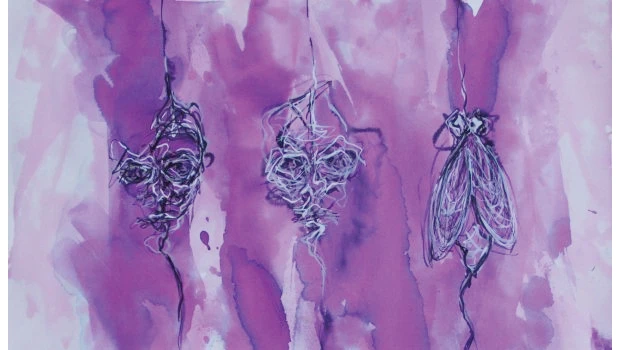
Khorma views flies as a symbol of freedom, explaining that, “they don’t care about who you are or what you were in the past.”
Questions of identity and self-purpose are still unanswered for the young artist, but in painting, he begins to slowly understand them.
In a way, Khorma has experienced his own metamorphosis. He has risen above the life that was given to him. He has created his own reality.
“This is part of my experience as a refugee,” he says.
An old proverb reads, “A fly may conquer a lion.”
Perhaps from within a small refugee camp in Irbid, Jordan, the next Picasso will emerge, or perhaps merely a bold message of perseverance.
“Flies are always moving,” Khorma stated, “they are enjoying the short life they live. I’m trying to use my life to the max, using every moment.”