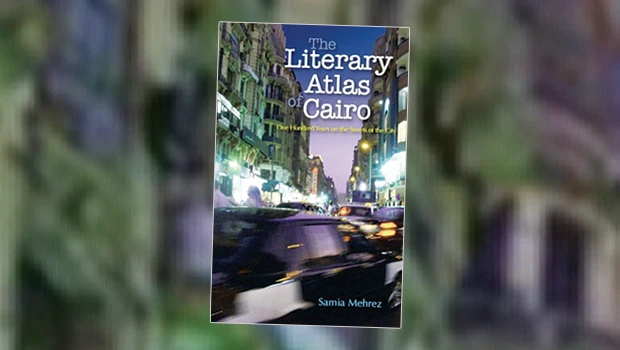
- This book is based on an academic paper: “Emerging Urban Metaphors in the Literary Production on Contemporary Cairo”.
- However, the author, professor of Arabic literature at the American University in Cairo, acknowledges that it was inspired by a nagging apprehension linked to a great extent with the ever-approaching date of the relocation of the American University in Cairo to its present location in New Cairo.
“The old campus witnessed my student years at AUC as well as 18 years of my professional life in the institution. This imminent displacement from the city of my childhood, school years, social life, and professional growth, not to mention emotional attachments and a lifetime of memories, all brought forth a surge of sudden desire to try to capture this ever-expanding space all at once before I was uprooted from it, so to speak.”
Moved by past recollections and being the witness of the American University in Cairo’s historic move, Mehrez is deeply aware of the relationship between a writer and a place. The writers who have described Cairo, can be seen as “architects of its history. Their literary works reconstruct and re-map the city” which ‘’becomes a text that is constantly rewritten.”
This “Literary Atlas of Cairo” is not a collection of maps but rather the overall plan that has been drawn from the literature presented in this book. It begins with a “Prelude” in the company of Naguib Mahfouz which sets the tone of the book. Mahfouz has brought to life, Cairo, Mother of Cities, with a talent that earned him the Nobel Prize in literature. His descriptions of Old Cairo are so effective, they appear to jump out of the book. Mahfouz has a genial way of depicting life in Old Cairo: He transcends the local and touches the universal. In the following excerpt, (Khan Al-Khalili, Cairo AUC Press, 2008) Mahfouz takes us to the heart of Khan Al-Khalili, the largest medieval urban center in the world: “All around him he spotted cafes teeming with customers and the occasional store, some selling taamiya, others jewelry and trinkets. And there were hordes of people, a never-ending flow, some wearing turbans, others fezzes, and still others skullcaps. The air was filled with shouts, yells, and screams, all of them guaranteed to shatter the nerves of someone like himself… The atmosphere of the place was enveloped in a brownish haze, as though the entire quarter never saw the sun’s rays. The reason was that in many places the sky was blocked by overhanging balconies. The various craftsmen sat in front of their stalls, patiently and skillfully plying their trade and producing little masterpieces; the ancient quarter still preserved its long-standing reputation as a place where the human hand could make exquisite crafts. It had managed to withstand the influx of modern civilization and to confront the insane pace with its own calming wisdom; its simple skills stood counter to complex technologies, its reverie of imagination to an uncouth realism, and its drowsy ochre hue to the gleaming brilliance of modernity.”
The atmosphere in the Khan Al-Khalili is still the same apart from the fezzes which nobody wears these days. If it were not for the ubiquitous mobile phones and the odd cars squeezing through the narrow alleys with much difficulty, one could easily imagine oneself in another age. A visit to Cairo is a journey through time, a taste of living history.
Youssef Idris has also been counted as a ‘literary architect’ whose works contribute to the mapping of Cairo. He was expecting to win the Nobel Prize for Literature and was bitterly disappointed when it was justly awarded to Naguib Mahfouz. Unlike Mahfouz who wrote mainly novels, Yusuf Idris specialized in short stories, a genre he excelled at but which is not as popular as the novel. Samia Mehrez has rightfully included in The Literary Atlas, this picturesque description of a Cairene traffic jam:
“At the bridgehead they are joined by streams of cars pouring from Zamalek, Gezira, Dokki, and Giza. Bright, colorful, shining, like flocks of birds… At Ataba it becomes one great merry-go-round. Automobiles and buses and tram cars and pedestrians and horse-drawn carts mill around in utter chaos. It reaches a peak when they turn in Al-Azhar Street. Here, it is a madhouse of pedestrians and automobiles, screeching wheels, howling klaxons, the whistles of bus conductors, and roaring motors… The roads and pavements are a moving mass of flesh. Everything is wholesale. Riding a vehicle, trading, and even accidents come wholesale.”
Traffic jams are a mainstay in Cairo and the massive exodus to the outskirts of the city has only worsened the problem. Getting around Cairo is a hassle no one can escape from. The difficulties of moving around have forged the Cairenes’character and it has also “determined their relationship with the city” according to Samira Mehrez who is not surprised that, “so much creative energy has gone into representing everyday life as it unfolds on the move in Cairo.”
This is certainly very true and there is no better proof than “Taxi” an instant best seller when it was published four years ago. The author Khaled Al-Khamissi is one of Egypt’s leading intellectuals of the new generation. “Taxi” is a brilliant analysis of life in Egypt seen through the conversations between a taxi driver and his customers. It is so well written that many believe the dialogues are real conversations. Al-Khamissi asserts that Taxi is reality fiction and all the conversations are the fruit of his imagination.
The selection of writers also includes Ahmed Alaidy, another writer who is part of Egypt’s new generation of writers. Like Al-Khamissi, he is innovative. His first novel, Being Abbas El-Abd (AUC Press, 2006) expresses the deep frustration and hardships endured by young Egyptians in their everyday lives. It is powerful, outrageous, and a formidable testimony of a generation in limbo.
Many of the scenes in Being Abbas El-Abd, take place in shopping centers which have become “the symbolic site for the city’s new and contested social mores: The mall as a haven for anonymity and the freedom of human relations”. The mall is the new public space replacing the old cinemas, so popular during the golden age of Egyptian cinema. During a taxi ride, Khaled Al-Khamissi, hears a driver moaning about the cost of going to the expensive cinemas mostly situated in malls and that he’s had his time and “now”, he says: “It’s the kids’ turn. They’ve never been to the cinema or the theater, and they never will. They watch satellite TV at the coffee shop downstairs, God help them. Personally, I don’t know what will grow in their brains, other than cactus.”
This last sentence is typical Egyptian humor. Despite their hardships, Cairenes, from all walks of life, always find a way to laugh about their misfortunes. The most moving part of this Literary Atlas is “Private Spaces” which takes us into the heart of people’s lives from the urban poor living on the roofs of the high rise buildings to the privileged elite of a bygone age.
Prince Hassan Hassan (In the House of Muhammad Ali. Cairo AUC Press, 2000), takes us on a visit to Muhammad Ali’s Palace in Shubra which was then considered ‘a world apart’. This area is now a far cry from the fields where lurked wolves, foxes and jackals. Once a beautiful area, Shubra is now popular and overcrowded.
Cairo’s sprawling growth has transformed the city into one of the world’s largest, historic, multicultural urban centers. Writers throughout Cairo’s history have described these changes. Gamal Al-Ghitani, one of Egypt’s major writers has often expressed in his works, especially in Pyramid Texts (Cairo: AUC Press, 2007) the relationship between writers and their surroundings:
“Fundamentally, writing is linked to a specific place, the history and past of this place, and the spirit of this place. To be interested in time, and the passage of time, is to be interested in a specific place as well. For space and time are indissolubly tied. Place contains time… It is for this reason that the relationship between a writer and a place is very important, because place implies time, history, society and human relations.”
Due to the exceptional amount of material available on the relationship between literature and geography, a second volume, “The Literary Life of Cairo”, will be published. It will draw “the reader into the complex network of socioeconomic and cultural lives in the city across that literary geography,” the author explains.
Samia Mehrez has dedicated, “The Literary Atlas of Cairo, One Hundred Years on the Streets of the City,” to Cairo and her authors but I believe it is definitely meant for all those who love Cairo despite its shortcomings. Cairo is overcrowded, noisy, choked with traffic but, unlike other mega-cities, it has retained its soul.