
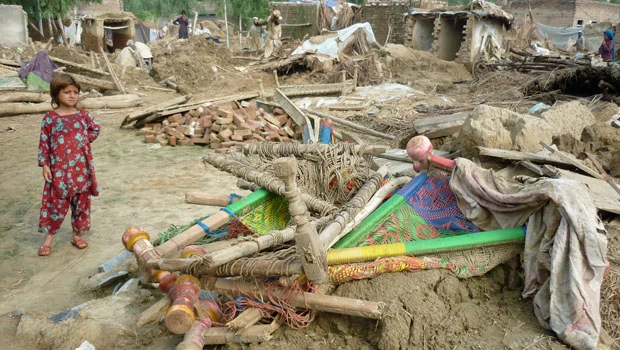
- Floods leave behind trail of death and destruction across Pakistan
MARDAN, Pakistan: As raging torrents of mud water continue to swallow swaths of Sindh, Shakako, 45, huddles close to her daughters at a refugee camp in Charsadda, where the waters have receded, leaving behind death and devastation.
“I thought we were going to die, I prayed we die quickly, I saw people’s heads disappear under the water, we ran to the roof, people were screaming, crying, begging for help, we waited three days for help without food, we drank the dirty water, (our village) Zarinabad was destroyed,” she says, sobbing as she forces the words out. “We have nothing to go back to.”
Sardar Khan, who runs the refugee camp Shakako’s family fled to, says, “Everywhere our team goes, all we see is tabahi (destruction), this is worse than anything we have ever handled, during the Swat conflict at least the refugees had shoes and clothes, these people have nothing.”
As bloated rivers burst their banks, local landlords Farooq Toru and Shakeela Farooq went to work tirelessly to restore a sense of normalcy to Khorabad, where 350 of its 400 mud and wood homes have been turned to a mixture of sludge and debris.
Roofs have collapsed, walls dissolved, bedding and clothes turned into ragged mush. Families are sleeping on the plots of their destroyed homes, sectioning off sites with a patchwork of drenched blankets, sacks and cardboard to create screens to maintain purdah (veil) for the women in the family.
Idris, Ataullah and Amanullah are sleeping in the open on a plot dotted with pools of mosquito-infested greenish black water for a different reason.
“We have to protect this land, it’s our home,” says Amanullah, 15, pointing to the slushy land. “We are poor now, if we lose this, we are finished.”
Shakeela Farooq walks from house to house, surveying the damage and counting the children: “There is no water to drink, the children are falling sick, they have skin disease because they have only one pair of clothes, eye infections, diarrhea, cholera.”
Toru is standing in the scorching midday sun, trying to make sure every family get their share of food: 1,630 rupees worth of flour, oil, dry milk, pulses, tea, sugar and rice. The tension is palpable, men begin to jostle, tempers flare and a fight breaks out.
“If you had to watch your family starve, anyone would turn aggressive,” he says after calming the crowd. A few days ago, Toru’s team handed each family head tokens with his stamp on it. Every time they get rations, he punches their card, and their name is checked off a list.
One-fifth of the country is underwater and 20 million people have been displaced, and 2,000 are dead, according to the UN. The price of tents has skyrocketed, leaving refugees exposed to the punishing glare of the sun, with mosquitoes tearing at their skin as the day gives way to night. Aid workers are exhausted and resources are stretched.
“We are at a breaking point, the tide of refugees just keeps growing, we are lucky that individual citizens have donated so much food and money, we need a coordinated government response,” says one frustrated aid worker.
On both sides of the Sardaryab bridge, where the Kabul River burst its banks, uprooted trees and mangled beds mark the path of floodwater. Buffaloes lie rotting by the roadside, sugar cane and tobacco crops are covered in layers of mud and rubbish, and roads have been ripped off the earth.
Rain continued to reinforce the floodwater rushing south across Sindh and Balochistan. In Sindh, retired Justice Fakharuddin Ebrahim visited flooded areas with a group of citizens who returned from their fact-finding mission “with the feeling that unless we citizens put our shoulders together to create a massive relief effort, the misery and suffering of millions would be compounded...”
Within days they had come together as Aitemaad Pakistan Trust, established base camps in Khairpur and Shikarpur, and begun moving toward their target of providing 6,000 families with meals for a month by sending out their first two trucks loaded with 850 dry ration bags each. Their dispatch manager is constantly on the phone, sourcing 4,000 mosquito coils one minute, answering donors’ queries the next.
A similar scenario plays out up north at the Toru home in Surkh Deri, near Khorabad in Khyber Pakhtoonkhwa. Toru loads a borrowed truck with 3,000 one-liter water bottles while Shakeela Farooq staffs the phone arranging for clean clothing with which she hopes to combat the spread of skin disease. The Toru family runs a school called The Center for Speech and Hearing, where the poorest of deaf children learn to recognize sounds and interact with the hearing. A week after Khyber Pukhtoonkhwa felt the vicious force of the floodwater, 25 of their 50 students are still missing.
“It’s the Nowshera kids, no way to reach them, we have tried every phone, every relative, no one answers,” says the head teacher.
Toru decided to answer a distress call from his sister who is managing a relief operation in Swat. Hundreds of men are trekking 25 hours over steep, treacherous mountain paths to Miadam from the worst flood-hit villages in Kalaam to ask for aid because their families are stranded without hope of being airlifted.
“I went with 150 bags of dry ration but more men showed up than bags, I was saddened to see them turn back with nothing, some of them elderly men,” he said. “We will return with more food rations.”
The Swatis are among 800,000 flood victims across Pakistan that the UN warns are still unreachable by road.
The Center for Speech and Hearing has launched relief operations in three villages near Mardan, Khyber Pukhtoonkhwa.
Donations can be made to the Center for Speech and Hearing, Account no. 425-4, United Bank Limited, Sheikh Maltoon Branch, Mardan Bank zipcode: 1409.
Aitemaad Pakistan Trust has mobilized the masses to provide food and shelter for Sindh’s refugees. It’s an ambitious, large-scale relief operation that deserves all the help it can get.
For donation: Aitemaad Pakistan Trust, Account No: 0107-036-1914 Swift: MEZNPKKA Meezan Bank, Clifton, Karachi.