- MAKKAH: During the holy month of Ramadan, while most people in the Kingdom are keen to have their iftar meals with their family members and relatives, there is a group of people who must be ready to swing into action at any moment.
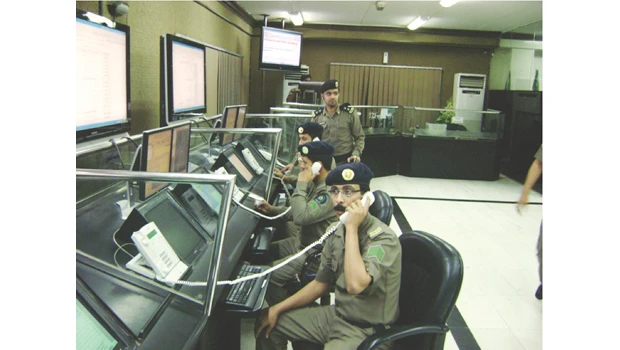
Civil Defense officers are monitoring distress calls and attending emergencies round the clock, even while finishing their simple iftar meal that often consists of a handful of dates and a cup of Arabic coffee.
Arab News visited the Civil Defense operation room in Makkah and joined in their modest iftar party.
“A few years ago, while breaking our fast, we received a call from a citizen. Trapped in the middle of a burning house, he was crying and begging for help, asking us to rescue him and his family,” Deputy Sgt. Abdul Rahman Al-Matrafi told Arab News.
He added that they expect such calls at any time and are ready to act immediately.
“The nature of our duty demands full alertness to safeguard the lives and properties of people. We prefer the safety of citizens to our pleasures and desires,” he said.
“What distinguishes our duty is that it is also a humanitarian mission. We are keen to perform our duty in the best manner and are attending calls even at iftar,” he said. Al-Matrafi, who is married, said there is nothing that upsets him and his colleagues even though they remain
away from their wives and children.
Deputy Sgt. Saad Al-Sharif has been working in the operation room for over seven years.
“I am married and have children. I never get an opportunity to break my fast with my family,” he said.
“I have no regrets as I feel happy to win rewards from Allah by serving the country and people during the holy month. Moreover, I see risking our life for the sake of public safety as a great religious duty.”
Saad recalls that iftar was always a simple affair, usually a handful of dates and a cup of Arabic coffee.
“But sometimes, we do not have time to eat or drink because of an increase in the frequency of calls. When we receive information about an emergency situation, we do our best to dispatch firefighting and rescue units to the scene immediately,” he said.
“For this, we do coordination work with Civil Defense units in the vicinity.”
He added that it was painful for them to find out about fatalities during iftar.
Molhi Al-Robai has also been working with the Civil Defense for seven years and says it is rare for him to have an iftar meal with his family.
“One day during Ramadan, I could take my iftar meal only at 10.30 p.m. because I was so busy at work,” he said.
Yasir Al-Nimri, a new recruit in the operation room, enjoys his work.
“We have a feeling of accomplishment when we help our people and nation, in addition to the fact that we are performing a religious duty. It gives us happiness when we attend to distress calls and help victims,” he said.
He added that Civil Defense workers in the operation room sometimes get no time to offer prayers on time because of the frequency of emergency calls.
“During Ramadan, we have been forced to delay our Isha prayers often,” he said.