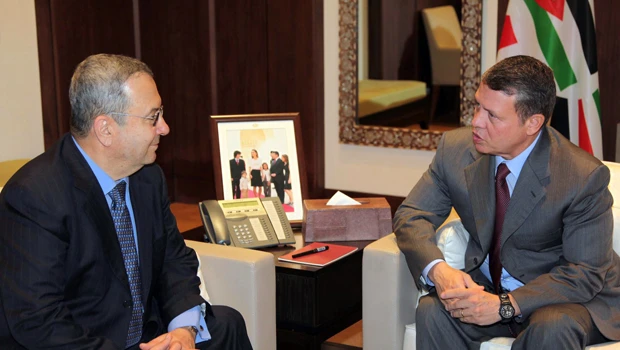
- AMMAN: Jordan's King Abdallah, who met Israel's defense minister on Sunday, said success in Israeli-Palestinian peace talks will depend on speedy progress before extremism returns to center stage.
"I don't think we should put a one-year target date," Abdallah said in an interview with Israel's TV1 late on Saturday ahead of the direct talks being relaunched in Washington this week.
"I believe words coming out of the United States is within one year (for a two-state settlement). Why wait for one year? The longer we wait, the more we give people a chance to create violence," he said.
After the opening in Washington on Wednesday, attended by Abdallah and Egypt's President Hosni Mubarak, Israeli Prime Minister Benjamin Netanyahu and Palestinian leader Mahmoud Abbas are to launch direct talks the following day.
"It is the willingness of the leaders on the second day to really solve this problem, which is going to be the deciding factor of how the Middle East is going to shape itself over the next 10 years," said Abdallah.
A senior Jordanian official, meanwhile, said his country and Egypt, the only two Arab states to have signed peace treaties with Israel, are "cautiously optimistic, because historically such meetings have led to no success."
On Netanyahu, the official said the Israeli leader "does not want to commit to anything but he says he is in a hurry and would like to finalize it all in six months."
Jordan's advice to Abbas was: "Try to be positive. Don't say 'no,' you can say 'yes, but'."
On Sunday, Abdallah told Barak that the negotiations "should be dealt with in a serious way," the palace said. Middle East peace was "of strategic interest for the region and the world."
Ahead of the talks, Israeli Prime Minister Benjamin Netanyahu restated Sunday what he said were essential components of a peace agreement, chief among them recognition of Israel as the Jewish homeland.
Speaking to reporters at the start of the weekly Cabinet meeting, Netanyahu said an agreement would have to be based "first of all on recognition of Israel as the national state of the Jewish people, an end to the conflict and an end to further demands on Israel."
The Palestinians object to endorsing Israel as essentially Jewish as that would imply dropping their claim that Palestinian refugees should be able to reclaim former homes now within Israel.