
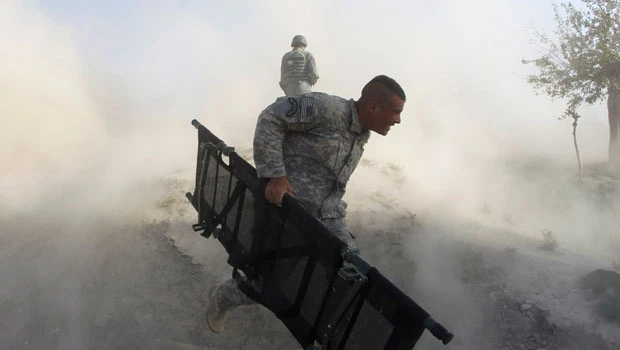
- KABUL: Seven American service members were killed Monday in two separate roadside bomb attacks in southern Afghanistan, NATO said.
No details were given of the attacks, although eyewitnesses in the southern city of Kandahar said an armored US Army Humvee hit a roadside bomb in the early afternoon. Several bodies were seen being removed from the vehicle, which was engulfed in fire after the blast.
The deaths bring to 14 the number of US soldiers killed in action in eastern and southern Afghanistan over the past three days.
A spike in US troop numbers in Afghanistan to over 120,000 has brought increased contact with insurgents and a rising death toll. Forty-nine US service members have died in Afghanistan this month, still fewer than the 66 killed in July.
Later Monday evening, a pair of rockets were fired at the Kandahar offices of the United Nations mission in Afghanistan, said a police officer. One fell short and slightly wounded a guard at the compound gate, while another missed entirely and landed in an empty field.
To the east in Nangarhar province, the head of Lal Pur district, Syed Mohammad Palawan, was killed when a bomb planted on his vehicle exploded as he was driving into a government compound to attend a meeting of provincial security and political leaders, said police spokesman Ghafour Khan.
Insurgents apparently planned for the bomb to explode inside the compound in the provincial capital Jalalabad where it could potentially have caused far greater destruction, Khan said.
Three of Palawan's bodyguards were wounded, Khan said, while the Interior Ministry put the figure at five.
The attack followed a failed assault on two coalition bases in nearby Khost province Saturday, in which more than 30 insurgents were killed. The attacks indicate that militant activity is rising in parts of the east, as coalition forces focus resources on Kandahar and other Taleban strongholds in the south.
Security in eastern Afghanistan is critical because the region includes the capital, Kabul, which the insurgents have sought to surround and isolate from the rest of the country. Jalalabad also lies just 55 km west of the Pakistan border, where militants maintain safe havens from which to plan attacks and infiltrate foreign fighters linked to Al-Qaeda across the rugged mountains.
Shutting down such sanctuaries has been a key demand of the government of President Hamid Karzai, who on Saturday renewed his criticism of coalition strategy in fighting Afghanistan's stubborn insurgency — part of a pattern of greater outspokenness by the Afghan leader as he appeals for support among the beleaguered Afghan public.