
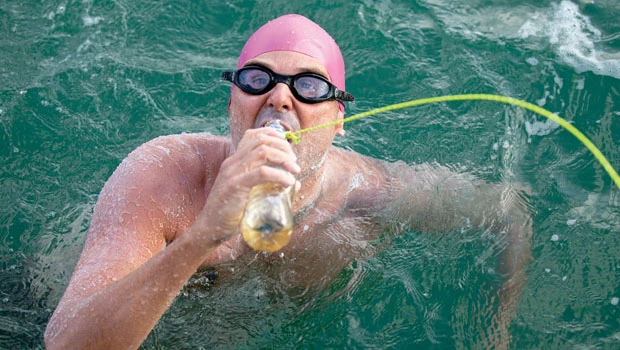
- Fourteen hours and one minute after entering the chilly waters of the English Channel off a shingle beach in Dover, Dubai resident Scott Ragsdale’s feet finally touched the rocks on the French shore at Cap Griz Nes.
That feat gained him entry into the exclusive club of fewer than 900 swimmers since Captain Matthew Webb — the first who made the crossing successfully in 1875 — and places him in the 20 percent or so who have completed the swim having started it. To put it in proportion, over 4,000 climbers have achieved the summit of Everest since 1953.
It was a decidedly tired Ragsdale — normally an ebullient and intensely focused man — who spoke to Arab News after a night’s rest. “I feel dreadful today but tomorrow I am sure I shall feel alright,” he said. “However, it’s my shoulder I am concerned about. I feel I have completely destroyed my right arm.”
He described the symptoms as similar to “tennis elbow” () brought on by the repetitive strain of the swim. “There were times I could barely move it, there were times I was swimming breast-stroke, back stroke, anything to get through that current.”
Despite his Ironman exploits and extensive training swims in the Mediterranean, Ragsdale admitted that this, his longest swim, held an unexpected challenge. “I was prepared for the cold mentally, but I didn’t anticipate the massive waves and the choppiness of the sea. I was swimming in waves that were crashing down on me.”
He said that he could not concentrate because the waves were so high. “I’d look at the boat and I would be above it. The captain told me at the end that had he known it was like this we would not have been able to go. It was wind force four for the last three hours — it was massive.”
He said that it took all his mental reserves to keep plowing on knowing that for much of the time he was not making any forward progress at all but simply maintaining position. “That was just miserable. I didn’t prepare myself for that.”
Ragsdale noted that a particular feature of a channel swim is that the swimmer cannot stop. The rules of the swim state that he cannot touch the support boat at all, and to add to this, any stopping results in being pulled off course by current or wave action.
“So it’s 14 hours of nonstop effort, whereas in the Ironman challenge there are changes in discipline and opportunities to stop.” He emphasized that if he stopped in the channel, even for 15 seconds or so, he started to get very cold.
To counter the effects of dehydration and replenish energy levels, Ragsdale was regularly fed with high-energy drinks, hot water and even flat Coca-Cola either thrown to him in bottles or floated out on a small boat attached to the support vessel by a string.
While the effort of swimming drained physical reserves, equally important was the demand placed on Ragsdale’s mental reserves. He confided that the crew had, in the interests of sustaining him, provided constant vital encouragement and had not been entirely accurate in the latter parts of the swim, namely in their estimate of his distance from the French shore.
“They kept on shouting at me ‘One more hour, one more hour,’ but in truth I had eight hours left. It helped though. That played a big part, I just kept going.” He had not seen the actual course he took when we spoke, but a NE/SW current that took hold of him at about the half way point, dragged Ragsdale south west and necessitated him having to swim a huge ‘U’ shaped course for the final nine hours. For much of that he was swimming parallel to the coast attempting to get onto the north side of Cap Griz Nes. If he had not made that, he would have had to abort the attempt, as the current would have pulled out toward the open Atlantic.
Although about as tough as they come mentally, Ragsdale confided that he had had a moment of doubt when he arrived in Dover. “I had trained in the warm Mediterranean, but when I arrived here, it was freezing! I thought ‘How am I ever going to swim in that?’”
Once under way, he said that he felt “pretty good” for the first six hours and the crew relayed supportive information about times and position. A swimmer, just a couple of days earlier, had completed in 9 hours 25 minutes and Ragsdale was well on course to match this until he hit the mid-channel current.
Eventually the French coast came into view a few kilometers away. “I could see it but I wasn’t swimming towards it. I had to swim into the current to get north of the landing point.”
He said that he estimated from his training experience that it was three hours away by swimming, but after having asked his position every half hour for three hours and with the coast no nearer, he was getting “a little bit concerned.”
Eventually and with 800 meters to go, Ragsdale made a final burst for the shore. Initially, it seemed that he was making no progress towards it, but the sure knowledge that he would have to abort the swim if he missed the landing point on the cape spurred him on for the final 30 minutes. “Then, I saw the bottom and realized I had made it!”
Although a super-fit athlete, surprisingly to many, Ragsdale is also a vegan. “It makes me feel so much better physically,” he said.
To prepare for his swim however, he needed to gain fat as insulation and trained on a high carbohydrate and fat diet and confided that he had also started the first day of recovery with a vast non-vegan and very traditional English breakfast.
I could not resist asking him what the next challenge might be perhaps expecting that he might be done with challenges for now.
“Not a swim. A marathon across the Amazon rainforest.”
Silly question.