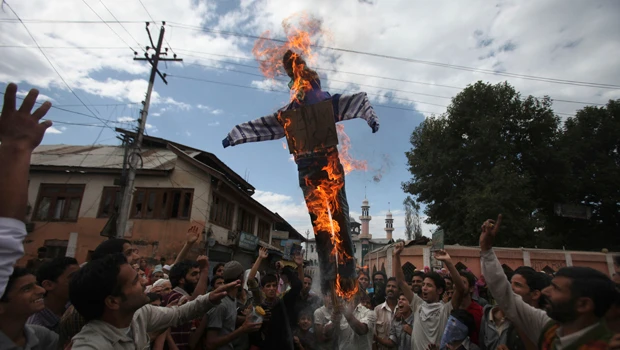
- SRINAGAR: Eighteen civilians were killed and 80 others wounded across Kashmir in a day of escalated violence intensified by anger over the desecration of the Holy Qur’an in US.
- A police officer was also killed during protests in Budgam after he was hit by a vehicle that then sped away.
The day also saw gutting of two Christian missionary schools, several government buildings and two police vehicles by the irate mobs.
Highly charged mobs took to the streets early morning on Monday defying a round-the-clock curfew to stage massive pro-freedom and anti-US protests leading to fierce daylong clashes with Indian security forces.
People were inflamed after the Iranian state-run channel Press TV broadcast images of a small group of Christians ripping a copy of the Holy Book in Washington. Authorities quickly banned Press TV.
The protesters chanted “Down with Qur’an desecrators,” and protest leaders denounced the desecration in speeches to the crowds. There were also shouts of “Down with America” and “Down with Israel” -- rarely heard in Kashmir, where anger is normally only directed at India.
Monday’s toll takes the death count in the unremitting three-month Kashmir unrest to 89. The killing of 18 persons is the highest single-day toll in Kashmir Valley’s unrest since June 11 when a schoolboy Tufail Ahmad Mattoo was killed after being hit by a tear smoke shell.
US Ambassador Timothy Roemer said the US government was “dismayed” by reports of the rioting and appealed for calm. He also condemned any Qur’an desecration as “disrespectful, intolerant, divisive and unrepresentative of American values. The deliberate destruction of any holy book is an abhorrent act.”
Roemer said: “The acts of this one individual are not representative of America and American values. These acts are well outside of the American mainstream and offend millions, including myself. Our commitment to religious tolerance and religious freedom goes back to the very beginning of our nation and will continue to be a guiding principle of our country well into the future. Islam has its rightful and equal place at the table in America along with all other religions and always will.”
Following the daylong violence authorities were desperately trying to enforce the curfew with loudspeaker-fitted police jeeps warning residents to stay indoors and not run the risk of being shot at. Police opened fire in Tangmarg, the famous north Kashmir health resort where an unruly mob set on fire a Christian missionary school and over 20 government buildings, killing two persons on the spot and wounding 40 others, majority of them with gunshot wounds, a senior police officer said. The injured were evacuated to the capital Srinagar for specialized treatment where three more succumbed to injuries, he added. An unruly mob set on fire another Christian missionary school in Pulwama town in south Kashmir.
In the central Kashmir Budgam district, irate mobs shouting anti-US and pro-independence slogans pelted stones and rocks on the police and paramilitary personnel and torched a rail hut and an abandoned house.
In New Delhi, Prime Minister Manmohan Singh said India was searching for a peaceful resolution to the summer of conflict.
“We are willing to talk to every person or group which abjures violence, within the framework of our constitution,” Singh said in a speech to top army commanders. In a statement at the end of a special Cabinet meeting on Kashmir, the government said it was “deeply distressed by the turn of events” and appealed for calm.
It decided against heeding calls from some in the government to partially lift a 20-year-old army emergency law that is seen as a symbol of injustice by many in Kashmir. The government reiterated its offer of talks to all peaceful groups in Kashmir, which would cover the “trust deficit and the governance deficit.”
It also called an all-party meeting on Wednesday in New Delhi. Singh said the grievances of the youth of Kashmir have to be addressed. “We have to ensure better delivery of services and generate avenues for economic advancement for the people of that state,” he said. However, Kashmiris main complaints are not over economics, but rather the presence of hundreds of thousands of Indian troops in the region, the use of harsh laws there and the lack of progress toward independence.
(With input from Shahid Raza Burney)