
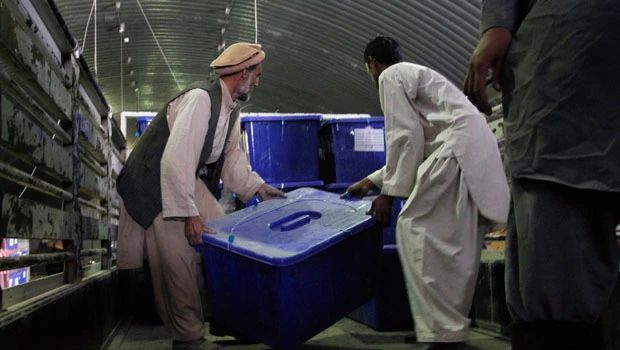
- KABUL: Thousands of fake voter registration cards have been found across Afghanistan, election officials said on Tuesday, and observers called on the government to act to prevent widespread fraud in Saturday’s election.
The parliamentary vote is seen as a key test of stability in Afghanistan, where violence is at its worst since the Taleban were ousted in 2001, before US President Barack Obama conducts a war strategy review in December.
Poor security and fraud are major concerns ahead of the polls, which the Taleban have vowed to disrupt by hitting foreign troops and then Afghan targets.
Last year’s presidential poll was marred by widespread fraud, with a third of votes cast for President Hamid Karzai thrown out as fake by the UN-backed Electoral Complaints Commission (ECC).
On Tuesday, both the ECC and independent watchdog the Free and Fair Election Foundation of Afghanistan (FEFA) said fake copies of registration cards, the document voters must produce to cast ballots, had been found in Herat in the west, Kunduz and Baghlan in the north and Nuristan and Paktia in the east.
Neither had exact figures or could say who was behind the fake cards, but some media reports have put the figure as high as 3 million — about a sixth of Afghanistan’s roughly 17.5 million registered voters.
FEFA’s Jandad Spinghar told Reuters some counterfeit cards had been used in the past three elections, but numbers seemed to be much higher this time.
“We have seen samples of fake cards found by our observers. If the government does take preventive measures, the level of fraud can be reduced, if not totally prevented,” Spinghar said.
“The security organs have the time to basically find the specific differences between the real and fake cards and appoint police at each polling station to check any voter’s card. Any one found with a faked card should be arrested and prosecuted.”
Afghanistan’s main security agency said forged cards had been distributed but said it had had taken “serious measures” to stop them from being used. It did not elaborate.
The election is seen as a test of credibility for Karzai after last year’s ballot. Karzai has lately been seeking to assert his independence from his Western allies after his government was criticized for not doing enough to tackle graft.
Washington worries that widespread corruption weakens the central government’s control, hampering its ability to train Afghan security forces so the almost 150,000 foreign troops in Afghanistan can gradually start to leave.
While Karzai is not running, he could face a hostile Parliament if enough regional and ethnic-based members form blocs that could oppose him on issues such as Cabinet appointments.
After last year’s election, Karzai moved quickly to change the make-up of the ECC, reducing the number of foreigners among its five commissioners from three to two. However, at the United Nations’ insistence, no ECC decision will be ratified unless it has the agreement of at least one of the foreign commissioners.
A spokesman said the ECC had also seen counterfeit cards but did not know who was behind them.
The Independent Election Commission (IEC), which is running the poll, said the real cards had special security features which made it easy to distinguish fakes.
“I want to assure you that no such fraud will take place. It will not be possible to use them,” IEC head Fazal Ahmad Manawi told reporters. Staffan de Mistura, the top UN diplomat in Afghanistan, said those trying to use fake cards “were wasting their time.” De Mistura also displayed the ink that will be used to mark voters’ fingers, another safeguard against fraud and multiple voting.
More than 1,000 complaints have been lodged with the ECC, ranging from intimidation of candidates and voters to improper use of government services in support of particular candidates and unfair campaigners.
Election observers expect many more complaints to be lodged after the election, in which 2,447 candidates are vying for 249 seats in the jirga, or lower house of Parliament. A high number of complaints could delay the results of the election. Preliminary results are not expected until Oct. 8, with the final outcome set to be released on Oct. 30.
Meanwhile, NATO and Afghan officials say up to 30 insurgents have been killed in fighting ahead of the parliamentary elections.
The military alliance said Tuesday that up to 23 militants were killed in action in southern Helmand province Monday and three in eastern Wardak province Tuesday.
An Afghan official said four Taleban were killed Tuesday in southeastern Zabul province.
There were no reports of casualties among joint NATO-Afghan forces. Attacks and clashes are rising amid an allied offensive aimed at suppressing the Taleban insurgency.