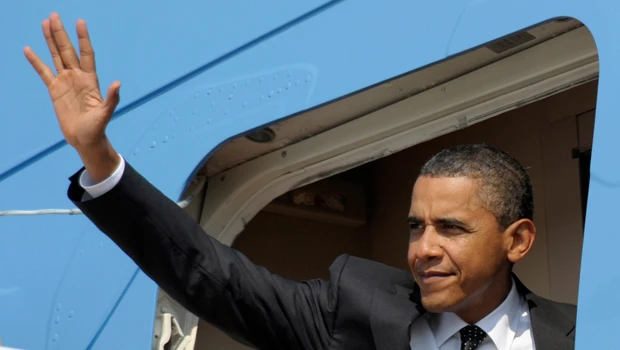
- WASHINGTON: Bob Woodward's new book "Obama's Wars" has rattled Washington with its news of discord and infighting among President Barack Obama's aides over what to do in Afghanistan.
The Washington Post and The New York Times both published excerpts Wednesday of the upcoming book by Bob Woodward, an associate editor at the Washington Post, who was granted extensive access and interviewed Obama and administration officials.
The book, due to be released this Monday, depicts an administration deeply torn over the war in Afghanistan, even as the president agreed to triple troop levels there amid suspicion that he was being boxed in by the military.
The book's insider information creates a state of unsettled anxiety for the reader, such as when Obama's top White House adviser on Afghanistan and his special envoy for the region are described as believing the strategy will not work.
Vice President Joe Biden also harbored doubts about the strategy's chances for success, as did Lt. Gen. Douglas E. Lute, the president's Afghanistan adviser.
Most surprising for this correspondent is that the book also reports that the US has intelligence reports showing that Afghan President Hamid Karzai was diagnosed as manic depressive.
"He's on his meds, he's off his meds," Woodward quotes US Ambassador Karl Eikenberry as saying, but adds no details. Karzai's mood swings, it is revealed, have been a challenge for the Obama administration.
Little reference in the book is made to Iraq, except as a reference point.
The book's title "Obama's Wars," apparently is meant to refer not only to the conflict in Afghanistan, but also the conflicts among the president's national security team.
Infighting is rampant throughout the book. Although the internal divisions described have become public, the book suggests that they were even more intense and disparate than previously known and offers new details.
Vice President Biden is quoted as calling Richard Holbrooke, the president's special representative for Afghanistan and Pakistan as "the most egotistical bastard I've ever met."
Woodward reveals a president greatly at odds with top military advisers Gen. David Petraeus and Adm. Mike Mullen, chairman of the Joint Chiefs of Staff.
Woodward writes that dissent turned into name calling on both sides, the Post reported. At one point, Petraeus felt shut out and told an aide that he considered Obama adviser David Axelrod a "complete spin doctor."
Several administration officials expressed contempt for Gen. James Jones, the retired Marine general who is Obama's national security adviser, while he privately referred to them as the "Politburo," the "Mafia," the "campaign set," or "the water bugs."
Adm. Mike Mullen, chairman of the Joint Chiefs of Staff, thought his vice chairman, Gen. James Cartwright, went behind his back, while Gen. Cartwright dismissed Adm. Mullen because he wasn't a war fighter.
Defense Secretary Robert Gates worried that Gen. Jones would be succeeded by his deputy, Thomas Donilon, who would be a "disaster."
Beyond the internal battles, the book offers fresh revelations on the nation's continuing battle with terrorists. It reports that the CIA has a 3,000-man "covert army" in Afghanistan called the Counterterrorism Pursuit Teams, or CTPT.
The book says the men are mostly Afghans who capture or kill Taleban fighters and seek support in tribal areas.
Obama rejected the military's request for 40,000 personnel as part of an expansive mission that had no foreseeable end. ''I'm not doing 10 years,'' he told Gates and Secretary of State, Hillary Clinton, at a meeting on October 26, 2009. ''I'm not doing long-term nation building. I am not spending a trillion dollars.''
The accounts say military leaders continued to press Obama for more resources after the president announced he would send an additional 30,000 troops to Afghanistan.
They say this resulted in Obama issuing a six-page memo explicitly detailing the objectives of the troop strategy so the military would not reinterpret his decision.
Woodward's book portrays Obama and the White House as bombarded with warnings about the threat of terrorist attacks on US soil and confronted with the difficulty in preventing them.
On Wednesday, a senior administration official defended Obama as a decisive commander-in-chief ahead of next week's release of the book, and downplayed the rifts portrayed in the book.
"The president comes across in the review, and throughout the decision-making process as a commander-in-chief who is analytical, strategic, and decisive, with a broad view of history, national security, and his role," the unnamed official told CNN.
Woodward is best known for his work, along with journalist Carl Bernstein, uncovering the Watergate scandal that ultimately led to the resignation of former president Richard Nixon.