
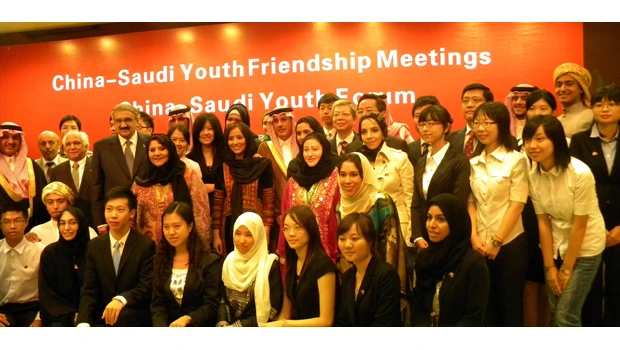
- SHANGHAI: Twenty young Saudis are marking the 20 years of diplomatic relations between the People’s Republic of China and Saudi Arabia by participating in a forum hosted by the All-China Youth Federation.
Speaking at the Saudi-Chinese Youth Forum presentation at Fudan University in Shanghai on Wednesday, Prince Mansour bin Miteb, minister of municipal and rural affairs, said the coming together of the youth of the two countries is a good augury.
“This cooperation between our youngsters will help us build bridges of understanding which in turn will benefit the whole of humanity,” he said.
The prince conveyed the good wishes of Custodian of the Two Holy Mosques King Abdullah for the success of the forum and underscored the role of youth in building a peaceful world for tomorrow.
Yousef Al-Sadoun, undersecretary for economic and cultural affairs at the Ministry of Foreign Affairs, said: “Saudi and Chinese youth share many aspirations and ambitions. Our aspiration, as rightly pointed out by Chinese president, is the struggle for truth and glory.”
He quoted King Abdullah’s vision for the people of the entire planet. “We all are equal partners on this planet ... We need to cooperate to get the best for everybody.”
Organizers and participants of the forum said the goal of the event was to foster better relations and to build bridges of understanding between the two nations.
The Saudi contingent also toured mainland China during the visit.
Participants visited the Great Wall of China and Beijing’s Forbidden City. They went to the Museum of Qin dedicated to the terra cotta warriors and horses and also visited China’s most ancient city, Xian, and the Xian Opera House where they watched the Tang Dynasty Music and Dance Troupe perform.
Perhaps one of the most symbolic moments of their visit occurred when they toured the Xian Mosque. Constructed by Arab merchants in 742 during the Tang Dynasty, the 12,000 square-meter mosque is a blend of Chinese and Arabic architecture and can accommodate more than 1,000 worshippers.
Steles, some dating back to the Tang Dynasty, also show the blending of the long traditions of Arabic and Chinese calligraphy.
“These visits have expanded our understanding of China’s economy and culture,” said Mohammad S. Al-Thaqafi, a member of the Saudi youth delegation. “In our open discussions we discovered many matters of common interest in areas of development and cooperation in science and technology, economy, arts and culture,” delegate Khalid Masri said.
The trip ended in Shanghai where participants met with Chinese colleagues at Fudan University and delivered two letters, one addressed to Custodian of the Two Holy Mosques King Abdullah and Chinese President Ho Jin Tao and the other to United Nations Secretary-General Ban Ki Moon. Both letters expressed hope for a global future of peace, understanding and prosperity.
“The appeals we sent to the leaders of the two countries and the secretary-general of the United Nations reflect the vision of the youth of both countries,” delegate Sara Almaeena said. “We have achieved many things during this visit. The most important of them may be an insight into the working of the minds of the Chinese youth and their view of Saudi Arabia, and I find it both brilliant and excellent. The exchange of ideas is the most important factor that will boost mutual relations.”
The Saudi contingent included Marwa Salem Abduljawad, Yousuf Najeeb H. Al-Bassam, Alaa Hashim A. Al-Hashim, Boshra Abdullah S. Al-Eidy, Rakan Abdulsalam Al-Sadoun, Mohammad Sameer Al-Thaqafi, Sara Almaeena, Mohamad Anwar Al-Shingiti, Lamees Ammar Al-Mufti, Sarah A. Al-Khedheiri, Khalid Abdullah Masri, Maryam Abdulsamad Al-Seini, Salman Nasser Y. Al-Rashed, Haneen Krimly, Dima Ikhwan, Bader Al-Hammoud, Saad Melhi Al-Shahrani, Abdullah A. A. Shakhi and Saud Abdullah Al-Zaidi.
“These young participants are the real wealth of Saudi Arabia, and they should be provided with more opportunities to learn from others,” said Al-Sadoun.

