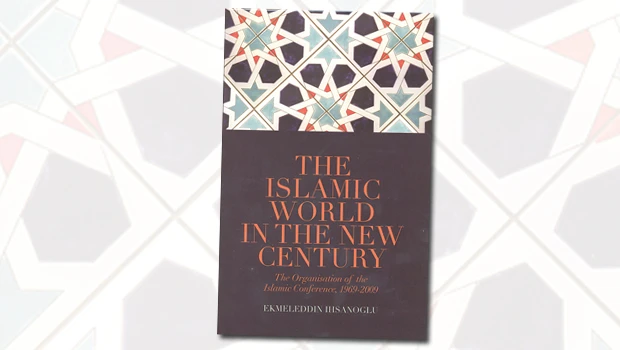
- This book answers the question: What has the Organization of the Islamic Conference (OIC) done in the past 40 years of its existence? It courageously addresses some existential questions of its relevance and place in today’s complicated, interconnected and multiclustered world.
Written from an insider’s standpoint, it is a fairly objective recount of the Organization’s successes and failures with much self-evaluation and criticism.
Ekmeleddin Ihsanoglu is the current secretary-general of the OIC since 2005. He is the ninth, and first democratically elected, secretary-general of the OIC, but his association with the OIC goes back to 1980 when he took office as founding director general of the Research Center for Islamic History, Art and Culture (IRCICA) — one of the OIC subsidiary organs.
The book is a very informative and useful study of the history of the OIC within the context of the history of the Islamic world and international events during the past 40 years. It provides a clear perspective on the OIC as an organization, what it stands for, its role and objectives, and how it came into existence and why. However, it is not just simply a historical narrative of events, but more importantly an in-depth analysis of the background and circumstances that prompted its creation and influenced its function. In that, the book is valuable in its honest evaluation of the OIC in terms of meeting objectives and expectations by admitting to its weaknesses and shortcomings, particularly with regards to inadequate financial and human resources as well as political will and support from the member states.
The book falls in nine chapters, in addition to an annex of statistical indicators of the OIC member countries and appendices of important documents such as: The Ten Year Program of Action, the new OIC Charter, Makkah Declaration on the Iraqi Situation and selected speeches from the secretary-general.
The first chapter sheds light on the period following the abolition in 1924 of the last Caliphate, an institution under which many Muslims had lived for centuries as a united entity, nurtured and comforted by the feeling of belonging to one nation: the Muslim Ummah. Muslim world leaders had made several calls and taken several initiatives to convene Islamic forums to revive that concept of Islamic unity and solidarity in the contemporary world. However, it was not until 1969, when an arson attack by a fanatical Australian Jew caused extensive damage to Islam’s third holiest sanctuary, the Al-Aqsa Mosque in Jerusalem, that steps to form a representation of the Muslim world became more urgent.
Thus, the OIC was established as the first intergovernmental Islamic organization of the modern era. Ihsanoglu takes great care in clarifying the position and weight of religion as a frame of reference, drawing the line between religion and politics. He states that Islam provides a source of likeness amongst the OIC member states, which came together in an organization based on the participation of sovereign states. “Thus it is the nation state that is the principle unit in this organization,” writes Ihsanoglu.
Chapter two details the formative years of the OIC and its subsequent expansion and development in terms of membership from 25 to 57 countries and the establishment of standing committees, subsidiary, specialized and affiliated institutions, which were created to meet the various objectives and mandates of the OIC in different fields including political, economic, cultural and scientific.
The third and fourth chapters are very interesting as they chronicle and explain the reform and restructuring process of the OIC, which is the primary theme of the book, from its early attempts culminating into the historic milestone achievement of the Third Extraordinary Islamic Summit in Makkah in 2005. That heralded a new era for the OIC by launching the Ten-Year Program of Action (TYPOA) and was further endorsed by the adoption of a new charter at the Eleventh Islamic Summit in Dakar in 2008. Thus, the principle mission that the OIC assumes today is to achieve modernization and moderation in the Muslim world shaped by the guiding concept and vision of the TYPOA and motivated by the motto: “Solidarity in Action.”
The following chapters delve into the various activities of the OIC undertaken in fulfillment of its role which were expanded on, reframed or added based on the new charter and TYPOA. Hence, the book documents OIC action with regard to some political causes of the Muslim world, particularly Palestine, Afghanistan, Bosnia, Jammu and Kashmir, Iraq and Somalia as part of its role in promoting peace and resolving conflicts. This also includes addressing issues of Muslim minorities and communities in different parts of the world. It also highlights the new challenges and aspirations tackled by the OIC such as Islamophobia, post-disaster humanitarian relief, reinvigorating science, technology and innovation, attaining better economic and commercial cooperation among the member states and strengthening socio-economic development.
Ihsanoglu argues that representative government, free speech and equal rights for all citizens are critical for Muslim societies, and as OIC is the voice of the Muslim world, he envisions the need to reform the OIC as a necessary step toward renewing the Muslim world. This book points to the achievements of the past five years in reaching that goal and what is yet to be achieved.