- KABUL: A US apology for a helicopter strike inside Pakistan has raised hopes of an end to a week-long blockade of a vital NATO supply line, although the alliance said on Thursday it was not hindering the war in Afghanistan.
The US ambassador to Islamabad said late on Wednesday that the cross-border raid, which killed two Pakistani soldiers and triggered the supply shut-down, was a “terrible accident.”
A joint NATO-Pakistani report released the same day said gunmen aboard the Apaches had likely mistaken warning shots from the border guards for an insurgent attack when they opened fire.
Pakistan closed the supply route through its territory on Sept. 30 after NATO helicopters strayed over the border several times, culminating in the shooting.
The military cited security concerns, but the move was taken as a pointed response to a violation of Pakistani sovereignty.
“I think the US apology and NATO regrets should be more than enough and I don’t believe that the issue of reopening of the route will drag on,” said Mehmood Shah, former security chief of the Pakistani tribal areas bordering Afghanistan.
“By closing the route, Pakistanis wanted to convey a message and I think they (NATO) have learnt the lesson.”
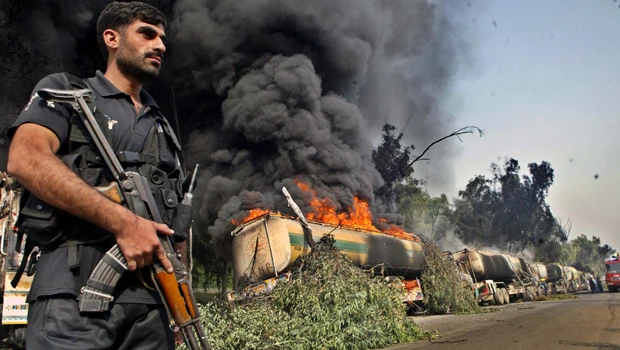
The closure of the route through the famous Khyber Pass was followed by a series of attacks on dozens of fuel tankers plying a second, southern route into the country to supply NATO troops.
Pakistan’s foreign ministry said security was being evaluated and a decision on reopening the supply route would be taken “in due course,” but also emphasised Washington and Islamabad were “allies in the fight against militancy.”
They are an often fractious pairing, but NATO needs Afghanistan’s neighbor. Trucking routes through the country bring in around one third of the fuel for NATO forces in Afghanistan, and large amounts of other supplies.
Stockpiled reserves and a concerted bid to build up a range of supply routes meant the cut-off had “not impeded” the war, said Brig.-General Josef Blotz, spokesman for the NATO-led International Security Assistance Force (ISAF).
“We have plenty of stocks and supplies within Afghanistan, just in case things like this happen. Secondly, over the last couple of years we managed to diversify supply routes,” he said.
“We also rely on the so-called northern distribution network and we are getting in dry goods, fuel and other essential military equipment through border crossing points with, for example, Uzbekistan, so there is no shortage, there is no danger for the execution of our operations.”
NATO has struggled with intermittent breaks in supply lines, and worked hard to build up alternative routes, to make the war effort less vulnerable, but for the long term, Pakistan is key.
“Small disruptions may not greatly impact their operations but if there are long disruptions then definitely they will have difficulties,” said Talat Masood, an analyst and retired general.
“For example, if they want to carry supplies through Russia ... (they) will ask for their pound of flesh. They have other alternatives but these are not as easy and cheap as Pakistan.”
The Afghan war enters its tenth year on Thursday, with the insurgency at the bloodiest since the 2001 ouster of the Taleban.
Surging violence and casualties are worrying for US President Barack Obama and his NATO allies as they come under growing pressure at home over the unpopular conflict.
More than 2,000 foreign troops have died since the start of the war, over half of those in the last two years alone.