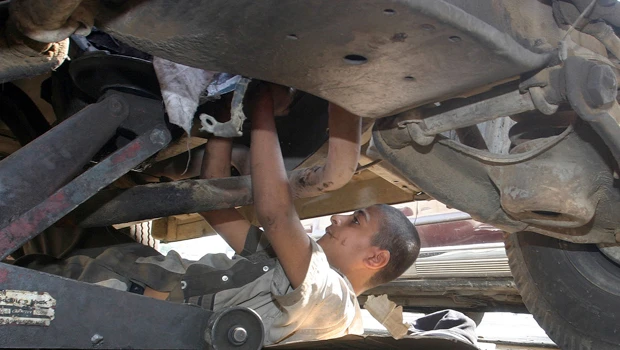
- JEDDAH: Many car workshops across Jeddah employ young children, often barely 15, who should be in school rather than doing work that is well beyond their age.
Ahmad Saeed, a Yemeni boy who is hardly 15, said he stopped going to school after the elementary level and found a job. He said he works to help his family of eight pay for day-to-day living costs, particularly rent.
He believes that learning how to repair cars is equivalent to gaining a university degree.
Two of Saeed’s brothers are university graduates but still unemployed. “The most important thing for me is to shoulder responsibility from an early age and depend on myself in earning an income instead of taking pocket money from my brothers,” he said.
Saeed is typical of many young foreigners who experience financial difficulties, something that forces them to leave school and learn a trade that would enable them to face the hardships of life.
There are, however, many other young children who have been forced to leave school by their families and work to take advantage of the money they earn.
Hussain Al-Sharif, chairman of the Human Rights Commission (HRC) in Makkah province, said behind every working child is a family that has forced him to leave school and work, adding that the HRC will fight the phenomenon of working children who have every right to education.
“We must take good care of children in order to make them useful members of society," he said, adding that the phenomenon is not limited to foreigners but includes Saudi children. “The number of working children has increased in the past five years and the majority of them are beggars,” he added.
In addition to being employed in car workshops, foreign children also sell fruit and vegetables on carts outside mosques. “I sell bottles of water and tissue near traffic signals,” said Salah Fallah, a 12-year-old Yemeni, who said he is confident that his line of work will not prevent him from continuing his education.
“This is a simple type of work which does not interfere with my schooling. However, the rising need for money may force me to quit school one of these days," he said.
The vegetable and fish markets in the Eastern Province are also places where underage children look for work. Human rights activist Waleed Al-Silais said these markets employ children under 16.
“Many of these children should be in school,” he said, blaming poverty on them working. “They want to help their needy families face the hardships of life,” he added.