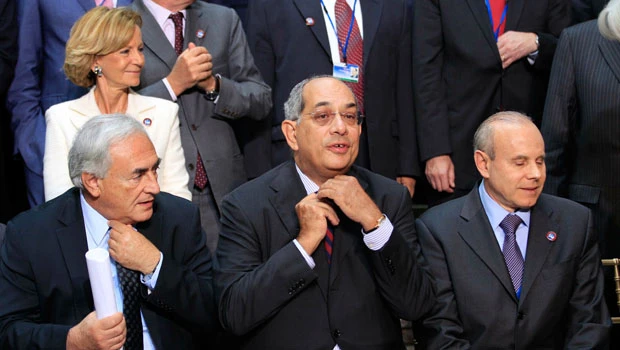
- WASHINGTON: The United States led a drive on Saturday for the IMF to take a more assertive role in refereeing disputes over currencies and ensuring that national economic policies don't disrupt global growth.
Strengthening the International Monetary Fund's hand could put global weight behind the US effort to persuade China to allow faster appreciation of its currency. But the proposal appeared to be gaining little support.
Currencies have become a hot-button issue as countries seek to solidify a shaky economic recovery, particularly in advanced economies.
Liquidity-boosting efforts by the US Federal Reserve have led to a weaker dollar, while rigid foreign exchange policies in other countries, notably China, have left emerging markets bearing the brunt of currency adjustment as investors pile into higher-yielding assets.
"The IMF must strengthen its surveillance of exchange-rate policies and reserve accumulation practices," US Treasury Secretary Timothy Geithner said in a statement to the IMF.
The IMF already conducts annual economic reviews of most of its 187 member countries and reports on a range of issues including exchange rate moves and monetary and fiscal policy.
It is considering giving more heft to its economic surveillance of the five key powers — the United States, euro zone, China, Japan and Britain — by issuing their reports simultaneously to better gauge whether their policies might have unintended consequences for other countries.
But the United Kingdom poured cold water on the new approach. "It sounds like everyone just doing their (regular IMF reviews) at the same time," a British official said.
China said currency tensions should resolve over time as global growth strengthens.
The Group of 20 rich and emerging nations have already tasked the Fund with evaluating whether national policies mesh. But some leaders want to see both the Fund and G20 raise their voices even louder when they spot potential problems, whether in currency alignments or other policies.
Christine Lagarde, economy minister for France, which chairs the G20 next year, said the increasing frequency of financial crises shows weaknesses in coordination on economic policies, especially exchange rates.
"Further work seems necessary and the IMF could make a decisive contribution to it," Lagarde said.
"There is a need to promote a dialogue on exchange rate issues while pursuing the ongoing work on macroeconomic policy coordination within the G20," she added.
Japanese Finance Minister Yoshihiko Noda said he explained the rationale behind his country's intervention last month aimed at capping the yen's rise, a go-it-alone move that drew criticism from Europe and elsewhere.
"We did not discuss anything about the future, but I believe we've gained understanding on our basic stance," Noda said late on Friday after a G7 finance leaders' dinner.
The IMF has a mixed track record when it comes to identifying the seeds of crisis and getting countries to change their policies before it is too late.
Some critics argue that the IMF cannot be a respected voice in the global economy until all of its members feel their views are heard on world policy decisions.
The IMF is well aware that its leadership is heavily skewed toward the United States and Europe, and it must give dynamic emerging markets greater power.
Geithner said IMF reform and foreign exchange rate policies were directly linked, and if emerging markets want greater say they must release their grip on tightly managed currencies.
"An agreement to modernize the governance of the IMF needs to be accompanied with more progress by countries, particularly the surplus countries, towards more market-oriented exchange rate policies that will reduce reliance on exports and strengthen domestic demand," he said in a thinly veiled reference to China.
China, however, has long pushed back against international pressure on how it manages its yuan currency.
The head of China's central bank said on Friday that a faster appreciation of the yuan might do little to help the economies of developed nations, which should heal with time.
"This issue may gradually fade out along with the recovery," People's Bank of China Gov. Zhou Xiaochuan said on Friday.
There is broad agreement to shift about five percent of IMF voting power to emerging and developing countries from advanced ones, but IMF members have yet to forge agreement on how to do that. This is one of the trickiest issues to be hashed out on Saturday in hopes of reaching an agreement by a G20 leaders summit in Seoul next month.
The United States and Europe have been squabbling for months over how to allocate seats on the IMF's executive board. Europe currently controls about one-third of the 24 spots, and the United States wants to see some of those seats handed over to emerging markets.
Europe has proposed a power-sharing agreement where it would rotate some of its seats, but that idea has met with a cool reception in Washington.
The developing countries themselves also disagree on how to fairly divvy up their share of the increase, with some expressing concern that China will gain at the expense of other smaller emerging economies.