- DAMMAM: A new survey from global management consultancy PRTM claims that a majority of GCC business leaders plan to put a much higher emphasis on innovation in the year ahead.
- The research has uncovered a shift from the traditional approach of importing innovation, to its homegrown creation.
Most executives surveyed believe that the trend of buying innovation will soon run its course. In contrast, doing innovation emphasizes the generation of value, rather than its consumption. Executives realize that building a strong, sustained experience in doing innovation is essential for GCC countries to build their own innovation ecosystems. The research found that virtually all GCC participants surveyed, 95 percent, are looking past the current economic crisis, with the majority focusing on innovation for growth opportunities.
Visiting SAOGE 2010, it was easy to see how the Saudi oil and gas industry has been enabled through the buying of innovation. Valves, pipes, control systems and hundreds of other technologies have been imported to Saudi Arabia to further the growth of the Kingdom’s oil industry. The majority of exhibitors at SAOGE are agents for technology companies headquartered abroad. There are a few however, that are starting to find profits in something more than the import and sell onwards approach.
Cairo headquartered Elsewedy Electric was established in 1984. The company now has production facilities in 14 countries and exports to 100 countries worldwide. Instead of simply licensing technologies for its new business enterprises, Elsewedy has decided to move into process design. This year the firm set up a new business unit under the name of R&D Tech, which specializes in the design, construction and operation of a broad line of water and environmental related applications. Taking a fundamental approach to process design, rather than relying on pre-engineered systems, has led the company into the field of research and product development to the extent that R&D Tech now has its own packaged systems.
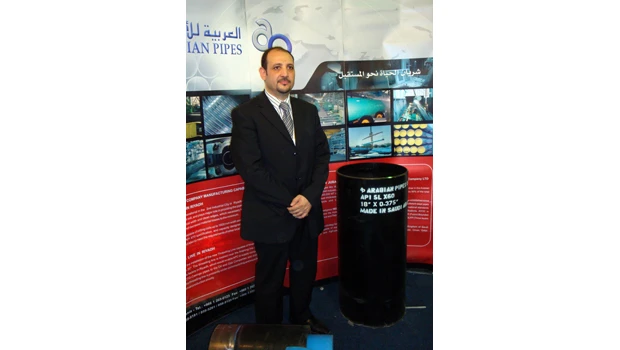
Arabian Pipes Company is another firm that has taken technology imported from abroad and built upon it. Arabian Pipes started out manufacturing electric resistance welded (ERW) steel pipes in Riyadh and later set up an anti-corrosion coating facility. They are now exporting to 19 countries outside Saudi Arabia.
“At the beginning, we depended on different international technologies imported from outside — mainly Korea, Japan and Germany. But in order to keep up with the latest requirements from Saudi Aramco, Shell and other major customers, we found that it is important to have in-house development of the technology,” said Mohammed H. Dakdouk, manager, Sales and Marketing, Arabian Pipes Co. “This includes bringing in all the related equipment for that and improving testing to match our products with the specifications.”
Arabian Pipes has made changes to its production lines and to the equipment that manufactures the pipes. They believe that by being experts in all aspects of pipe production and anti-corrosion coating, not just licensees of technologies, that this gives their customers greater confidence in their products.
So there is some momentum towards being more than just technology consumers, but there’s plenty to be done to strengthen the Kingdom’s technology exports. Mazen A. Bader, CEO of Mahabes Company Ltd. finds it shocking that although it’s been over 70 years since oil was discovered in Saudi Arabia, that the Kingdom isn’t holding the commercialized patents for more of the technology used in the oil and gas industry.
“What happens now is that the technology is prepared on the ground in Saudi Arabia and then taken outside to other companies in the world and developed and brought back to us. We should have developed it here,” remarked Bader.
He pointed to other industries in Saudi Arabia such as air conditioning, steel structures and valves, which have been innovative and are now exporting their innovative technologies and products abroad.
“There are good ways to start and if my plans succeed in a few years we’ll be developing technology in Saudi Arabia,” Bader said. “We don’t need to re-invent the wheel. We can continue with someone else’s investment and build on that — in terms of time investment, engineering investment and financial investment.”