- Life has its ways, which are often impossible to predict.
- When Tony Blair ended 18 years of Conservative rule in 1997, the media adulated him.
How far away that seems when he is now their punching bag. A book signing was even canceled because of promised disruption by protesters. Yet, that would in no way affect Blair’s self-confidence. He himself recognized that he always had a better relationship with the people than with the media. As Nick Cohen rightfully said: “As a professional who could work an electorate, Blair was a maestro.”
Blair realized at a very early stage in his career the importance of being a good communicator. Interestingly enough, he recalls a brief visit ex-President Bill Clinton made to Britain en route to a NATO summit, soon after he became prime minister in 1997. He remembers him saying: “Don’t forget: Communication is 50 percent of the battle in the information age. Say it once, say it twice and keep on saying it, and when you’ve finished, you’ll know you’ve still not said it enough.”
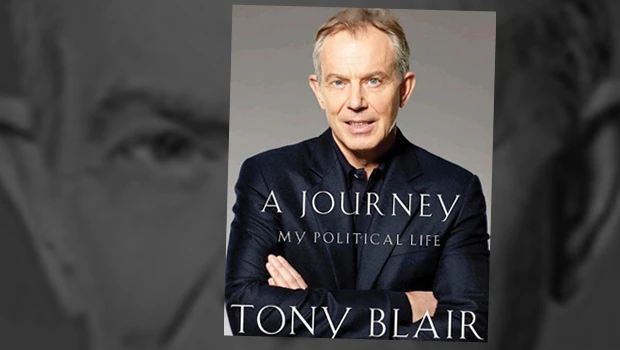
“A Journey” is very much about politics and policy and is not written by a ghostwriter. Blair has a lot of convincing to do and he speaks in his own voice. Some of the best chapters deal with his political debut and his first years at 10, Downing Street. He was the soul of New Labor, which he described in an article in The Times in July 1995, as “a rejuvenated and revitalized left of center that is placed to respond to and shape this new world of change.”
He was charming, self-assured and had the gift to convince because he genuinely believed in New Labor. He shrewdly explains that “if you don’t have core beliefs as a politician, real path-finding instincts groomed out of conviction, you will never be a good communicator because, and this may seem corny, but it’s true, the best communication comes from the heart.”
Blair has deliberately chosen to be open and he has clearly tried to show how politicians are human beings. He explains how the schedule of today’s politicians is nonsensical and far more damaging than just two decades ago: “Have a bad night’s sleep or feel lousy because your system is shot to pieces, and you perform badly. And the difference with us is that each performance is on film or reported, and there are no second takes.”
Although Blair has accepted the fact he is no longer prime minister, he admits that he would have stayed on, hadn’t his chancellor, Gordon Brown, pressed him to leave. Even in his memoirs postscript, he acknowledges that he has never felt a greater sense of frustration or indeed a greater urge to leadership. But, is he convincing? His analysis of Islamic extremism is fallacious, and he is wrong when he writes that extremism “is a strain within Islam.”
Looking back on his foreign policy, Blair does not regret his decision to go to war, but he admits that he did not anticipate the role of Al-Qaeda or Iran. “Whether we should have is another matter; and if we had anticipated, what we would have done about it is another matter again,” writes Blair.
The truth is that he failed to think about what might happen in Iraq and the region after Saddam would be removed. He never prepared for the worst. He could not foresee the ultimate scenario. Neither did George Bush. “George had immense simplicity in how he saw the world. Right or wrong, it led to decisive leadership,” he writes.
His love for America has grown even stronger since he has retired from politics. The introduction is all about America’s leadership and the three presidents he has worked with: Clinton, Bush and Obama. He genuinely liked Clinton, whom he described as “a brilliant president.” And, regarding George Bush, he states that, “the stupidest misconception was that he was stupid.” As for Obama, he sees “a man with steel in every part of him. The expectation is beyond exaggeration. The criticism is now exaggerated. He has remained the same throughout.”
According to Blair, the real test of leadership is to put what you perceive to the common good of the nation before your own political self. Each of these presidents has passed this ultimate test “for a reason not connected to them.”
At the end of “A Journey,” Blair finds “the insouciance toward the decline of the transAtlantic relationship, on both sides of the ocean, a little shocking” and he exhorts America and Europe to work together.
All these concerns and worries, however, are no longer part of his daily work. Blair leads a high life. Although he protests that much of what he does is unpaid, like the role of Middle East envoy, his faith foundation and the work on governance in Africa. However, he earns a lot with his speeches, the advisory work for a bank and the consultancy contracts for Tony Blair Associates. Blair has always been straightforward about money:
“Did I want a nice home? Yes. Did I prefer a five-star hotel to a two-star? Yes. Did I appreciate that there was more to life than this? Yes. I never thought that enjoying life’s good things led to indifference to the plight of those who couldn’t. For me, the opposite was true: What I wanted for myself, I also wanted for others. But, I didn’t feel it wrong to want it nonetheless.”
Despite all the political issues, this political memoir is amazingly easy to read. I thoroughly enjoyed the chapter on Diana and I was as surprised as Blair must have been when he attended the traditional barbecue that Prince Philips cooks.
“This, too, is governed by convention and tradition. The royals cook, and serve the guests. They do the washing-up. You think I’m joking, but I’m not. They put the gloves on and stick the hands in the sink. You sit there having eaten, the Queen asks if you’ve finished, she stacks the plates up and goes off to the sink.”
We are also told how the day after Diana’s funeral, Blair was led into the drawing room to meet the Queen and was sternly asked not to sit “in a rather inviting-looking chair” that had been Queen Victoria’s chair and that no one had ever sat in after her death.
Looking back on the days following the death of Diana, Blair did a wonderful job of bridging the gap between the monarch’s reaction and the people’s grief. He is also right in saying that “the furor around Diana’s death was the point at which things turned. People not only felt the monarchy had taken a further step toward being more open to public opinion, but they also saw the human frailty and strength of its leading representatives and accepted both equally. The monarchy realized it could open up while remaining royal.”
“A Journey” conveys all the excitement, joy, drama and scandal, which come with the job. Blair certainly will not convince his opponents, but that is not a reason to ignore a book that deserves to be read. There are lessons to be learned by the author himself.