
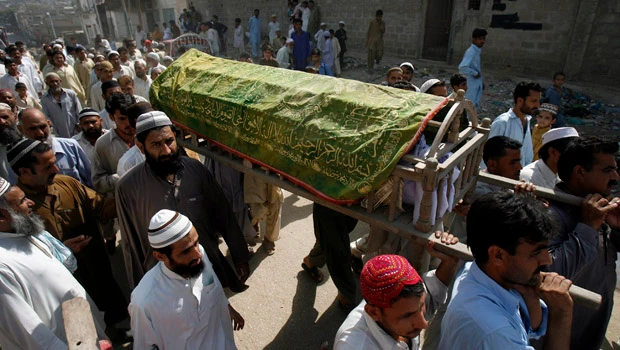
- KARACHI: Pakistan’s dominant political force in Karachi has stepped up pressure on the government to protect its workers after violence again raised fears of instability in the country’s commercial capital.
The Muttahida Qaumi Movement (MQM) threatened to pull out of the coalition government of President Zardari after at least 33 people were killed in weekend attacks coinciding with a by-election to replace a MQM lawmaker murdered in August.
That could lead to the central government losing its majority in the National Assembly, or its downfall if the MQM sides with the opposition.
The government already faces an array of problems, including a possible showdown with the judiciary, a Taleban insurgency and the task of rebuilding after summer floods that made more than 10 million homeless and are likely to strain the economy for years.
MQM has made similar threats before, but the latest bloodshed has increased the chances of that happening, party sources say. Several party workers were killed, the MQM said.
“We cannot tolerate the continued killings of our workers and are increasingly unable to justify our presence in a government which has failed to protect us,” said a senior MQM leader.
Speculation has swirled for weeks that Pakistan’s Supreme Court would uphold the scrapping of an amnesty law, possibly opening the door to attempts to prosecute government leaders, including Zardari.
The law allowed some current politicians — including Zardari — to return after years of exile, but was thrown out in December 2009 by the Supreme Court which must now pronounce on a government attempt to overturn that ruling.
The MQM blamed its rival, the ethnic Pashtun-based Awami National Party (ANP) for the weekend killings in Pakistan’s biggest city, an allegation it denied.
Mohajirs, descendants of Urdu-speakers who migrated from India after the creation of Pakistan in 1947, are the biggest community and dominate the city’s politics through the MQM party.
Political and ethnic rivalries and turf wars between them — sometimes linked to criminal gangs — make it difficult to maintan order in Karachi, home to Pakistan’s main port, stock exchange and central bank and the main gateway for Western military supplies bound for neighboring landlocked Afghanistan.
Karachi has been relatively calm over the past two years as militants have focused on cities in the north and across the northwest.
But several bombings this year fueled concerns they are expanding their fight to the city of 18 million, where most foreign companies investing in Pakistan have offices.
The MQM is taking a harder line with the government because a rising number of its workers are being killed in street fighting. Frustrations are growing over what is says is an inadequate response by authorities.
“Somebody must take responsibility. Somebody has to put an end to it without considering the political aspects,” said Masood Sharif Khattak, former head of Pakistan’s domestic intelligence agency.
“That’s not happening because police and other law enforcement organizations have been politicized. They do not take responsibility; they react to their political masters.”
Unofficial results showed the MQM sweeping Sunday’s election for a provincial seat to replace lawmaker Raza Haider, whose shooting triggered violence which killed 100 people in a week.

