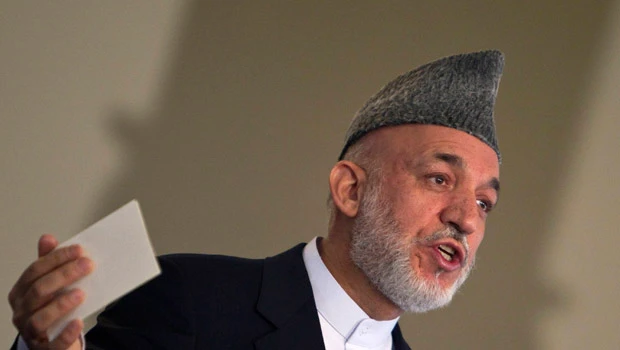
- KABUL: The hope for peace and reconciliation in Afghanistan after almost 10 years of war has increased, President Hamid Karzai said on Wednesday, reinforcing his wish for a political settlement to the intractable conflict.
During a long address at his presidential palace in the Afghan capital, Karzai made no direct reference to peace talks between his government and the Taleban and other insurgents.
But he said Afghanistan and its allies were all working toward a settlement and that he hoped significant improvements would be achieved within one or two years.
"Hope for peace in Afghanistan has increased. The international community, our neighbors and all our people are endeavouring a lot toward it," Karzai said.
"We are in contact with our neighbors ... so that they endorse this process and we are hopeful that we all see improvement in the security situation and stability of our country within a year or two, compared to what we have today and yesterday," Karzai said.
Violence is at its worst across Afghanistan since the Taleban were overthrown by US-backed Afghan forces in late 2001, with civilian and military casualties hitting record levels this year despite the presence of almost 150,000 foreign troops.
Karzai has established a High Peace Council, the leader of which has indicated he will be flexible about tough conditions set by Karzai for any attempts at mediation with the Taleban.
On Wednesday, The New York Times newspaper quoted an unidentified source as saying talks to end the war involved "extensive, face-to-face discussions with Taleban commanders."
US Gen. David Petraeus, the commander of foreign troops in Afghanistan, said last week NATO-led forces had facilitated the passage of a senior Taleban leader to Kabul for talks with the Afghan government as part of the reconciliation process.
Petraeus said the discussions were preliminary and could not yet be characterized as negotiations.
Richard Holbrooke, the senior US envoy for Afghanistan and Pakistan, has said reports about secret talks between the Taleban and the Afghan government were exaggerated and warned against over-emphasizing what he described as unofficial contacts.
Such sentiments were backed by a source among the Afghanistan opposition based in Pakistan.
"Definitely there are contacts but, let me tell you, you can't call them talks," the source said.
The Taleban has repeatedly dismissed the reports of negotiations, repeating its position that all foreign troops must leave Afghanistan before talks are possible.
Karzai said on Wednesday Afghanistan was cooperating with the United States and its allies in Europe and elsewhere to confront terrorism. "But where our own people are angry and frustrated for various reasons, we want reconciliation and peace," he said.
With Taleban attacks spreading out of traditional strongholds in the south and east, rising casualties and sagging support in the West for the war, Karzai in June won approval from a tribal gathering to seek a negotiated end to the conflict.
The New York Times report said Taleban leaders from the "Quetta shoura" - the leadership of the Afghan Taleban who are based in Pakistan - and one member of the Haqqani network had taken part in talks.
The Al-Qaeda-linked Haqqani network has been increasingly active in Afghanistan's east and has been blamed for a number of recent high-profile attacks.