- Wrong, wrong, wrong! The silken voice of the GPS had confided between thunderclaps that the muddy Essex farmyard littered with puddles and near-derelict buildings was the destination.
- It was supposed to have located one of the very few surviving makers of some of man’s oldest technology: the edged weapon.
“It’s a bit agricultural I’m afraid,” announced a cheery voice, emanating from a solid looking citizen with blacksmith’s forearms and shod in stout boots who had materialized out of the horizontal rain. He was beaming broadly and was obviously blessed with a talent for understatement. If this were the right place it was where, quite literally, ploughshares could be turned into swords.
The smug little GPS was right.
Simon Fearnhamm and his two colleagues — the even more substantial Mark Tyler, who looks born to wield a mediaeval broadsword and Colin Heggs — are rare people. While many call themselves “craftsmen” and infest agricultural showgrounds and village bazaars touting lace doilies and worthy but lumpen pottery, Fearnhamm and his colleagues, working in what can only be called primitive conditions, truly are of the breed. They produce edged weapons of supreme quality and artistry, all entirely by hand.
The Raven Armoury is the UK’s preeminent sword-maker. Such are the levels of skills that irreplaceable historical swords (for example that of Shah Jehan of Taj Mahal repute) are entrusted to their care for cleaning and restoration. They have also worked with the Royal Armouries, National Museum of Arms and Armour.
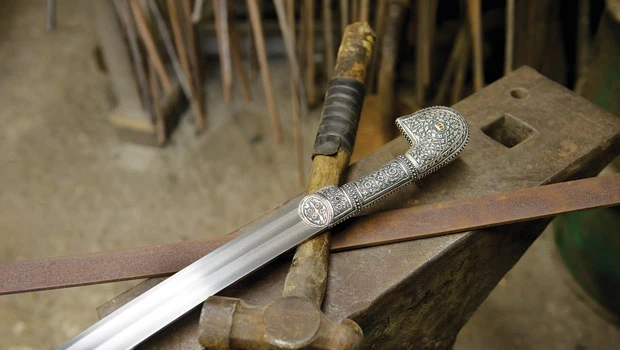
Knights, potentates and warriors through history have valued their swords highly even after the development of ballistic weapons. Their symbolic value as a weapon lives on as ceremonial swords in military communities everywhere as symbols of justice and power and on flags and coats of arms. Ceremonial swords may only be used for ceremonies, but Fearnhamm is very committed to the idea that nothing leaves his workshop that is not of fighting standard and “with an edge that you can shave with.” Handling with great care a sample of one of the dozen or so glorious and silver mounted swords he is in the process of making for the Jordanian Royal Guard, he is absolutely right. Fearnhamm normally makes swords and knives — and even battle-axes — to individual order. He typically defines mass production as “more than one.”
Their workshop — in essence a couple of rustic outhouses — confirm the simplicity of the technology and the need for tremendous skill in the production of the armory’s blades. Dominating the main workshop is the forge and anvil. There are almost no power tools at all — a simple pillar drill and a hand-held grinder comprise almost the entire inventory.
“That’s it,” said Fearnhamm pointing at the rude facilities, “Just add hands.” The hands and eyes of the trio are the truly valuable precision tools that produce their swords and knives.
“We show potential clients the samples to see the perfect lines,” Fearnhamm confided. “They just don’t believe that Mark can produce such perfect finishes with a hand-held grinder.” He can and he does. Comparing blades on the current sword order, they were exactly similar and insanely sharp.
Colin Heggs is equally skilled but in a very different field. A mounter and setter (a craftsman who makes gold items and sets the precious stones in them), engraver and chaser (who raises patterns on metal using tiny intricately shaped punches and a hammer), he is a whole precious metal industry in himself. Not only does he work with metals but sometimes impossibly exotic materials. One recently finished commission involved setting 1500 silver pins flush into a fossilized mammoth tusk handle of a dagger. “It’s a lovely material to work with,” he mused modestly.
Raven Armoury is a glorious anomaly in the world of mass production. Their clientele is drawn from collectors, military re-enactment players and those who want the very best in working knives. Many of Fearnhamm’s pieces are in daily use and made from steel drawn from dwindling sources. “I started by making fantasy swords out of old car-springs,” he said. “Then I bought some of the same steel from the supplier and it grew from there.”
Occasionally the workshop is asked to produce a museum copy of a piece. In one of their display cabinets stands a mighty broadsword that is pockmarked and stained from lying for centuries underground. It is in reality an exact replica, aged and marked like the original right down to the rust. “We restored and effectively rebuilt a helm (the steel headgear of a knight) once. The client couldn’t see what was original and what we had done,” said Fearnhamm with a smile.
Recently he bought in much of the remaining sword steel from the now defunct Wilkinson Sword Company, a company that supplied generations of the British army with their fighting weapons. “The selection of steels is something of an art and a science. We use everything from high carbon and vanadium rich steels through to Damascus steel. It depends on the customer and the application,” he said.
The mention of Damascus steel, the folded and forged steel of legend yet very real even today, prompted a thought. The legend says that Richard the Lion-Heart bragged to Saladin about the strength and power of his broadsword compared with the less substantial Arab scimitar. Saladin tossed a silk handkerchief into the air. “But can it do this?” With a slash of his scimitar he sliced the silk in two. Would it really be possible for an Arab scimitar to slice through a silken kerchief thrown into the air? Fearnhamm thought for a moment. “If the silk was not very fine, then yes, I think it would.” There may well be some truth in the legend of Saladin’s sword after all.
Significantly the Raven Armoury has made a good number of daggers and swords for the Middle Eastern market. He sees it as something of an honor to be approached to replicate and originate swords and daggers that involve not just some of the most exotic steels but the most intricate traditional precious metal decoration.
It is significant in the throwaway age that individuals with this level of craftsmanship, skill, knowledge of steel technology and strong sense of history are located in a shed in Essex and deals with a small client base, much of it from overseas. The lemming rush for the lowest price and subsequent quality has depleted cultures of many skills and a large part of their industrial history. With that goes much social history that can never be replaced.
I can think of countries where these craftsmen would be a national treasure, a repository of esoteric knowledge and source of national pride.
The answer to the obvious question, “What’s the use of a broadsword nowadays?” is simply this: Pick one up, feel the heft and balance, hear the soft hiss of parting air as you swing it and it will tell you more about the difficulties of using a weapon, something of the technology of the culture that produced it and the people that used it than any book ever could.
Pick up one of Simon Fearnhamm’s scimitars, run your eye along the line of light kissing the blade, feel the prick of the edge and you will instinctively know the truth of the legend of Saladin.