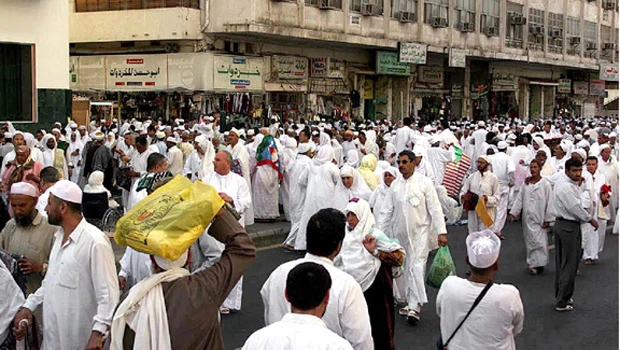
- MAKKAH: The holy city of Makkah is considered one of the most expensive cities to live in based on the high price of accommodation in the central area close to the Grand Mosque.
This, according to economic experts, has created the wrong impression that local residents are well off and that only giant investment projects take place there.
In fact, there are many poor Saudi and foreign families in Makkah who settled there years ago to be near the Holy Haram. They multiplied and their descendants, with no work opportunities, resorted to small projects in order to sustain themselves and their families.
Most of the time, such projects cost only a few riyals, but the revenue they generated was enough to feed hungry mouths.
Mohsen Attiyah, a 62-year-old Saudi citizen, told Arab News that he sells miswaks (tooth-cleaning sticks) in the courtyards of the Grand Mosque to sustain his family of eight children. “I have been selling miswaks for more than 25 years. I started my business with a base capital of not more than SR25,” he said.
Attiyah said he buys a batch of miswak for about SR300, cuts them into small pieces to make about 700 miswaks and sells each piece for around SR3. “I make a profit of between SR1,400 and SR2,100,” he said.
Attiyah was, however, quick to explain that he would not sell all the miswaks in a day. “It can sometimes take me days to sell all of my miswaks,” he said, describing Makkah as the best place to sell such goods.
Arshad Haj, a 22-year-old illegal expat, said he bought a pair of scissors for SR6 and started trimming the hair of pilgrims at the doors of the Grand Mosque for SR3 per head, increasing the price to SR5 during the Ramadan and Haj season. “I have a daily income of about SR120 on normal days, but I can make three times as much during peak seasons,” he said.
Bakr Kano, an illegal resident from Chad, said he thought of a simple and cheap project that would sustain him and his family — mineral water. He said he would buy 30 cases of mineral water cans for SR18 each and sell them on for SR30 each. “Every day I sell about two to three cartons of mineral water at traffic lights and make a profit of more than SR36 a day,” he said.
A peculiar small project involves selling salams (greetings). It is usually done by street cleaners who say “Assalamu Alaikum” to rich car drivers at traffic signals. The drivers consider them to be among the poor people worthy of Sadaqa (alms) and so return the salams by giving them some money. “I make more money by selling salams than I get from my job,” a street cleaner said.
Muhammad Al-Sahli, a professor of Shariah at Umm Al-Qura University, said poor people are able to make money in Makkah because of Prophet Ibrahim's (peace be upon him) prayer to Allah to bestow his bounties on the residents of the holy city.
He said a number of people who came to Makkah destitute were able to find various sources of income, like selling water or miswaks. “Some of them have even become businessmen and traders,” he said.