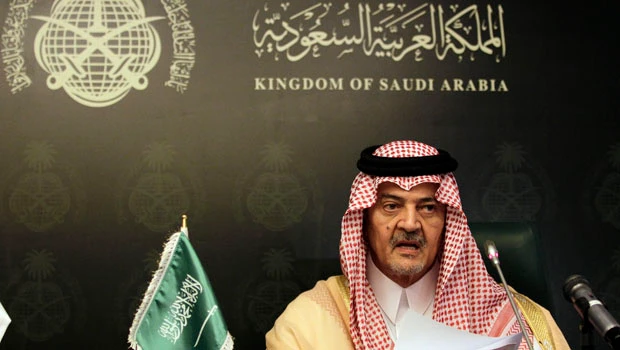
- RIYADH: Foreign Minister Prince Saud Al-Faisal expressed Saudi Arabia’s fears on Saturday that Sudan's upcoming referendum on the south's independence could reignite violence in the country rather than bring peace.
Addressing a joint press conference with his Italian counterpart Franco Frattini, Prince Saud said the original reason for the January referendum was to bring peace between the north and south in the wake of a two-decade-old civil war.
"The solution needed is to stop the fighting between the north and the south … If the referendum leads to a renewal of fighting, that is what we fear," he said, stressing that the referendum, scheduled for Jan. 9, must be fair and free.
He said the Sudan referendum marks, "a critical juncture in its history, threatening its territorial division." The referendum is part of a 2005 peace deal that ended the civil war in Sudan, which left an estimated two million people dead.
Prince Saud also spoke about the wide acceptance Custodian of the Two Holy Mosques King Abdullah’s invitation to Iraqi political leaders received.
“King Abdullah’s initiative has received wide support from Iraqi leaders inside and outside the country. The king will do everything possible to end the bloodbath in Iraq, unify the Iraqi ranks and support Iraq’s security, stability and prosperity and protect its independence and sovereignty,” he said.
Prince Saud voiced the Kingdom’s denunciation of terrorist attacks in Iraq that kill innocent people as well as attacks on places of worship. “Such attacks go against the teachings of Islam and violate international resolutions and charters.”
Asked whether there were attempts to narrow the differences between Iraqi groups, Prince Saud said: “The Kingdom is continuing its efforts in this respect in cooperation with the Arab League.”
He said Saudi Arabia has halted mediation efforts between the Afghan government and the Taleban because the latter has refused to break ties with Al-Qaeda.
Prince Saud said his talks with Frattini were positive. “We have held deep and comprehensive talks on various regional and international issues including peace in the Middle East and the two-state solution,” he said.
Frattini urged Israel to reinstate a moratorium on settlement building in the West Bank until a final peace deal is reached with the Palestinians. Europe has to make a greater effort to convince the Jewish state, "that it is in the best interest of Israel to reach a peace deal," he added.
That means Israel needs to extend the moratorium on settlement building in the occupied West Bank and East Jerusalem that expired at the end of September, halting three-week-old peace talks, Frattini said.
Palestinian negotiators called off the talks when the moratorium expired, saying they cannot negotiate for a two-state peace deal while Israel builds Jewish homes on lands the Palestinians hope to reclaim.
Prince Saud said the Arab League, which on Oct. 8 gave Washington one month to get the talks restarted, would take the Palestinian case to the UN Security Council if nothing happens. “The intent is to go to the United Nations” to seek peace for the Palestinians, he said.
A committee of Arab League foreign ministers in Libya set the one-month deadline.They are to meet again after the 30-day period to decide on the next step. On Friday, a senior Palestinian official said the next committee meeting on the stalled direct peace talks was likely to be delayed until the end of November.