- MINA: Pilgrims performed the symbolic stoning of the Satan on the first of the three days of stoning, as Muslims celebrated Eid Al-Adha — the festival of sacrifice.
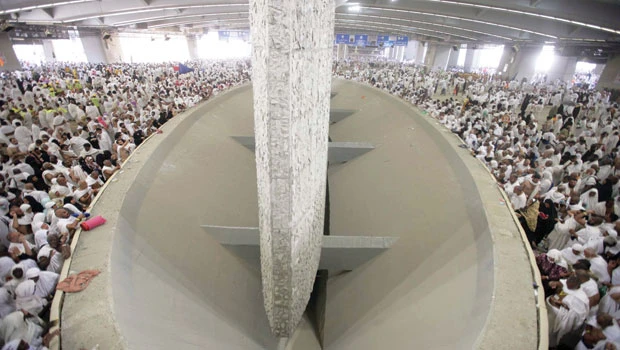
- Massive crowds of pilgrims filed along a giant pedestrian bridge that houses the walls in the Mina valley, pelting Jamrat Al-Aqabah.
MINA: Pilgrims performed the symbolic stoning of the Satan on the first of the three days of stoning, as Muslims celebrated Eid Al-Adha - the festival of sacrifice.
Massive crowds of pilgrims filed along a giant pedestrian bridge that houses the walls in the Mina valley, pelting Jamrat Al-Aqabah.
Many of the nearly three million pilgrims expressed their happiness at the spacious new Jamrat Bridge and expansion along the Masa'a area in the Grand Mosque.
Instead, the biggest problem this year appeared to be traffic on roads, as the throngs of pilgrims moved between Mina, the nearby holy city of Makkah and other ritual sites.
Some buses transporting pilgrims couldn't move because they were surrounded by "unlicensed" pilgrims camped out in parking lots. Further snarling the logistical nightmare, Saudi authorities shut down some roads to vehicles to allow the hundreds of thousands of pilgrims moving on foot to pass.
Expressing particular delight at the now-complete five-story Jamrat Bridge, many pilgrims said that overcrowding has become a thing of the past. Unlike previous years, anxiety was not seen on the faces of pilgrims who had completed the first day of one of the most crowded rituals of the annual pilgrimage.
The stoning at Jamrat is, potentially, the most perilous part of Haj due to so many people converging at one place at one time. Nearly three million people pass through the pedestrian bridge during the three-day ritual to throw stones at three pillars representing Satan and re-enacting what Prophet Ibrahim (peace be upon him) did thousands of years ago.
In order to ease traffic, the Ministry of Haj had asked tawafa establishments and other domestic Haj organizers to stick to the schedules assigned to them when sending pilgrims to the Jamrat.
Police officials said there was no overcrowding at the bridge, being manned by a large contingent of police officers and volunteers.
Head of the Civil Defense forces on the Jamrat Bridge Col. Zuhair Sebaih said the bridge's ground floor was the busiest of the five floors on the first day of stoning. He added that pilgrims arriving via the new Mashair Railway are using the top floor.
"The train project was a huge success in Haj because it managed to lower the level of traffic jams and crowds. There have been no recorded injuries or accidents with the exception of a very few numbers of pilgrims who fainted because of exhaustion. These people were mainly elderly," he said.
"The giant projects that were carried out by the Saudi government at the holy sites have played an important role in easing the movement of pilgrims from Makkah to the holy sites and then their return," said Prince Khaled Al-Faisal, Makkah governor and president of the Central Haj Committee. "Projects such as bridges and tunnels were ordered by Custodian of the Two Holy Mosques King Abdullah and Crown Prince Sultan, deputy premier and minister of defense and aviation, to ease the movement of pilgrims," he added.
"This is my first Haj, and, by the grace of Allah, we completed all of the rituals with ease and without any trouble," said Egyptian pilgrim Samir Al-Fakeeh. "This is really unbelievable that over 2.5 million pilgrims performed Haj without any incident whatsoever. Just amazing," he added.
"Alhamdulillah, the stoning was peaceful and smooth and everybody is safe and sound. What more can we expect?" said Sabir Al-Jassaram from Kuwait. Another pilgrim from Kuwaiti Salem Al-Hummadi said: "Now overcrowding is a thing of the past ... the bridge is so spacious that it can take over five million pilgrims and they all will be able to stone the devil smoothly."
The new bridge contains a wider column-free interior space and expanded Jamrat pillars many times wider than their pre-2006 predecessors. Additional ramps and tunnels have been built for easier access, and bottlenecks were engineered out.
Shumael-e-Nabi, an Indian who was on Haj for the third time, was amazed at the speed at which work was carried out at the Jamrat Bridge and in the Grand Mosque. "When I performed the Haj for the first time in 1998, the round shape seemed to be a hindrance in performing the stoning ritual," he said.
He was back for Haj in 2007 and then again got a chance to perform Haj in 2008. "I was very happy to see the oval shape of the Jamrat when I performed the Haj in 2007 and the addition of two floors to the bridge has helped ease the flow of pilgrims even further," he said.
Another pilgrim, who came for the second time to perform Haj, said that first time he performed Haj he was very nervous especially during the stoning ritual. "It was awful and very tough. It was a real test. It was literally impossible for old and infirm pilgrims to perform this very important ritual. But now everybody can perform this ritual without any difficulties," said Saleem Qureshi from Britain.
Ruqaiya Marwan from New Zealand was in awe at the sight of the holy places. She was happy to see the facilities but said pilgrims need to behave better. "There were some good pilgrims and some not so good pilgrims. I was very afraid of performing the stoning ritual, but went ahead on the insistence of my fellow pilgrims. It was not as bad as I had heard it would be. It could be much better if the pilgrims take care of each other," she said.
Sudanese national Alla Eldin Saeid was delighted at the completion of the most important ritual of Haj on Tuesday. "I am amazed by this show of unity," he said. "However, my wish is that Muslims all over the world would similarly demonstrate this kind of unity. Why is it that we are united here in Makkah, Mina and Arafat and not when we are outside these holy places?" he commented. Saeid felt that the message of Haj is unity as stressed by the grand mufti in the plains of Arafat on Monday. "There is dire need to for all our countries to forget their differences and come together for a larger good," he said. "We keep abusing the West but there the common people show all kinds of courtesies. If you need help in London or Washington, ordinary people will guide you without asking your religion. This is an Islamic trait but we Muslims have forgotten it. Let us be good Muslims inside and outside the holy places."
Mohammed Coovadia of South African Haj service operators Khidmatul Awaam said: "You know what? The Saudi organization was brilliant. We really didn't have a problem. This year was very exceptional and smooth."
"Of course, this (the stoning of the devil) is an essential part of the Haj experience. It was overwhelming because there is a real story behind the ritual. I thought to myself, this is part of all the essential requirements of the Haj. We did an incredible walk, but you felt every step was a step in the right direction. It doesn't matter where you come from, everyone is in it together, performing this important ritual."
The ground and lower levels were completed in time for last year's Haj. Construction on the fifth level was completed in time for this year's Haj. The bridge has five floors with 12 entrances and 12 exits for nearly three million pilgrims to pass through as they performed the stoning. This year 300,000 pilgrims per hour were allowed for stoning the Jamrat. The new bridge has an advanced early warning system to prevent overcrowding and stampedes.
The new SR4.2 billion Jamrat Bridge is 800-meter-long and 100-meter-wide. Earlier, the length of the bridge was 600 meters and the width was 80 meters. And it had only two stories. All the three Satan symbols have been extended to 40 meters long and 16 meters wide.
- With input from Faisal Ali, Badea Abu Al-Naja, Siraj Wahab and Amjad Parkar