- MAKKAH: Mayor of Makkah Osama Al-Bar said on Thursday that the municipality would start disposing of garbage in the holy sites the moment pilgrims leave Mina.
As the pilgrimage nears its end, Saudi authorities face the daunting task of cleaning up the holy sites.
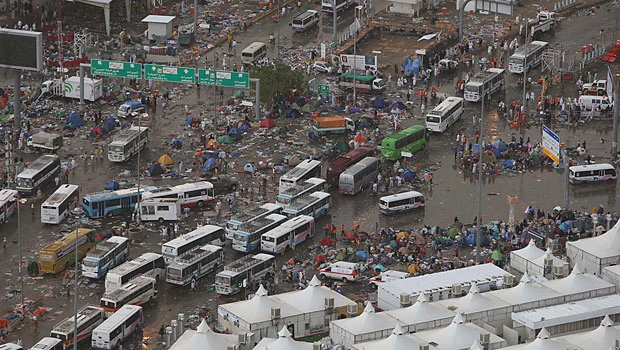
During the short Haj season, the streets of the tent city of Mina were awash with litter.
The situation in the Arafat plains, where pilgrims spent the Haj peak day on Monday, and in Makkah itself was no better.
Islamic teaching stresses cleanliness, with Muslims taught from an early age that “cleanliness is half of faith” in the words of the Prophet (peace be upon him).
But as male pilgrims performed the rite of shaving heads on Tuesday, the streets of Mina and the neighborhood of the Grand Mosque in Makkah were strewn with hair and used razors.
The mess appeared to be mostly the work of “unauthorized” pilgrims, without the official permits, who flooded the valley.
Some 2.8 million pilgrims are estimated to have taken part in this year’s Haj, almost 800,000 more than expected based on the number of permits issued, according to Saudi authorities.
Those pilgrims with no places reserved in equipped camps have squatted on pavements, under bridges and on rocky terraces. And where police turned a blind eye, they camped in the street. Colorful bedsheets and blankets were stretched between walls and lamp-posts for shade. Those who were better prepared erected beach tents.
Many of the illegal pilgrims, who flouted the strict rule of “No permit, No Haj,” were foreigners who live in Saudi Arabia. Some were Saudi nationals.
“I work in Makkah, so I decided to perform the Haj,” said an Egyptian who declined to give his name as he sat on a mat spread under the elevated track of the new Mashair Railway.
These pilgrims, many of them with young children, ate and drank in the same place. As their litter grew around them, some admitted that they were at fault.
“We are the reason behind this mess,” said Adnan Naji, 26, sitting with two fellow Egyptians on a straw mat on the road in Mina, while trash flowed out of a bin three meters away.
He explained that some people could not afford to pay for a legal Haj through a licensed group that would charge for decent accommodation, so they “sacrifice for Haj.”
“We came to answer Allah’s call for Haj,” said Al-Sayyed Ali Jad, 24, who works in construction, like Naji.
Meanwhile, binmen in yellow overalls toiled nonstop, pushing overflowing orange bins, sweeping the streets and loading large garbage containers onto lorries.
The garbage is for the time being collected at 131 temporary dumps within Mina, as moving it outside is impossible because of crowds.
Al-Bar said the garbage was being removed to the various dumping grounds with the help of 900 mechanized garbage boxes from all public utilities and markets around the clock.
Speaking about the role of the municipality in guaranteeing the hygiene of food and other items sold to pilgrims in the holy city, the mayor said municipal inspectors have been checking food outlets and other shops in the holy sites and Makkah. They routinely visit about 33,000 commercial establishments, including food outlets. There are 2,590 groceries, 1,245 shops selling light refreshments, 400 shops selling meat, poultry and fish, 669 restaurants, 408 bakeries, 287 shopping centers, 198 kitchens and over 18,000 other shops in the city.
Al-Bar pointed out that the authorities have also issued temporary licenses to 2,200 seasonal shops.
He added that the technical inspectors of the municipality keep a constant watch on the 57 tunnels with a total length of 30 km, in addition to 37 bridges in Makkah.
The municipality has deployed 12 teams to undertake emergency asphalting of roads and sidewalks and 15 teams to look after 40,000 streetlights, Al-Bar said.
He put the number of public toilets in Makkah districts at 600.