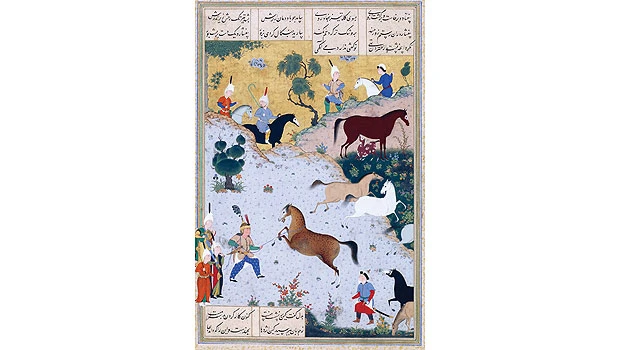
- It’s like Aladdin’s cave in here,” the curator of Islamic Art said as she led a group of journalists into the Sackler Gallery of the Smithsonian’s collection of Shahnama, 1,000 Years of the Persian Book of Kings.
The exhibition is modest in size, with 33 paintings on display, but the quality of the exhibition is remarkable, filled with examples of priceless treasures of two of the most famous manuscript paintings from the mythical past of poet Firdawsi’s epic poem the Shahnama, or Book of Kings. “The manuscript paintings selected are of the finest quality, and the ‘envy of most museums in the US,’” said Farsemeh Farhad.
Considered one of the greatest literary works ever written, the illustrations are from two of the most precious, beautiful copies of the Shahnama, from the 14th and 16th centuries; which are considered two of the finest example of art from Iran and the Islamic world.
Despite its age, the Shahnama remains one of the popular texts in Iran and much of the Islamic world, and is beloved by children.
Considered the greatest Persian epic poem, the Shahnama is composed of some 50,000 verses structured around the reign of 50 monarchs, which in turn serves as a frame for other sub-stories, filled with colorful characters and supernatural beings. The stories explore epic themes, such honor, loyalty and justice.
These fifty “chronicles” provide a framework for the dramatic deeds and heroic actions of a range of other personalities who are often aided by — or at battle with — a host of fantastic creatures and treacherous villains.
“In its cultural significance and popularity the Shahnama is often compared with to Gilgamesh and Homer’s Odyssey,” said Farhad.
The Shahnama recounts the myths and legends of Iran from the beginning of time to the Arab conquest of Persia in the 7th century, at a time when Islam was being introduced to Iran,” said Farhad, “which was a period of dramatic change.”
Completed in 1010, exactly one thousand years ago, Firdawsi drew on a wealth of oral and written sources, including local and dynastic histories, and myths and legends for his poem.
And, due to its emphasis on justice, legitimacy and the concept of divine glory, commissioning ravishingly illustrated copies of the Shahnama became almost a royal duty. By representing the kings and heroes of the epic according to the style of their own times, members of the ruling elite were able to cast themselves as the legitimate heirs of Iran’s monarchical traditions.
The Sackler’s exhibition: “Shahnama: 1000 Years of the Persian Book of Kings” consists of several parts: First focus on the major characters from the Shahnama’s mythical section such as the legendary hero Rustam, and his father, Zal.
The second section of the exhibition focuses primarily on Iskandar, or Alexander the Great, who brings in the quasi-historical section of the Shahnama. Although Alexander invaded Iran in 330 BCE, he is represented here as a just, wise king. “The recasting of Alexander illustrates how effortlessly the epic transform history to serve the interest of national myth and ideology,” said Farhad.
For all the fame of the Shahnama, Firdawsi himself does not have a happy ending. After taking 10 years to write the Shahnama, he took the manuscript to the Ghasnavid ruler Mahmud for approval, but the sultan insulted the poet by paying him a meager fee. Firdawsi returned to his homeland, Tus, a poor and disheartened man.
Ten years later, however, Sultan Mahmud regretted the insult and sent camels loaded with precious cargo to Firdawsi’s town. When the caravan entered Tus, it encountered another procession leaving: It was Firdawsi’s funeral procession.
Firdawsi always said that he hoped his work would outlive both him and the sultan, said Farhad, the Sackler’s curator of Islamic art. And, over time, the Shahnama became considered the most important example of Persian literary and national identity to this day.
Firdawsi said that all rulers needed “farr” to rule, which is the divine right of rulers. He wrote stories of the rulers who would lose their “farr,” followed by their legitimacy to rule.
But the Shahnama also appealed to common man, too, said Farhad. It discusses the consequences of a mortal’s actions, of pride and its consequences, treatment to others, and the fact that we are all mortal, which is why Firdawsi’s poem became so popular.
The characters from the Shahnama are similar to today’s heroes, said Farhad. “Rustam is like Batman, with supernatural powers. His father was an evil spirit, and his mother was a good spirit. He’s a brooding, quiet man, and his pride is his undoing.
“Rustam becomes known as the guardian of Iran. Like many larger-than-life champions, Rustam could be tempestuous and arrogant — traits that made him seem more human but ultimately cost him his life.”
Firdawsi’s preoccupation with tribal warfare offers an ideal vehicle to highlight the importance of royal legitimacy, loyalty and courage, said Farhad, which is why the dual concept of fighting and feasting is portrayed by artists throughout the Shahnama.
Hunting and warfare allowed kings and heroes to demonstrate their prowess, skill and bravery, and royal banquets served as ideal opportunities to bestow bounty and generosity, celebrate victories, and commemorate important events.
In order to maintain stability and vanquish their enemies, the mythical rulers in the Shahnama repeated call upon the heroes Zal and his son Rustam, due to their personification of strength, bravery, perseverance, and above all, commitment to protecting the throne.
To appreciate the miniatures details, one needs magnifying glasses, which the Sackler museum has made available for the exhibition. On one illustrated folio, for example, every rock has a funny face painted on it, which is all but impossible to see with the naked eye.
The exhibition, Shahnama: 1000 Years of the Persian Book of Kings will be open until April 17, 2011, at the Sackler Gallery located at the Smithsonian Museum.