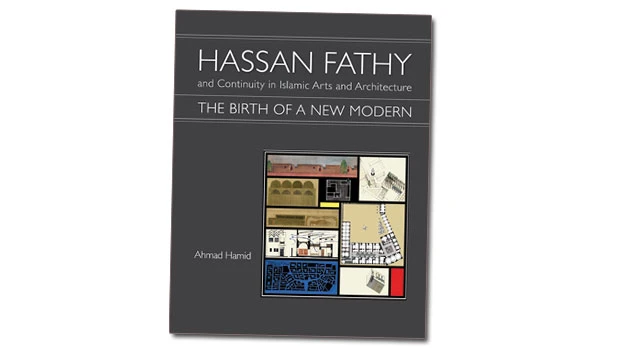
- Ahmad Hamid has written a genuine and fitting tribute to Hassan Fathy (1900 – 1989), Egypt’s most famous architect since Imhotep.
- Even his name, which means the “benevolent opener,” symbolizes his uniqueness.
“He opened the way,” said Hamid. Indeed, Fathy created an alternative model — a sustainability-oriented architecture. He envisioned a sustainable architecture, which responds to social issues as well as the needs of the community by using vernacular styles, materials and techniques.
Sustainable architecture is all about understanding culture and believing that architecture need not be beautiful to be effective. Students, lecturers and schools of architecture, traditionally, refute this view. However, more than 20 years after Fathy’s death, the current situation imperatively calls for his ideas and a realization of what he stood for.
Fathy strongly believed that centuries of expertise had led to the development of building methods using locally available materials and an arrangement of living and working spaces, based on their social requirements.
“I want to bridge the gulf that separates folk architecture from architect’s architecture. I always wanted to provide some solid and visible link between these two architectures in the shape of features, common to both, in which the people could find a familiar point of reference from which to enlarge their understanding of the new, and which the architect could use to test the truth of his work in relation to the people and the place,” writes Fathy.
Hamid whose work has received the World Architecture Award, is one Fathy’s first disciples from the generation of the 1960s and 1970s. He discovered the visionary architect for the first time on television in 1975. Although he only caught the last minutes of the program, he was so impressed by Fathy’s ideas that after his graduation in 1977, he began his professional career with Fathy who became his mentor for the following eight years at the Institute for Appropriate Technology. In 1985, Hamid asked his master’s permission to do a project on his own, and with his help and consent, set up his practice.
“In traditional Muslim cultural terms, the consent and permission to practice what the student was trained for is known as “igazat,” explained Hamid.
Fathy’s ideas appealed to many architects and decision makers in the Third World who were dissatisfied with what modernism had to offer in Europe and what might be applied in their respective countries. Published in 1986, “Natural Energy and Vernacular Architecture: Principles and Examples with Reference to Hot Climates,” presents some of Fathy’s main ideas.
Fathy believed that man, since antiquity, used his faculties to develop techniques and technologies in such internal psychological balance with nature that humanity historically lived attuned to the environment. Man’s creation was natural when built of the materials offered by landscape.
“With the advent of the industrial revolution, the inherited techniques and perfected knowledge of creating, using handmade tools, were lost and are now forgotten. Energy-intensive mechanized tools have diminished man’s personal, cellular contribution to the fabrication of objects, the building of structures and the growing of food…We are witnessing a change that is now forcing a complete rupture with the past; every concept and every value has been reversed. For house design in the Middle East, the introvert plan wherein family life looked into the courtyard was changed to a plan with family life looking out upon the street,” writes Fathy, the visionary architect .
During his lifetime, Fathy was either ignored or marginalized. His architectural views represented a “counter culture” in the 1950s, 60s and 70s — a time when a belief in Western science and technology dominated. Fathy, however, admitted to the author that maybe if he had not been so critical of his colleagues or others, they would not have been so personally disappointed to the extent of blocking him out from serving more people, whether as clients, poor communities or in universities where he was banned and his name stood for antagonism.
Hamid has highlighted in a brilliant way, Fathy’s eminent role as a “catalytic force in the continuity of Islamic art and architecture.” In fact, the research for this book developed for the author’s MA dissertation received the Frank G. Wisner Award in the same year and the Nadia Niazi Mostafa Award in 2010.
“Hassan Fathy and Continuity in Islamic Arts and Architecture: The Birth of a New Modern,” draws our attention to Fathy’s ground-breaking ideas and their relevance to contemporary architecture. It is interesting to know that UNESCO, in cooperation with the Egyptian Ministry of Culture and the governorate of Luxor, is launching a safeguarding project at New Gourna Village designed and built by Fathy to shelter the community of Old Gourna.
The project started in 1946 and ended in 1952. This remarkable endeavor, hailed by many as a “heroic failure” did not, at the time, win the support of the potential new residents. As Hamid clearly explains, there was not a combined effort of government officials, media, architects and community leaders to assist and help “integrate a traditional community into a modern architectural setting.”
This book explores Fathy’s lonely struggle to impose his ideas and noble beliefs, which were so against the prevailing culture during his lifetime. He also gives him his rightful place in the pantheon of architects.
“A work of architecture must be part of the bustle and turmoil, the ebb and flow of everyday life; it must relate harmoniously to the rhythm of the universe, and it must be consonant with man’s current stage of knowledge in the human and the mechanical sciences, and in their inseparable relationship within planning and architectural design,” writes Fathy.
Hassan Fathy is truly an architect for all times.