- Toto, I don't think we're in Kansas anymore,” says Dorothy in The Wizard of Oz.
- That was a sentiment shared by many last Wednesday at an open-air concert of Italian opera in Jeddah.
Sitting out in the open air at the city’s Italian Cultural Club, they might just as easily been in an outdoor theater in Catania or Naples. Only the noise of a 747 flying directly overhead served to remind the audience where they were — but only for a moment, as the music took them straight back to Italy.
The Italian consulate–general hosted the operatic event as part of a new program to promote Italian culture and to make use of culture as a means to strengthen the relations between Italy and the Kingdom.
Building bridges between Europe and Arab nations has always been a priority to Italy, explained the new Italian Consul-General, Simone Petroni. “We want to foster dialogue between Italy and Saudi Arabia as we perceive Saudi Arabia as a crucial ally.”
Culture, in this case music, can be a bridge between people, said Petroni. He used an anecdotic story about the composer Joseph Haydn as an example. Just before his death in Vienna in 1809, Napoleon had attacked and occupied the city. The French and the Austrians were enemies; however, the French troops placed a protective guard around Haydn’s house and a young French officer arrived at the great composer’s home to pay homage to him, singing an aria from “The Creation”. Joseph Haydn died few days later. Many French officers as well as the Vienna nobility attended his funeral. Their love of music overrode their political divisions.
“The message told by the anecdote is that ‘music and culture are ambassadors of peace.’ They dilute tensions by opening up dialogue and establishing universal understanding,” said Petroni.
The idea of music as a bridge was reinforced by Emilio Dini Ciacci, Chairman of the Italian Cultural Club. “This is the Italian Cultural Club, and music is a part of our culture,” said Ciacci as he welcomed the audience. “Music brings people together”.
The audience reflected just that. Thobes were as much in evidence as western costume. There were Saudi dignitaries, diplomats, a large section of the Italian community in Jeddah, as well as lovers of classical music — Saudis as well as expatriates.
On the proscenium arch above the stage, the following words were written in Latin: “Ars gratia artis.” When translated to English, it means “Art for the sake of art”. It was just that.
The tenor, Leonardo de Lisi, thrilled with his evocative performance of the songs, which noticeably improved as the evening went on. His mellifluous voice and subtle, yet noticeable, gestures while he sang brought his songs alive. One could easily imagine him in full costume, on stage, performing an entire opera. Figaro’s famous aria, “Largo al factotum” from Rossini’s “The Barber of Seville,” was particularly good.
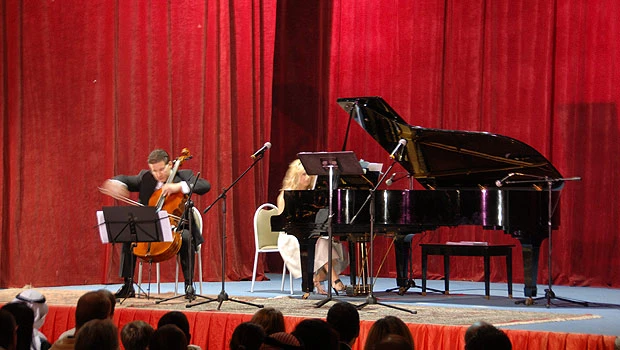
The soprano, Patrizia Morandini, had a remarkable voice. They must have heard her in nearby Hail Street and wondered what was happening. The cellist, Pierluigi Riggiero, played the prelude to Verdi’s I Masnadieri beautifully and it would be wonderful to hear more of him in Jeddah. It cannot have been easy keeping his instrument in tune in the open air on an evening that started with a pleasant breeze. The pianist, Lucrezia Proietti, who accompanied all three in their separate renditions, was accomplished throughout, never putting a finger wrong.
The only disappointment was the amplification. It made the piano sound metallic, flattened the texture of the instruments and voices and distorted the soprano’s voice when she sang loudly. The amplification was not needed as it robbed the performance of its immediacy and made it sound like an old mono record. Furthermore, both the soprano’s and tenor’s voices were big enough to La Scala, let alone the Italian Club, without any artificial help. Nonetheless, one got used to it.
The performers were at their very best in the renditions of traditional Neapolitan songs, such as “I’ te vurria vasa” and “Mama,” and brought a standing ovation from the audience.
“I found those songs the most emotionally touching,” revealed Arlene Attar whose favorite opera is Puccini’s Madame Butterfly. “I moved to Saudi Arabia in 1979 and never thought that 30 years later, I’d be sitting listening to live opera in an outdoor theater!”
Another opera aficionado, Raha Farsi, convinced her friends, whom she admits weren’t quite accustomed to classical music, to attend. “It really was a lovely evening, and it was nice to do something so different in Saudi Arabia,” she explained. “It’s not everyday you get to attend such an event.”
Lucky for us, there will be more to come. “We are starting to do many more cultural events such as these,” promised Petroni. “Next year marks the 150th anniversary of Italy’s unification and independence. In celebration, we are planning a series of cultural initiatives, which will definitely include opera and other musical concerts.”
Perhaps live performances of Madame Butterfly or The Magic Flute will become a typical Wednesday evening event in Jeddah? Here’s to hoping…