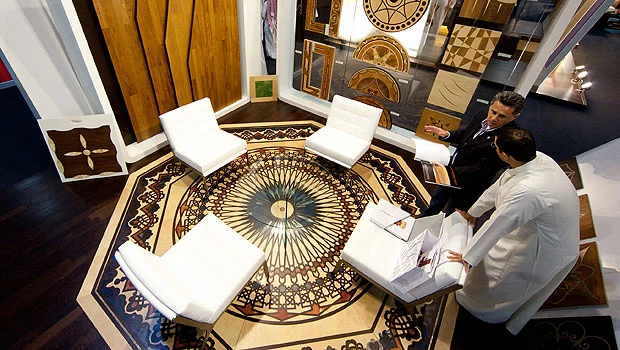
- Earlier this month, the Sunaidi Exhibition held its annual Deco Fair Furniture exhibition for the second time at the Jeddah Center for Events and Forums.
- It was a big improvement from last year’s, but that really isn’t saying much.
Saudi Arabia possesses one of the biggest marketfor interior designers and furniture suppliers. Just think of all those villas popping up on the way to Abhur; they’re not sitting there empty — or at least, if they are, not for long. As Saudi’s youth begin to marry and branch out into their own residences, the demand for home accessories and furniture can’t seem to keep up.
It seems the call center sector isn’t the only business being outsourced. Many interior designers and designer furniture brands recognize the potential and are making their way to the Kingdom. “We are based out of Lebanon, but many of our clients are from Saudi Arabia,” said Vicken Vanlian of Envy Interiors who came from Beirut to showcase his firm at the exhibition.
The Deco Fair should not be discouraged, but rather critiqued. How else are organizers and sponsors going to progress? There is no doubt that the initiative is solid, but unfortunately, the execution is still in its infancy. Both participants and visitors had numerous suggestions on how to polish the exhibition, which indirectly reveals the general consensus of the Deco Fair is actually one of support and not just condemnation.
“It was better than last year,” said Mazin Ghazzawi, a couture jeweler whose family consists of a fashion designer, an architect and a photographer. “You could definitely see many improvements.”
Ghazzawi is a veteran of the local design scene and acknowledged the exhibition’s efforts for trying to draw in Saudi talent. “The competition was a good initiative, but they still lack some major incentive for the prominent Saudi design houses,” he added.
Although there were some Saudi designers present — less than a handful, the exhibition really lacked in highlighting both established and emerging Saudi talent.
Its efforts could only be seen through the inclusion of an in-house design competition, a new addition to this year’s exhibition. “We made the competition for Saudis only,” said Amy Lam, an architect and Director of the 2010 Living Room Design Competition. “We wanted to showcase emerging local talent; each designer is a graduate with less than 5 years experience.”
The competition was a chance for Saudi Arabia’s emerging designers to get financing for a start-up firm. A great initiative, the competition was a success and will hopefully be a staple in future years to come.
Yet, while the competition is to be commended and hopefully refined for proceeding expos, many people still felt the exhibition looked more like a glamorized and over-priced Bab Makkah than a true furniture exhibition. The mix-and-match in quality of booths turned many people off and might have been the reason why many design brands opted not to participate.
Ligne Roset, Roche Bobois, Flex Form, and Rubaiyat Homes (which carries most of the designer collections) were all missing. Yet, cruise down the popular Al-Rawdah Street and you’ll find most of those names prominently displayed.
Corrado Mulfari, general manager of Berti (think the Rolls Royce of hardwood floors), believes that many of the prominent brands just feel they won’t receive the type of exposure they desire. “For them, people know their name so it’s not about the exposure — it’s really about getting a return on their investment,” stated Mulfari.
The translation? Major contracts! Forget the apartments or even houses. These companies are interested in hotels, restaurant chains, and yes, they’d even settle for a palace or two.
“I felt there should have been more industry people. For us [Berti], our aim was to reach architects and interior designers who have a strong clientele, rather than the individual clients themselves,” explained Mulfari.
However, industry insiders were just not present — or if they were, there was no discernable way to tell.
“There needs to be trade days,” said Saudi architect Rawan Al-Sahsah whose display booth consisting of suspended chairs was a big draw at the exhibition. “The problem with having everyday open to the public is that you don’t know who is here just to look versus who are the industry people.”
Other participants felt the exhibition was a good way to showcase their work. Mohammed Hesham Hafiz, the general manager of the Hafiz Contracting, which includes subsidiaries Kitchen Art and Fan Al-Abwab, stated that he was very pleased with the business received from the exposure of participating. “We get many potential clients,” explained Hafiz. “Being here is very beneficial for us.”
Omar Ashour, an architect and project coordinator at Zuhair Fayez Partnership, suggested better floor organization through zoning after realizing the exhibition lacked any sort of directory for the booths. “The layout is very random,” he commented, “they should have grouped sectors together—for example, all companies dealing with tiling and flooring together, kitchen companies together, all bathroom fixtures in one corner and outdoor furniture in another.”
Overall, the Deco Fair must be applauded for being brave enough to stand as Saudi’s initial mechanism, however premature, toward highlighting Saudi Arabia as a hub for design. The exhibition symbolizes more than Saudi’s desire for Missoni lounge chairs and Kenzo dinning room tables. It’s the coming together of Saudi talent, such as emerging interior designer, Bandar Al-Sudairi of B Design, together with furniture powerhouses, like Al-Esayi’s Garden Palace, which showcased their exquisite line of Dedon outdoor furniture (think the Bentley of lounge chairs and gazebos)! It is the first step toward achieving a Jeddah Design Week, in which local merchants participate and talent from the region is celebrated. We shouldn’t ridicule Deco Fair for not being great; instead, we need to actively help it become great. We can only progress from here.