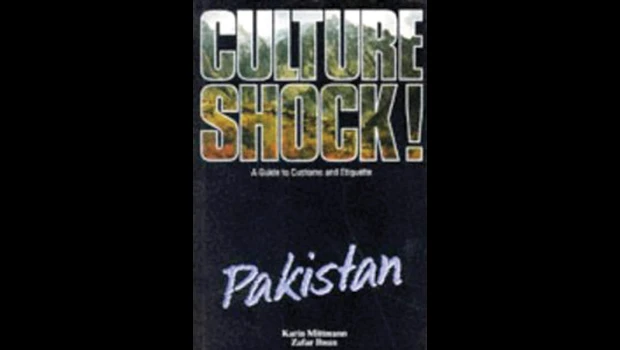
- The new style guidebook, “Culture Shock! Pakistan,” written by Zafar Ihsan and Karin Mittmann, tells visitors how to respond when faced with expected culture shock in Pakistan.
First published in 1991, it was received with mixed feelings both inside and outside the country. Call it an aftershock, the book has been published and republished many times. As Pakistan continues to shock and attract the world, the publishers have printed its many editions from print points as far apart as London, Oregon and Singapore.
This is a daughter-in-law and son-in-law book — Ihsan, the co-author, is also Mittmann’s Pakistani son-in-law. Mittmann comes from Berlin, but after marrying a Pakistani in 1955, she came to Pakistan. Even though her marriage broke up, she chose to stay behind in the shocking country.
According to the authors, there is no understanding of the magnitude of the situation of life in the “country of extremes.”
“Pakistan is not a country for the lightweights . . . even its beauty is grave or mighty,” the book says.
The first-time visitor to Pakistan is therefore told to be prepared for the culture shock he or she is going to experience — though many readers say the book is meant for men only. A few essential tips are offered on how to adapt and how to be successful without causing any offense.
But it’s not the author’s criticism that one would take offense against. The problem lies in Mittmann’s attempt to apply her ethno-European value judgments in comparing things to what “they are used to at home.” This approach produces condescension and cynicism, if not always contempt.
Another difficulty is her sources, which are fellow “expats,” Uncle Toms, poor servants out to humor the sahibs as well as mem sahibs. Like all foreign correspondents out on the hoof for a quick story, Mittmann does not seem to mind buying any yarn. Since she wants to see only extremes, “grave or mighty”, she misses the normal and the meridian.
The result is a 222-page paperback written in a light and readable style, which presents a daughter-in-law, turned mother-in-law, bird’s eye-view of Pakistan, its people, language, family life and social circle.
For example, Mittman describes Pakistani women — both rural and urban — with the stereotype expat attitude and are exemplified in expressions such as “they bite their lips rather than cry.”
She observes: “Traditionally women do not shake hands with men, and even a former woman prime minister used the orthodox style of greeting, and did not shake hands with men.” Why? Mittmann does not care to know.
However, she is at her best when she tries to deal with “a very delicate issue” by marrying a Pakistani. She should know better. She describes the family situation a foreign bride will be dealing with and the inevitable mother-in-law! Mothers-in-law in Pakistan are not a necessary disaster — not as yet! They could be useful too. Pakistani husbands are generally unwilling to “change Pakistani cooking for Western or any other cooking, except for the odd occasion,” and therefore the usefulness of mothers-in-law. She can stay at home and look after the cuisine and kids while the couple can go on their social rounds.
Not surprisingly, the bearded “dogmatic and narrow-minded,” mullah is seen as a problem. “His word there is law, and he constitutes a force that every government has to reckon with.”
However, she ignores the fact that the state power in Pakistan has always been wielded by the unbearded!
Mittmann’s great concern is that the people of Pakistan still use forceful centuries-old religious expressions of culture that it is difficult to find new, creative avenues of cultural expression. “That is why a Pakistani never looks backwards for solace, guidance and truth and to the glorious moments of country — centuries old: and hardly ever to the future,” she writes.
She urges the West to “create a situation of your own and lend it to cultural impact.” The post 9/11 situation convinces you that there is nothing to be shocked about, isn’t it? “It is high time that the West created a stronger cultural image in Pakistan,” she adds.
This mem-sahib view of the country is no doubt dotty but leaves the shock for its Western audience. The Pakistani reader may find it useful to look at the warts shown in Mittmann’s mirror. However, not all warts are unreal.
— Syed Neaz Ahmad is a London-based academic, writer and literary critic.