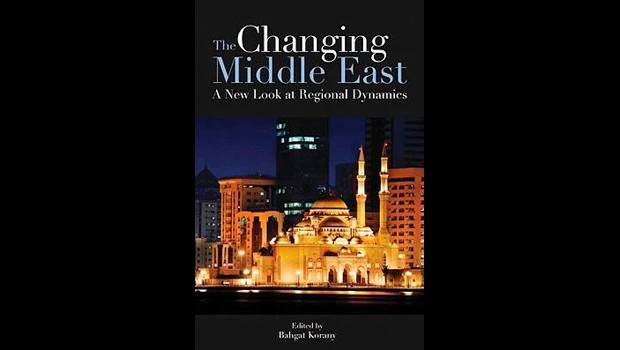
- The Changing Middle East: A New Look at Regional Dynamics” by Bahgat Korany is a response to the widely held opinion that very little is changing for the better in the Middle East.
- The Lebanese quagmire has spread to Iraq, Sudan and Somalia, and the Palestinian question still seems far away from a solution.
Korany has brought together an international team of contributors who shed light on the regional dynamics by focusing on two types of change: sudden and evolutionary. Sudden change can be triggered by war, revolution and milestone events while the progressive type consists of a change in life style patterns, the impact of unemployment and the growth of ideas, etc.
Korany sets the tone of the book in the first chapter with a brilliant analysis of the evolution of the region over the last 60 years. During that period, the Middle East went through ten wars: the first Arab-Israeli War in 1948, the 1956 Suez War, the 1967 Six Day War, the October 1973 War, the 1982 Lebanon War, the 1980-88 Iraq-Iran War know as the First Gulf War, the 1990-91 Second Gulf War, the 2003 Third Gulf War, the 2006 Israel-Hezbollah War and the 2008 Israel-Hamas war.
The impact of these wars, some very recent, is still unfolding. The effect of the 1967 War was particularly hard on Egypt, which lost the revenue of its oil fields and Suez Canal. Oil-producing countries first helped Egypt overcome its financial crisis then followed by Syria and Jordan. In fact, the humiliating defeat in the 1967 Six Day War marks the end of Egypt’s hegemony in the region, which began in 1954. It showed how a regime adulated by the Arab street failed to keep on its promises and delivered a deathblow to the Arab pride.
The loss of a dominant Arab voice has created a favorable momentum for Turkey. This country is playing an increasingly visible and important role in regional politics. It was a mediator between Palestinian political factions and Arab divisions following the Hamas-Israel 2008-2009 Gaza War. Despite their oil and financial wealth, the Gulf countries have showed their vulnerability with three Gulf Wars and the lurking danger of a nuclear Iran.
An interesting development is the appearance on the political scene of non-state actors such as Hezbollah and Hamas who alone faced the Israeli army. Presently, according to Korany, the Middle East is more “state-centric” as the concept of dawla, territorial state and its national interest supersede that of the “umma” — or community. The rivalry among states is increasing and leading to surprising decisions such as Syria’s alliance with Iran against most Arab countries during the First Gulf War or Egypt’s unilateral peace treaty with Israel.
“In addition, some Arab states are coalescing with non-Arab states, making the demarcation line between the Arab World and the Middle East increasingly blurred. For instance, at the beginning of September 2009, press reports published an official invitation by Damascus for the formation of a coalition among Syria, Iraq, Iran and Turkey for regional coordination,” says Korany who also notices that the unifying effect of the new Arab media “is not a substitute for the Arabs’ present balance of weakness or cognitive disarray.”
The remaining chapters of the book are unequal — some are excellent, while others are painfully boring. Ola Abou Zeid was given an interesting topic: women’s empowerment. Her academic approach and too many statistics do no justice to this important subject. The same can be said for Amani Kandil who tackled the development of Arab Civil Society. The rise of civil society is growing stronger, but this momentum was completely overlooked by the writer who turned an exciting topic into an insipid and dull essay. Hazem Kandil and his “Sociology of Arab Intellectuals under Authoritarianism” conclude this disappointing series of laborious academic verbiage.
Fortunately, Rasha Abdulla (Arab Media over the past Twenty years), Omar Ashour (The transformations of Armed Islamist Movements in Egypt and Algeria) and Julie Herrick (Nonstate Actors: A comparative Analyis of Change and Development within Hamas and Hezbollah) have written with Korany the best essays in the book. The facts and information are not only well presented but also very well analyzed.
Abdulla gives us a superb summary of the Arab Media in the last two decades. She rightly identifies “three big bang media change agents:” the introduction of CNN to the region in 1990, the launch of Al Jazeera in 1996 and most of the Internet.
“With the brilliant slogan, “history as it happens,” CNN entered Arab homes, as the station was broadcast through a deal with Cable News Egypt (CNE). “The event caused a media culture shock, not only to viewers but to media personnel and governments…after years of watching state-controlled official news that was composed mainly of heads of states meetings, Arabs were watching live war beamed straight into their living rooms 24 hours a day on CNN,” writes Abdulla. Undeniably, CNN forever changed the content and the format of news bulletins in the Arab World.
The second major media event was the creation of Al Jazeera channel. Shaikh Hamad bin Khalifa al-Thani was instrumental in setting up Al Jazeera. He hired BBC-trained Arab journalists who had just been laid off by BBC Arabic and launched the first 24-hour Arab news channel.
Al Jazeera, which is subsidized by the Qatari government, was the first Arab channel to give priority to newsworthiness over political protocol. It has been dubbed “the CNN of the Arab World” and Philip Seib said it is “the best known international satellite TV channel … in terms of brand recognition.”
Al Jazeera has definitely revolutionized the way talk shows are done in the Arab world. It encouraged viewers to take part in live programs through phone calls, faxes and emails. This format was immediately followed by most channels in the region. On the other hand, it is known for its leniency towards the United States and Israel. Abdallah Schleifer has also reiterated that the channel “seems at times as much devoted to embarrassing Saudi Arabia as it is to free discussion that never manages to touch upon Qatari sensitivities.” Moreover, its biased coverage of the Israeli assault on Gaza in December 2008 — January 2009 has affected its popularity in some parts of the Arab World.
Egypt is vying hard to retain its media leadership, which has been seriously threatened. Egypt is the only Arab country to own a satellite system namely Nile Sat 101 launched in 1998 and Nile Sat 102 in 2000. Egypt has also allowed private satellite channels such as Dream Television in 2001, El Mehwar in 2002 and Al Hayat. These channels broadcast three of the most popular talk shows in the Arab world. Egypt has also built a Media Production City in the Sixth of October City with 114 state-of-the-art recording studio complexes.
The Internet has undoubtedly created the deepest commotion. With its unlimited supply of information, it opens up a freer space for public exchange hence the phenomenal success of blogs.
“Blogs have certainly allowed an alternative platform for voice in the Arab Middle East that had previously gone unheard…New technologies in the form of the Internet and Web 2,0 applications mean that every citizen can now become a publisher of information, not just a consumer of information,” remarks Abdulla.
I particularly enjoyed Herrick’s analysis of change and development within Hamas and Hezbollah, referred to as “nonstate actors” — that is alternative forms of governance within a state. Hamas has been most successful in helping Palestinian refugees in the Occupied Palestinian Territories. The seven million Palestinian refugees constitute the world’s oldest and largest refugee population. Hamas provided charitable and social welfare services, including medical, educational, housing, and food assistance. It was effectively filling a governmental void due to the increasing inefficiency and corruption of the members of Fatah. As the Oslo Accords failed to bring any beneficial changes in the lives of the Palestinians, Hamas replaced Fatah as the symbol of Palestinian resistance.
They also came up with a political agenda and eventually won the legislative elections in January 2006. Hamas, however, lost two-thirds of its funding as it refused to recognize Israel’s right to exist, to accept all previous agreements between the PLO and Israel and to put an end to its terrorist activities. Hamas justifies its use of violence as a response to the overwhelming superiority of Israel’s military forces.
Since the December 2008 Israeli intervention, there has been a growing awareness of Hamas as a legitimate political entity. The grossly disproportionate number of casualties and the humanitarian crisis in the Gaza Strip has triggered a shift of perception regarding Hamas.
Hezbollah was created to help the Shiite Lebanese Muslims suffering as the Israelis occupied South Lebanon in 1982. It has a very effective network of social welfare services, which rival those of the Lebanese state. Heeding the advice of the late Sheikh Muhammad Hassan Fadlallah, Hezbollah developed a political agenda in order to participate in the country’s parliamentary elections. In the 2005 elections — the first elections in 30 years that were independent and free from Syrian and Israeli influence — Hezbollah and its allies won all 23 seats in southern Lebanon. Since then, Hezbollah has become a major player on the political scene. For the 2009 elections, the candidates were all educated business professionals as well as long-term Hezbollah supporters. This shows Hezbollah’s desire for respectability and viability as a long-term political actor in Lebanon.
“Hezbolllah’s future development and political trajectory will largely be determined by the degree to which Lebanese forces press the issue of disarmament, which remain to be seen…On the regional and international level, Hezbollah has proven itself an effective military fighting force. This fact has broad implications for international security arrangements and the wider international environment, which has traditionally focused on state-on-state-conflict,” says Herrick.
Its military strength was tested in July 2006 when it confronted the Israeli army in a surprising way, well described by Corey Oakley:
“Israel, the fifth most-powerful military on earth, was fought to a standstill by several thousand well-armed, well-organized fighters… The very fact that Hezbollah survived with its fighting forces intact was a huge victory.”
Since their inception, both Hamas and Hezbollah have changed, but it is still difficult to determine whether these organizations will become legitimate political parties. In Lebanon, Palestine and the rest of the Arab countries, two-thirds of the population is under 30 years old. These young people in need of education and jobs constitutes “the volcano underneath,” an unpredictable agent of change. These young Arabs faced with unemployment and a lack of opportunities are increasingly voicing their frustration and discontent at the lack of political resolve. Their uncensored blogs reflect a reality rarely seen on television and even in the press. If the complacent authorities do not initiate necessary reforms, this rising civil society too often ignored and marginalized by ruling authorities is certainly a potential agent of change.