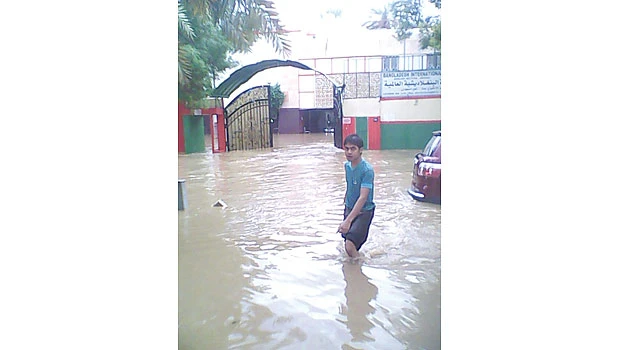
- JEDDAH: There are many individual stories following the Jan.
- 26 rains that led to massive flooding throughout city.
The rains got heavier later that morning, which meant students went to school that day. Amid relatively light rain, students begged teachers to let them go out and enjoy the experience, a rare one in Jeddah's typically hot and arid climate.
However, a dramatic shift occurred later that morning that changed the whole scenario. The rain fell harder, ceilings began to leak and many streets started to turn into rivers.
Mahmoud Salimullah, a student at the Bangladeshi School, went back to his home that morning, which is located close to the school. But then he noticed that the rains were starting to flood the city. Instead of huddling in his house, he returned to the school to see if he could help. There were young children at the school, even some infants in the day-care center provided for teaching staff.
Located in a 30-year-old building, the school’s roof began to leak heavily. Outside, the water was rising. Over 300 students, teachers and administrative staff were trapped; neither the roof nor the grounds outside were safe.
Principal Nawell Mossalli said the hours passed in real panic. Students were clustered in different classrooms. The nursery was almost cut off from the rest of the school by rising flood water. The threat of fatal electrocution from submerged electrical outlets was a real concern.
Older students ventured into parts of the school that was knee-deep in rushing water to get food and drinking water for others. At some point, everyone realized they might need to evacuate the building. But where? Outside, cars and garbage bins were floating past the school in murky floodwater filled with debris and tainted with sewage.
Vice Principal Mohammad Abdul Kaium said it felt like a tsunami. “We had to hold hands for the flood not to sweep us away,” he said.
The youngest children were put on buses, which were seen as the safest place. But the water quickly rose high enough that it began to accumulate inside the vehicles.
Fearing that the floodwater could rise high enough to pose a serious danger, Mossalli called the Civil Defense.
According to her, the voice on the phone said rescuers were too busy at other locations to answer a distress call from a primary school.
It was the kindness of local residents near the school that saved the students and staff of the school from spending the night in uncertain, dangerous circumstances, shivering and wet.
“Residents nearby took in our cold children, who spent the night without electricity,” said Mossalli.
The school's students and staff said there are no words to express their gratitude to those who provided them shelter. It wasn't until 6 p.m. on Thursday evening that parents began to reach their children.
“Parents were stuck at their jobs,” said Mossalli. “Some of our teachers were also panicking because their own children were stuck at other schools.”
A week after the Jan. 26 floods, the school remains badly damaged. The roof and walls were waterlogged. The air quality inside the building could easily cause an asthmatic reaction in young, sensitive lungs. The library was in a shambles. Four of the eight school buses used by most of the school's 1,400 students were submerged enough to cause considerable damage. “The school is now suffering and will not recover soon,” said the principal.
Nevertheless, students and staff were busy trying to put things back in order, an effort that will take weeks.
According to Ahmad Al-Zahrani, the head of the local education department, 136 Saudi public schools were damaged in Jeddah. Asked about the international schools, Al-Zahrani said his department has not received any reports.
“We have been told they are clean and ready for students,” he told Arab News.